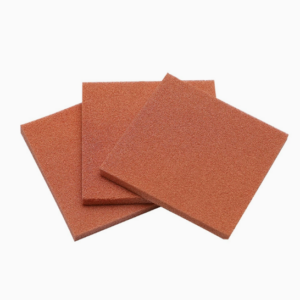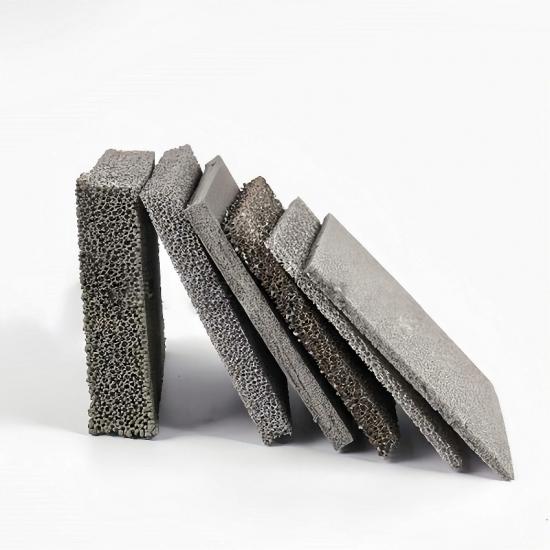
1. Basic Product Information
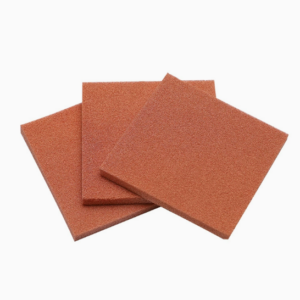
- Product Name: 3D Open-Cell Foam Aluminum
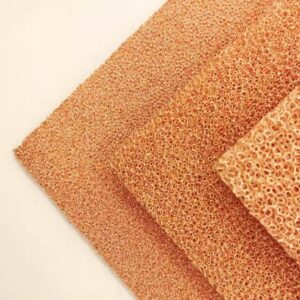
- Core Definition: A type of foam aluminum with interconnected internal pores, combining metallic properties and a porous structure. Its core advantages lie in excellent sound absorption performance and fire resistance.
2. Core Performance Parameters
2.1 Structural Parameters
- Pore Size: 0.5-1.0mm (corresponding to pore size specifications of 10PPI, 20PPI, 30PPI; customization available)
- Porosity: 70%-90%
- Open-Cell Rate: 98% (Note: Marked based on the product’s actual performance to ensure alignment with application characteristics)
- Purity: 93%
- Standard Thickness: 10mm
2.2 Functional Performance
- Sound Absorption Performance: The noise reduction coefficient (NRC) is >0.75. Sound absorption is achieved through the abrupt cross-sections formed by internal micro-channels and pores, as well as a large number of side-branch Helmholtz resonance cavities. Its sound absorption effect on medium and low frequencies is significantly better than that of traditional materials. (Sound Absorption Mechanism: Breaks through the limitations of conventional viscous sound absorption and heat conduction sound absorption, and enhances resonant sound absorption.)
- Fire Resistance: Fire rating reaches Class A1 (the highest fire rating, suitable for scenarios with high safety requirements).
3. Standard Specifications (Length × Width × Thickness)
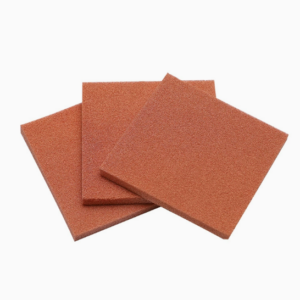
- 100mm × 100mm × 10mm (pore size: 20PPI)
- 50mm × 50mm × 10mm (pore size: 20PPI)
How does the pore size (PPI) of 3D open-cell foam aluminum affect its broadband sound absorption performance across frequency ranges?
The pore size influences the frequency range of optimal sound absorption. The product's noise reduction coefficient (NRC) is >0.75, achieved through combined viscous, heat conduction, and resonant absorption mechanisms. Smaller pores (higher PPI) typically enhance mid-to-high frequency absorption via viscous losses, while larger pores (lower PPI) improve low-frequency resonant absorption from Helmholtz cavities. However, specific frequency-dependent data for each PPI grade (10, 20, 30) is not provided in the source; consultation is recommended for application-specific optimization.
What are the key integration constraints when using this open-cell aluminum foam in a fire-rated acoustic panel assembly for industrial machinery enclosures?
The foam's open-cell structure (98% open-cell rate) allows sound penetration but requires it to be lined within a sealed enclosure rather than used as a standalone barrier. Standard thickness is 10 mm, and the A1 fire rating permits use in high-temperature areas. Mechanical support is necessary as the foam is not structural, and for low-frequency dominant noise, thicker panels or supplementary materials may be needed to meet the NRC >0.75 specification.
What handling and storage precautions are recommended to preserve the acoustic and structural integrity of this open-cell aluminum foam?
While the product description does not explicitly state handling guidelines, the 93% purity and high porosity (70–90%) make the foam prone to dust accumulation and permanent deformation under compressive loads. Store in a dry, clean environment to avoid pore clogging that reduces sound absorption efficiency. Avoid impact or sharp objects that could damage the thin pore walls, and do not stack heavy items on the foam to maintain the 0.5–1.0 mm pore structure.
This 3D open-cell foam aluminum delivers high sound absorption with a noise reduction coefficient >0.75 and achieves Class A1 fire resistance, but its 93% purity and fixed standard thickness/pore size range impose constraints on applications requiring higher purity or non-standard dimensions.
Positive
- High Sound Absorption Performance: Noise reduction coefficient (NRC) exceeds 0.75, leveraging internal micro-channels and Helmholtz resonance cavities for superior attenuation of mid-to-low frequency noise compared to traditional materials.
- Class A1 Fire Resistance: Achieves the highest fire rating (A1), making it suitable for scenarios with stringent fire safety requirements such as building insulation and industrial enclosures.
Trade-offs
- Moderate Purity Limitation: With 93% purity, the material contains alloying elements that may reduce electrical and thermal conductivity consistency relative to pure aluminum, which can be a factor in specialized applications.
- Fixed Standard Dimensions: Standard thickness is 10mm and pore sizes are limited to 0.5–1.0mm (10–30 PPI), requiring custom orders for alternative thicknesses or pore geometries, adding lead time and cost.
Every advanced material, component, equipment, and instrument in our catalog is backed by rigorous testing. We maintain strict internal quality management frameworks and align with CE conformity metrics to deliver transparent, reproducible performance data via our public open-science repository.
To request raw batch performance data, submit formal vendor registration paperwork, or execute a fast-turnaround R&D manufacturing loop, contact us at inquiry@atomfair.com.
Item is dispatched under the Atomfair Shipping & Delivery Framework (Free worldwide shipping on orders over $59 USD excl. heavy equipment). Return is governed by the Atomfair Return & Refund Policy (7-day technical return window).