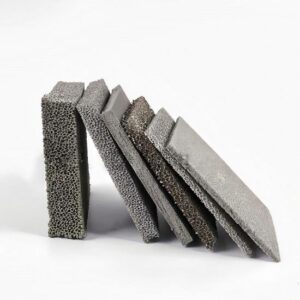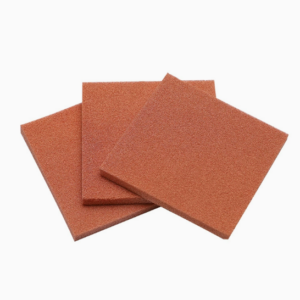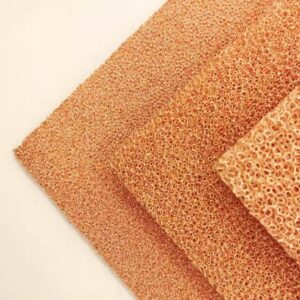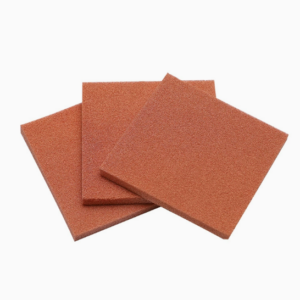
Nickel-Iron Foam Alloy Porous Filter Material
I. Core Pore Characteristics & Basic Parameters
II. Key Product Features
III. Core Application Fields
If you’re interested, have any questions, or have specific customization requirements, please feel free to contact us at inquiry@atomfair.com.
How does the pore size of the nickel-iron foam alloy filter affect its filtration precision and pressure drop?
The pore size range of 0.1 mm to 10 mm (5–130 ppi) allows selection for different filtration precision levels, with smaller pores providing finer filtration. The high porosity of 95–98% and open pore rate >98% ensure low flow resistance, though specific pressure drop data depends on the operating conditions and is not provided in the source.
What are the compatibility constraints of this nickel-iron foam alloy filter for high-temperature corrosive gas filtration?
The nickel-iron alloy substrate provides corrosion resistance and high-temperature stability up to ≥1100°C, making it compatible with high-temperature flue gas filtration. The material can be cut, bent, and bonded to fit existing equipment, but specific chemical compatibility data for aggressive corrosive gases is not detailed in the source.
What are the recommended handling and bonding methods for nickel-iron foam alloy filter material to avoid structural damage?
The material can be easily cut, bent, and simply bonded, requiring no specialized equipment or infrastructure. It is incombustible and maintains structural integrity at high temperatures, so standard metalworking techniques are sufficient. No specific bonding agents or handling precautions are mentioned in the source beyond these general guidelines.
The nickel-iron foam alloy filter material offers high porosity (95-98%) and high-temperature resistance (≥1100°C), making it suitable for demanding filtration and acoustic applications. However, the standard dimensions are limited to small coupons, and the minimum pore size of 0.1mm restricts use in sub-micron filtration.
Positive
- High porosity and open pore rate: Porosity of 95-98% and open pore rate >98% enable efficient fluid flow and high filtration throughput, reducing pressure drop across the filter.
- High-temperature resistance ≥1100°C: The nickel-iron alloy maintains structural stability and incombustibility at elevated temperatures, allowing deployment in high-temperature flue gas and industrial exhaust filtration.
Trade-offs
- Limited standard dimensions: Standard sizes are only 100×100 mm with thicknesses of 1.5 mm or 2 mm; larger or custom dimensions require special ordering, which may increase lead time.
- Minimum pore size of 0.1 mm: The smallest pore size (0.1 mm / 100 µm) is not fine enough for sub-micron or high-precision filtration applications, limiting its use in certain chemical or pharmaceutical processes.
Every advanced material, component, equipment, and instrument in our catalog is backed by rigorous testing. We maintain strict internal quality management frameworks and align with CE conformity metrics to deliver transparent, reproducible performance data via our public open-science repository.
To request raw batch performance data, submit formal vendor registration paperwork, or execute a fast-turnaround R&D manufacturing loop, contact us at inquiry@atomfair.com.
Item is dispatched under the Atomfair Shipping & Delivery Framework (Free worldwide shipping on orders over $59 USD excl. heavy equipment). Return is governed by the Atomfair Return & Refund Policy (7-day technical return window).