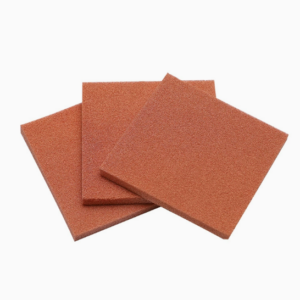
1. Standard Dimensions
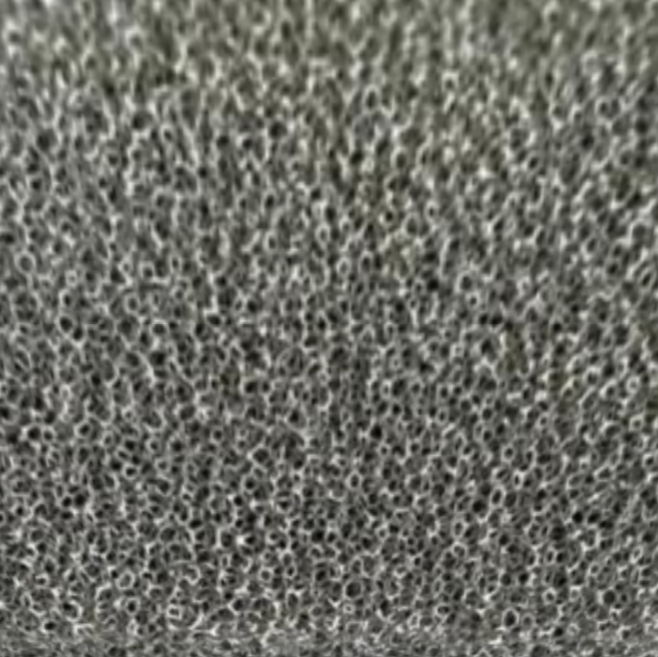
2. Pore Characteristics & Bulk Density
3. Key Product Features
4. Core Application Fields
If you’re interested, have any questions, or have specific customization requirements, please feel free to contact us at inquiry@atomfair.com.
How does the thickness of iron foam (0.5mm to 25mm) affect its application in sound insulation versus thermal management?
The source indicates that iron foam provides wide-frequency sound absorption and, after additional treatment, high noise interception. For thermal management, it has high thermal conductivity for rapid heat transfer. Thicker foams (e.g., 10–25 mm) may offer better sound insulation due to greater material depth, while thinner foams (0.5–5 mm) are more suitable for thermal interfaces where minimal thickness is desired. The specific thickness can be customized.
What is the recommended method for bonding iron foam to other materials in composite structures?
The source states that iron foam is easy to bond simply. It can be bonded using adhesives or mechanical fasteners. The high porosity (95–98%) and open pore structure (>98%) allow adhesives to penetrate and create strong mechanical interlocks. For high-temperature applications, the foam's heat resistance up to ≥1100°C should be considered when selecting bonding agents.
What safety precautions are necessary when handling iron foam due to its high porosity and metallic nature?
The source notes that iron foam is incombustible and stable at high temperatures (≥1100°C), so fire risk is low. However, its porous structure may retain sharp edges after cutting; gloves should be worn. The material is lightweight (bulk density 0.1–0.8 g/cm³) and easy to handle. No special storage conditions are specified, but keeping it dry prevents oxidation.
This iron foam product features a highly porous (95-98%) open-cell structure with >98% open pore rate, enabling efficient fluid flow and filtration, combined with thermal stability up to 1100°C and electromagnetic shielding effectiveness of approximately 90dB.
Positive
- High porosity and open pore structure: Porosity of 95-98% with >98% open pore rate ensures excellent fluid permeability and filtration efficiency, suitable for gas/liquid flow applications.
- Multifunctional performance: Combines sound absorption, electromagnetic shielding (~90dB), and high-temperature resistance (≥1100°C) in a single lightweight material, reducing system complexity.
Trade-offs
- Mechanical strength trade-off from high porosity: The high porosity (95-98%) inherently reduces mechanical strength compared to dense metals; structural applications may require reinforcement or careful load management.
- Customization required for non-standard sizes: Standard dimensions are limited to 100x100mm and 200x300mm sheets; other sizes and pore specifications require custom orders, potentially increasing lead time.
Every advanced material, component, equipment, and instrument in our catalog is backed by rigorous testing. We maintain strict internal quality management frameworks and align with CE conformity metrics to deliver transparent, reproducible performance data via our public open-science repository.
To request raw batch performance data, submit formal vendor registration paperwork, or execute a fast-turnaround R&D manufacturing loop, contact us at inquiry@atomfair.com.
Item is dispatched under the Atomfair Shipping & Delivery Framework (Free worldwide shipping on orders over $59 USD excl. heavy equipment). Return is governed by the Atomfair Return & Refund Policy (7-day technical return window).