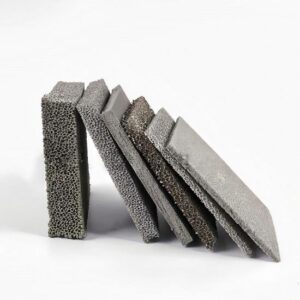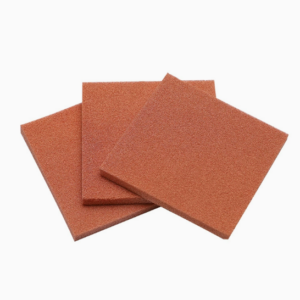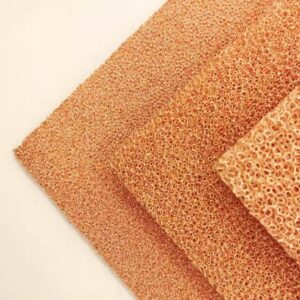
Summary of Core Information on Foam Carbon
I. Core Characteristics
II. Key Technical Specifications
III. Main Application Fields
If you’re interested, have any questions, or have specific customization requirements, please feel free to contact us at inquiry@atomfair.com.
How does adjusting porosity affect the thermal conductivity and compressive strength of foam carbon?
Porosity in foam carbon can be customized between 30% and 80%, which directly impacts thermal conductivity (25–80 W/(m·K)) and compressive strength (8–12 MPa). Higher porosity generally reduces thermal conductivity and compressive strength, but exact relationships can be engineered to meet specific requirements, as the material’s pore size and density are adjustable via foaming.
What are the temperature limits for foam carbon when used in air versus inert atmospheres, and how does this constrain application in fuel cell or aerospace components?
Foam carbon can withstand up to 600°C in air and 3000°C in inert gas, making it suitable for high-temperature fuel cell electrodes and aerospace components like propellant nozzles. It also exhibits excellent thermal shock resistance up to 1250°C, ensuring reliability during rapid temperature changes in these demanding applications.
What gas atmosphere infrastructure is required to operate foam carbon at temperatures exceeding 600°C?
For operation above 600°C, foam carbon must be used in an inert gas atmosphere because its maximum service temperature in air is 600°C, while in inert gas it reaches 3000°C. This requires an inert gas supply and containment system, such as a sealed furnace or enclosure, to prevent oxidation and maintain material integrity.
This foam carbon material provides exceptional thermal shock resistance and customizable physical properties, but its mechanical strengths are moderate and it requires inert atmosphere for high-temperature use above 600°C.
Positive
- Excellent thermal shock resistance and high temperature capability: Withstands abrupt temperature changes up to 1250°C and operates up to 600°C in air or 3000°C in inert gas, making it suitable for extreme thermal environments.
- Customizable physical properties and dimensions: Density, pore size, thermal conductivity, and dimensions can be tailored to specific application requirements, enabling optimized performance in fields like heat dissipation, catalysis, and aerospace.
Trade-offs
- Moderate tensile and compressive strength: Tensile strength ranges from 2 to 5 MPa and compressive strength from 8 to 12 MPa, which may be insufficient for high-load structural applications without reinforcement.
- Atmospheric sensitivity at high temperatures: Maximum service temperature in air is 600°C; above that, an inert gas atmosphere is required to prevent oxidation, adding infrastructure complexity.
Every advanced material, component, equipment, and instrument in our catalog is backed by rigorous testing. We maintain strict internal quality management frameworks and align with CE conformity metrics to deliver transparent, reproducible performance data via our public open-science repository.
To request raw batch performance data, submit formal vendor registration paperwork, or execute a fast-turnaround R&D manufacturing loop, contact us at inquiry@atomfair.com.
Item is dispatched under the Atomfair Shipping & Delivery Framework (Free worldwide shipping on orders over $59 USD excl. heavy equipment). Return is governed by the Atomfair Return & Refund Policy (7-day technical return window).