Description
ATOMFAIR LNPM-1C LIQUID NITROGEN PLANETARY BALL MILL -40°C 4-STATIONRESEARCH GRADE EQUIPMENT
|
|||||||||||||||||||||||||||||||||||||||||||||||||||||||||||||||||||||||||||||||||||
|
|||||||||||||||||||||||||||||||||||||||||||||||||||||||||||||||||||||||||||||||||||
|
TAILORED SOLUTIONS FOR RESEARCH
Contact our engineering team for technical support or official quotations.
EMAIL: inquiry@atomfair.com
|
|||||||||||||||||||||||||||||||||||||||||||||||||||||||||||||||||||||||||||||||||||
|
Manufacturer: Atomfair LLC
Brand: ATOMFAIR®
|
This cryogenic ball mill requires continuous liquid nitrogen supply to maintain sub-zero grinding temperatures between -40°C and 20°C. Adequate ventilation is mandatory to prevent nitrogen gas accumulation and oxygen displacement hazards in the operating area.
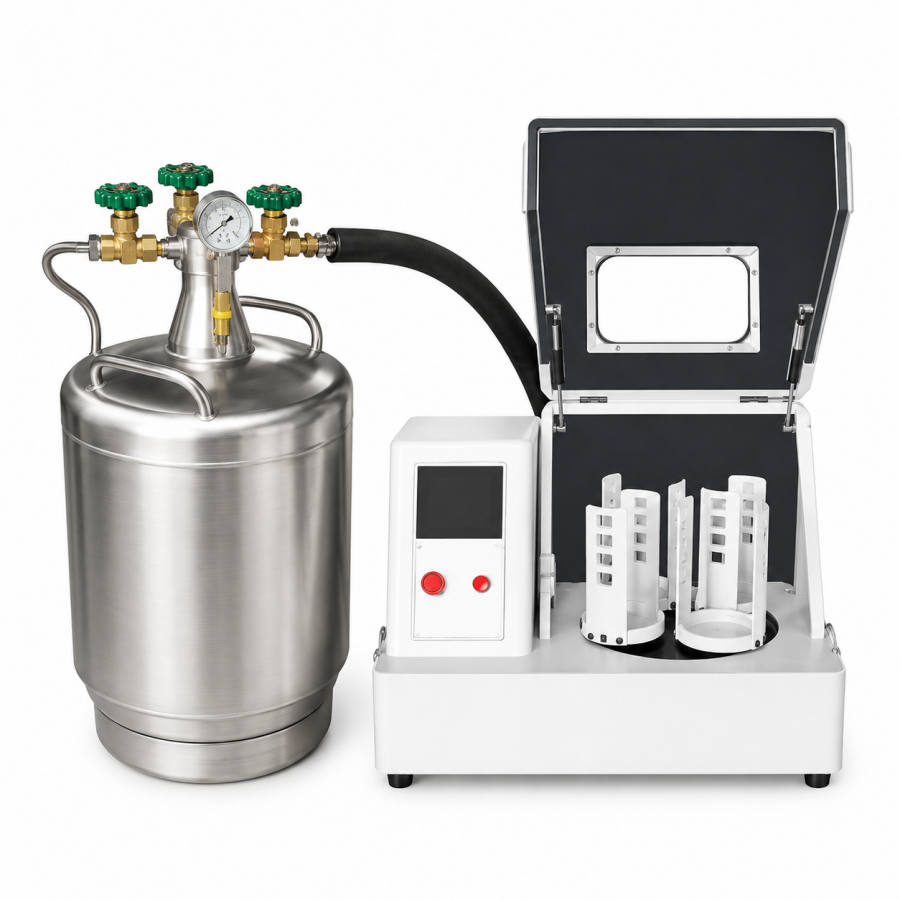
- Liquid Nitrogen Supply Rate: Under 0–10°C operating conditions, liquid nitrogen consumption is approximately 4–5 L/h, requiring a dedicated storage tank ordered separately.
- Temperature Control Range: The insulated chamber maintains a persistent low-temperature environment from -40°C to 20°C via continuous liquid nitrogen injection.
- Ventilation Requirement: Adequate ventilation is required in the operating area due to nitrogen gas displacement from the cryogenic cooling system.
- Jar Compatibility for Inert Atmosphere: Vacuum grinding jars are supported for inert gas or vacuum atmosphere cryogenic grinding of air-sensitive materials.
- Cryogenic Safety Protocols: Always follow cryogenic safety protocols when handling liquid nitrogen and consult the user manual prior to first use.
Set up the mill in a well-ventilated area with a connected liquid nitrogen tank and appropriate personal protective equipment. Follow cryogenic safety protocols and consult the user manual before first use.
Required Equipment: Liquid Nitrogen Storage Tank (30 L recommended), Grinding Jars and Balls (ordered separately), Personal Protective Equipment (cryogenic gloves and goggles), Ventilation System or Fume Hood
- Inspect Unit and Connections
Inspect the main grinding unit and all connections for damage or wear before connecting any supplies. - Connect Liquid Nitrogen Supply
Connect the liquid nitrogen storage tank to the mill's insulated chamber using the provided supply line. - Set Temperature Range
Set the desired temperature range on the controller between -40°C and 20°C for cryogenic processing. - Load Grinding Jars and Media
Load grinding jars with appropriate media (filling ~40% of jar capacity) and sample material, then secure them onto the four-station platform. - Start Rotation at Required Speed
Start the rotation at the required speed within the 70–810 rpm range for ultrafine grinding. - Monitor Liquid Nitrogen Consumption
Monitor liquid nitrogen consumption continuously and refill the storage tank as needed to maintain stable temperature.
What is the trade-off between rotation speed and cryogenic temperature stability in the ATOMFAIR LNPM-1C liquid nitrogen planetary ball mill?
The LNPM-1C operates at 70–810 rpm with a 0.75 kW motor, but maintaining the -40°C to 20°C temperature range depends on liquid nitrogen consumption, which is approximately 4–5 L/h under 0–10°C operating conditions. Higher rotation speeds generate more frictional heat, requiring increased LN2 injection to sustain cryogenic conditions, so users must balance grinding intensity with LN2 supply rate and tank capacity (recommended 30 L tank) to avoid temperature excursions during extended runs.
Can the LNPM-1C be used for vacuum or inert atmosphere cryogenic grinding of air-sensitive materials?
Yes, the LNPM-1C supports vacuum and inert atmosphere grinding when equipped with compatible vacuum grinding jars, which are available as separate order items. The four-station platform allows simultaneous processing of up to four different samples under cryogenic conditions, and the vacuum jar compatibility enables complete environmental isolation for air-sensitive materials such as lithium cobalt oxide or catalysts during low-temperature milling.
What are the infrastructure and safety requirements for operating the LNPM-1C liquid nitrogen planetary ball mill?
The LNPM-1C requires a 30 L liquid nitrogen storage tank (ordered separately) and a 220V/110V universal power supply. Adequate ventilation is mandatory in the operating area due to nitrogen gas displacement risk, and cryogenic safety protocols must be followed when handling liquid nitrogen. The unit weighs 83 kg with dimensions 750×470×590 mm, and liquid nitrogen consumption is approximately 4–5 L/h under 0–10°C conditions, so users must plan for continuous LN2 supply during extended grinding sessions.
The ATOMFAIR LNPM-1C is a 4-station cryogenic planetary ball mill with liquid nitrogen cooling down to -40°C, enabling ultrafine grinding of temperature-sensitive materials under vacuum or inert atmosphere, but requires external LN2 supply and careful ventilation management.
Positive
- Cryogenic grinding down to -40°C: Continuous liquid nitrogen injection maintains a persistent low-temperature environment as low as -40°C, enabling ultrafine grinding of temperature-sensitive materials such as electronic ceramics, battery materials, and pharmaceuticals without thermal degradation.
- Four-station vacuum/inert atmosphere compatibility: The four-station design allows simultaneous preparation of four different samples in a single run, and support for vacuum grinding jars enables inert or vacuum atmosphere cryogenic grinding for air-sensitive materials requiring complete environmental isolation.
Trade-offs
- External LN2 supply and storage required: Operation requires a separate liquid nitrogen storage tank (30 L, 50 L, or 100 L) ordered separately, with consumption of approximately 4–5 L/h under 0–10°C conditions, adding logistical overhead for continuous supply and refilling.
- Ventilation and cryogenic safety protocols needed: Adequate ventilation is mandatory in the operating area due to nitrogen gas displacement risk; laboratories must implement cryogenic safety protocols for handling liquid nitrogen, including proper personal protective equipment and oxygen monitoring.
Every advanced material, component, equipment, and instrument in our catalog is backed by rigorous testing. We maintain strict internal quality management frameworks and align with CE conformity metrics to deliver transparent, reproducible performance data via our public open-science repository.
To request raw batch performance data, submit formal vendor registration paperwork, or execute a fast-turnaround R&D manufacturing loop, contact us at inquiry@atomfair.com.
Item is dispatched under the Atomfair Shipping & Delivery Framework (Free worldwide shipping on orders over $59 USD). Return is governed by the Atomfair Return & Refund Policy (7-day technical return window).