
Solid-State Battery Materials
ATOMFAIR Solid-State Battery Materials supports research teams working on oxide, sulfide, halide, sodium-ion, and interface-modified solid-state battery systems. This category covers solid electrolyte powders, auxiliary salts, interface additives, ceramic oxide materials, and selected research tooling for pellet pressing, constant-pressure testing, and in-situ characterization.
When selecting solid-state battery materials, researchers should first define the target chemistry, moisture sensitivity, ionic conductivity requirement, particle size range, processing route, and cell architecture. Oxide systems such as LATP, LLZTO, and LAGP are typically selected for air stability, thermal stability, and ceramic processing compatibility. Sulfide systems are often chosen for high room-temperature ionic conductivity, while halide systems are widely evaluated for high-voltage cathode matching and interface-buffer studies.
Before inquiry or experimental planning, it is useful to confirm the material formula, purity, D50 particle size, package size, inert-atmosphere requirement, and whether the material will be used for electrolyte layers, composite membranes, cathode interface modification, sodium solid-state batteries, or pressure-assisted testing.
Show More Solid-State Battery Material Systems, Interface Additives & Research Tooling
I. Solid-State Battery Materials by Chemistry
| Material Family | Current Coverage | Typical Selection Logic | Handling Notes |
|---|---|---|---|
| Oxide Solid Electrolytes | LATP, LLZTO, LAGP | Suitable for ceramic electrolytes, composite membranes, tape casting, dry compounding, and air-stability screening. | Generally more stable than sulfides, but dry storage is still recommended. |
| Sulfide Solid Electrolytes | Li3PS4, Li7P3S11, Li6PS5Cl, LGPS, LPSCB, LiSiPSCl, sodium sulfides | Suitable for high ionic conductivity, cold pressing, lithium-metal studies, and composite cathode research. | Moisture sensitive; inert-atmosphere handling is strongly recommended. |
| Halide Solid Electrolytes | Li2ZrCl6, Li3InCl6, Li2In1/3Sc1/3Cl4, LiBr | Useful for high-voltage cathode matching, interface-buffer layers, and halide-assisted studies. | Protect from humidity; inert-atmosphere storage is recommended for long-term use. |
| Interface Additives | ZrO2, TiO2, LiBr, and related additives | Used for interface modification, ceramic reinforcement, and composite electrolyte optimization. | Compatibility should be verified for the specific electrode and electrolyte system. |
| Research Tooling | Pressure fixtures, PEEK molds, Raman fixtures | Used for pellet pressing, constant-pressure cycling, in-situ testing, and contact-pressure control. | Best displayed as cross-listed tooling or under a dedicated solid-state battery fixture category. |
II. Key Parameters to Confirm Before Inquiry
| Parameter | What to Confirm |
|---|---|
| Chemistry / Formula | LATP, LLZTO, LAGP, Li6PS5Cl, LGPS, Li3InCl6, Li2ZrCl6, sodium sulfide systems, or custom formulas. |
| Form Factor | Powder, ceramic pellet, separator disk, salt, additive, composite membrane, or testing fixture. |
| Particle Size | Submicron powders are often useful for coating and dense composites; larger D50 grades may be suitable for pressing, mixing, or process screening. |
| Purity & Moisture Control | Especially important for sulfide, halide, and other moisture-sensitive powders. |
| Ionic Conductivity | Compare values only under similar temperature, density, processing, pressure, and measurement conditions. |
| Research Application | Electrolyte layer, cathode interface, lithium-metal compatibility, sodium solid-state cell, or in-situ pressure testing. |
III. Typical Research Application Paths
In oxide solid-state battery research, LATP, LLZTO, and LAGP powders can be used for ceramic electrolyte layers, composite polymer electrolytes, protective interlayers, and laboratory sintering studies. These systems are often selected by teams that prioritize thermal stability, air tolerance, and ceramic processing routes.
In sulfide solid-state battery research, Li3PS4, Li7P3S11, Li6PS5Cl, LGPS-type materials, LPSCB, and related systems are suitable for high-conductivity screening, cold-pressed electrolyte layers, and lithium-metal or composite cathode development. Because sulfides are generally moisture sensitive, glovebox handling and sealed packaging should be treated as part of the experimental design.
In halide and high-voltage cathode interface research, chloride and bromide systems can help evaluate oxidative stability, cathode-electrolyte contact, and interface-buffer strategies. Selection should consider cathode voltage, humidity control, particle contact, and compatibility with the full cell stack.
For mechanical pressure and in-situ characterization, pressure molds, PEEK fixtures, and Raman-compatible cells can help standardize pellet thickness, pressure history, and interface contact during testing. These products support the solid-state battery workflow, but they are best separated from core electrolyte materials in navigation when possible.
FAQ for Researchers
For early-stage solid-state battery screening, should I start with oxide, sulfide, or halide solid electrolytes?
If the project prioritizes stability, air tolerance, and ceramic processing, LATP, LLZTO, or LAGP oxide systems are common starting points. If the goal is high room-temperature ionic conductivity and low-temperature pellet pressing, sulfide systems may be more suitable. If the research focuses on high-voltage cathode interfaces or composite cathode layers, halide systems are often worth evaluating.
Why can the reported conductivity of the same solid electrolyte vary across papers or supplier batches?
Ionic conductivity can be affected by particle size, phase purity, moisture content, pressing pressure, sintering or annealing conditions, pellet density, electrode contact, test temperature, and EIS fitting method. Researchers should compare data measured under similar conditions rather than relying on a single nominal value.
What experiments are LATP, LLZTO, and LAGP oxide powders typically used for?
They are commonly used for ceramic electrolyte pellets, composite polymer electrolytes, cathode or separator coatings, interface protection layers, and air-stable model solid-state battery systems. For dense ceramic pellets, researchers should also consider sintering aids, particle size distribution, forming pressure, and the sintering profile.
What problems are most common when working with sulfide solid electrolytes?
Common issues include moisture-driven degradation, powder oxidation, interfacial side reactions, pellet cracking, unstable contact with oxide cathodes, and high interfacial resistance caused by insufficient stack pressure. We recommend completing weighing, mixing, pressing, and sealing inside a glovebox while recording pressure, humidity, and air exposure time.
Where do halide solid electrolytes fit in a research workflow?
Halide systems are often used for high-voltage cathode matching, composite cathode layers, interface-buffer layers, and oxidative-stability studies. They can complement sulfide or oxide systems, but researchers should still evaluate humidity sensitivity, particle contact, and compatibility with lithium-metal anodes.
How should I choose powder particle size for composite solid electrolytes?
Finer powders can help form a more uniform composite phase and shorter ion-transport pathways, but they may also increase surface area, moisture adsorption, and interface-reaction risk. Larger particles are often easier to handle, but may reduce film uniformity or density. Selection should be matched with the polymer matrix, solid loading, coating thickness, and target mechanical properties.
Why are constant-pressure fixtures or pressure molds important in solid-state battery testing?
Solid-state battery interfaces are highly pressure dependent. Insufficient pressure can cause poor particle contact, high interfacial resistance, and unstable cycling data, while excessive pressure may crack pellets, cause short circuits, or deform materials. Constant-pressure fixtures help control this variable and improve sample-to-sample comparability.
What information should a research team provide for material inquiry or customization?
Please provide the target chemistry, formula, required purity, particle size range, package size, inert-atmosphere packaging requirement, intended use, test temperature, cell architecture, whether lithium metal or a high-voltage cathode will be used, and whether COA, XRD, particle size distribution, or conductivity data are required.
Showing 1–16 of 24 results
-
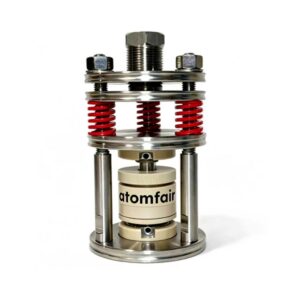
Constant-Pressure Battery Test Mold 0–20 MPa ATOMFAIR®
$280.00 -
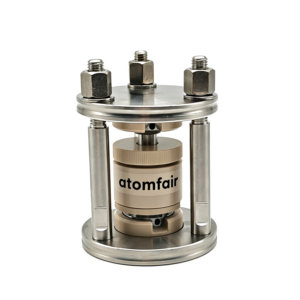
In-Situ Raman Cell & PEEK Mold Kit Ø70×94mm ATOMFAIR®
$800.00 -
LAGP Solid-State Electrolyte 20g Research Grade ATOMFAIR®
Price range: $429.95 through $749.95 -
LATP Solid Electrolyte Powder 0.3μm Research Grade ATOMFAIR®
Price range: $459.00 through $2,011.00 -
LATP Solid-State Electrolyte Powder 99.9% 300nm ATOMFAIR®
$359.95 -
LGPS (Li10GeP2S12) Electrolyte Research Grade ATOMFAIR®
$539.00 -
Li2In1/3Sc1/3Cl4 Solid Electrolyte 10g Grade ATOMFAIR®
$560.00 -
Li3InCl6 Solid-State Electrolyte Research Grade ATOMFAIR®
$336.00 -
Li6PS5Cl Sulfide Solid Electrolyte Powder 99.9% ATOMFAIR®
Price range: $359.95 through $379.95 -
Li7P8S2I Sulfide Solid Electrolyte Powder 99.9% ATOMFAIR®
$399.95 -
LiSiPSCl Solid-State Electrolyte Research Grade 10g ATOMFAIR®
$540.00 -
Lithium Bromide LiBr 99.99% Research Grade ATOMFAIR®
Price range: $282.00 through $495.00 -
Lithium Li7P3S11 Sulfide Solid Electrolyte 10g ATOMFAIR®
$540.00 -
Lithium Phosphorus Sulfide Li3PS4 Research Grade ATOMFAIR®
$540.00 -
Lithium Zirconium Chloride Li2ZrCl6 Research 10g ATOMFAIR®
$435.00 -
LLZTO Solid-State Electrolyte Powder 100g ATOMFAIR®
$329.95