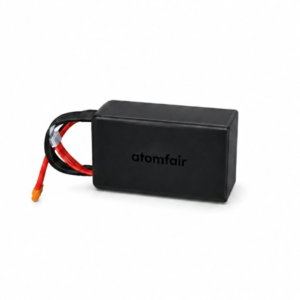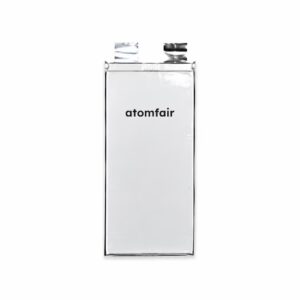
Description
ZC Series High-Rate Power Cells (Professional Tool Grade) | ATOMFAIRCOMMERCIAL GRADE · PRODUCTION
|
|||||||||||||||||||||||||
|
|||||||||||||||||||||||||
|
TAILORED SOLUTIONS FOR RESEARCH
Contact our engineering team for technical support or official institutional quotations.
EMAIL: INQUIRY@ATOMFAIR.COM
|
|||||||||||||||||||||||||
|
MANUFACTURER: ATOMFAIR LLC
BRAND: ATOMFAIR®
|
Store the ZC5078T1-4 cell in a dry, ventilated environment within a 15°C to 30°C thermal zone to prevent electrochemical degradation. Always isolate terminals from short-circuit paths and secure multi-cell assemblies in a rigid compression fixture to maintain uniform solid-layer contact.
- Storage Environment: Maintain ambient temperature between 15°C and 30°C in a dry, ventilated area to preserve cell integrity.
- Short-Circuit Prevention: Prevent terminals from contacting conductive surfaces or short-circuit tracks to avoid uncontrolled discharge.
- Mechanical Restraint: Secure active cell rows within a rigid compression fixture plate when building multi-cell assemblies to ensure uniform solid layer contact.
- Thermal Runaway Mitigation: Proprietary electrolyte coating layers suppress internal thermal runaway paths under extreme multi-shift operations.
Follow these steps to safely store and handle the ZC5078T1-4 high-rate lithium cell. Adherence mitigates electrical hazards and ensures reliable operation.
Required Equipment: Rigid compression fixture plate
- Environment Preparation
Store the cell in a dry, ventilated area maintained at 15°C to 30°C to prevent thermal stress. - Terminal Isolation
Prevent terminals from contacting short-circuit tracks by insulating exposed contacts with non-conductive covers. - Multi-Cell Assembly
Handle active cell rows securely within a rigid compression fixture plate to maintain uniform solid layer contact.
How does the ZC5078T1-4 cell maintain thermal stability during sustained 7C discharge?
The ZC5078T1-4 limits cell face temperature rise to a peak increment of ≤30°C under full-load discharge, achieved through its advanced solid-state structural synthesis and proprietary high-performance electrolyte coating layers. Additionally, the ultra-low internal AC resistance of ≤5 mΩ minimizes energy conversion loss, further reducing heat generation. These features enable reliable 7C continuous discharge without thermal runaway, as stated in the product specifications.
What mechanical infrastructure is necessary when assembling the ZC5078T1-4 cells into a multi-cell battery pack?
The product compliance notice explicitly states that multi-cell assemblies require a rigid compression fixture plate structure to maintain uniform solid layer contact between cells. Additionally, terminals must be protected from short-circuit tracks, and the cells should be operated within the 3.0V–4.3V window. These constraints ensure consistent performance and prevent mechanical or electrical failure in high-rate applications like power tools and AGVs.
What storage and handling conditions are required for the ZC5078T1-4 high-rate cell to ensure operational safety?
Cells must be stored in a dry, ventilated environment held between a constant 15°C–30°C thermal zone, as per the product's operational compliance notice. Terminals must be prevented from contacting short-circuit tracks, and active rows should be handled securely in a rigid compression fixture for multi-cell assemblies. The high-rate solid-state cell carries substantial electrochemical power, so these precautions are critical to avoid thermal runaway.
The ZC5078T1-4 high-rate power cell delivers 4 Ah capacity with a 7C continuous discharge capability and ≤5 mΩ internal resistance, making it well-suited for heavy-duty industrial tools and pulse current processing, but requires strict temperature-controlled storage (15°C–30°C) and rigid compression fixture support in multi-cell assemblies.
Positive
- 7C continuous discharge capability: Delivers up to 7C continuous discharge rate, enabling high-torque industrial power tool and pulse current processing applications without performance restriction.
- Ultra-low internal resistance: Internal AC resistance ≤5 mΩ minimizes energy conversion losses and maximizes runtime efficiency, supporting rapid current delivery with minimal heat generation.
Trade-offs
- Narrow storage temperature range: Cells must be stored in dry, ventilated environments held between 15°C and 30°C, requiring climate-controlled storage facilities to maintain electrochemical stability.
- Rigid compression fixture required: In multi-cell assemblies, a rigid compression fixture plate is necessary to maintain uniform solid layer contact, adding mechanical design complexity and assembly constraints.
Every advanced material, component, equipment, and instrument in our catalog is backed by rigorous testing. We maintain strict internal quality management frameworks and align with CE conformity metrics to deliver transparent, reproducible performance data via our public open-science repository.
To request raw batch performance data, submit formal vendor registration paperwork, or execute a fast-turnaround R&D manufacturing loop, contact us at inquiry@atomfair.com.
Item is dispatched under the Atomfair Shipping & Delivery Framework (Free worldwide shipping on orders over $59 USD excl. heavy equipment). Return is governed by the Atomfair Return & Refund Policy (7-day technical return window).