Description
ATOMFAIR® ATM-PCBT-SS-4L STAINLESS STEEL BATTERY CYCLE TEST FIXTURERESEARCH GRADE MATERIAL
|
|||||||||||||||||||||||||||||||||||||||||||
|
|||||||||||||||||||||||||||||||||||||||||||
|
TAILORED SOLUTIONS FOR RESEARCH
Contact our engineering team for technical support or custom institutional quotations.
EMAIL: inquiry@atomfair.com
|
|||||||||||||||||||||||||||||||||||||||||||
|
Manufacturer: Atomfair LLC
Brand: ATOMFAIR®
|
|||||||||||||||||||||||||||||||||||||||||||
The fixture imposes maximum working pressure limits of 400 kg to 600 kg depending on size, with a compatible battery thickness range of 0.1–2.5 cm. Material selection between 304 and 316 stainless steel determines corrosion resistance and load-bearing capacity in electrolyte-exposed environments.
- Pressure Limits: Exceeding the rated working pressure may cause structural deformation or failure of the four-layer assembly.
- Material Compatibility: Stainless steel grades 304 and 316 offer different resistance to acidic or alkaline electrolyte leakage.
- Cell Size Constraints: Maximum cell length and width must be at least 30 mm less than the fixture’s internal dimensions to ensure proper alignment and clamping.
- Uniform Pressure Requirement: The single nut design requires even torque application across all four layers to maintain pressure distribution and avoid localized stress.
- Customization Limits: Custom fixture sizes, layer spacing, and surface treatments must remain within the structural load capacity of the stainless steel assembly.
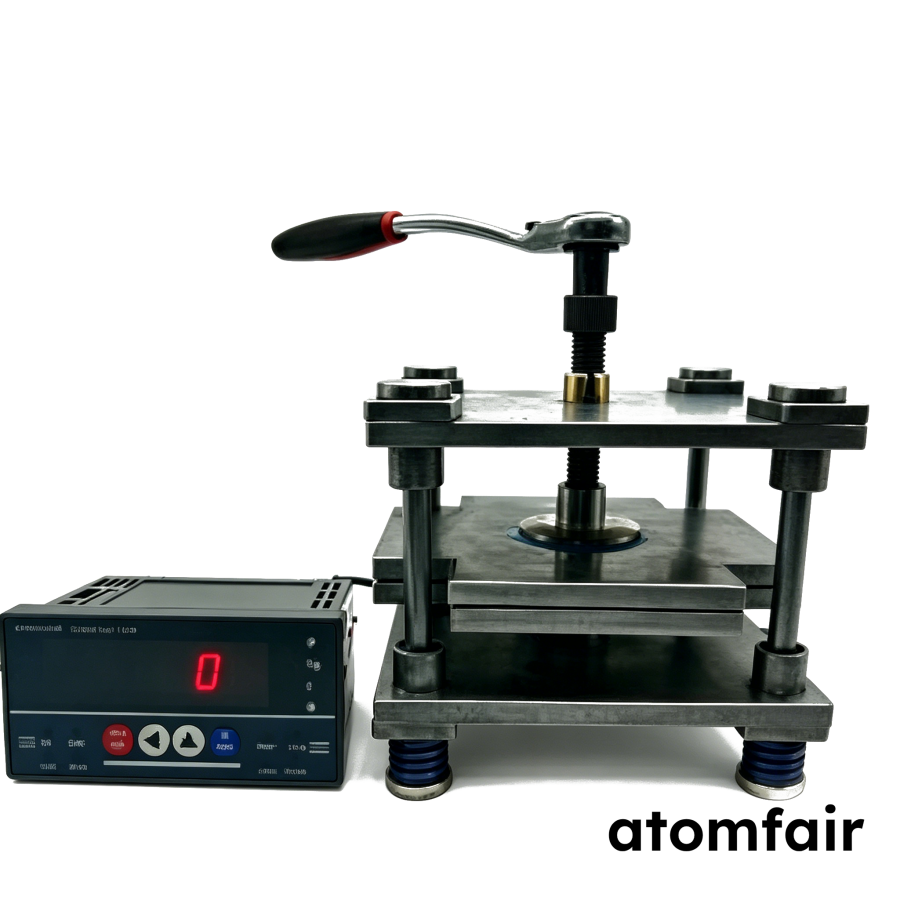
This fixture clamps pouch cells under controlled pressure for cycle testing while the pressure sensor monitors real-time load. Correct assembly ensures uniform force distribution and prevents cell damage or sensor misreading.
Required Equipment: Torque wrench or calibrated nut driver
- Prepare the fixture
Inspect all four layers for cleanliness and confirm the die spring and pressure sensor are properly seated. - Position the cell
Place the pouch cell centrally between the stainless steel layers, ensuring it does not protrude beyond the fixture boundaries. - Tighten the single nut
Turn the single nut gradually until the die spring compresses and the target working pressure (400 kg or as specified) is displayed on the pressure sensor. - Verify uniform clamping
Check that all four layers move synchronously and the pressure reading remains stable across the sensor. - Connect test leads
Attach battery cycle test leads to the pouch cell tabs, ensuring no short circuits or mechanical stress on the connections. - Monitor during cycling
Observe the pressure sensor output continuously and adjust the nut if the pressure drifts outside the acceptable tolerance.
How does the material choice (304 vs 316 stainless steel vs aluminum vs plastic) affect the maximum working pressure and corrosion resistance of the ATM-PCBT-SS-4L pouch cell fixture?
The standard working pressure is 400 kg, customizable up to 600 kg for stainless steel and carbon steel. 304 and 316 stainless steel offer high load-bearing capacity and corrosion resistance, with 316 providing superior acid/alkali resistance for harsh environments like leakage testing. Aluminum alloys (7075-T6, 6061-T6) are lightweight but lower strength; PP/HDPE and PEEK are ultra-lightweight and fully electrolyte-resistant but suited for low-pressure testing only. Carbon steel provides lowest cost with strong load-bearing for high-pressure applications.
What is the maximum compatible cell size for the ATM-PCBT-SS-4L fixture, and how is it determined?
Maximum cell length and width equal fixture length and width minus 30 mm. For example, a 150×180 mm fixture accommodates cells up to 120×150 mm with thickness ≤ 28 mm for the 10*150*180 variant or ≤ 26 mm for the 12*150*180 variant. The four-layer spacing is adjustable to support cell thicknesses from 0.1 to 2.5 cm, allowing testing of thicker batteries or multiple batteries simultaneously.
Does the integrated pressure sensor require any special calibration or setup before use, and how does the single nut design ensure uniform pressure?
The pressure sensor is an essential structural component built into the four-layer fixture, enabling real-time pressure monitoring without additional calibration steps. The single nut locking mechanism combined with a die spring buffer ensures uniform pressure distribution across all four layers, eliminating the need for external pressure distribution plates. The standard working pressure is 400 kg (customizable up to 600 kg), and the fixture size, layer spacing, and pressure level can be customized per test requirements.
The ATM-PCBT-SS-4L four-layer stainless steel fixture incorporates a built-in pressure sensor and single nut clamping mechanism to deliver uniform pressure distribution for pouch cell cycle testing, with customizable working pressure up to 600 kg. Operational constraints include a mandatory 30 mm size margin between cell and fixture dimensions, and the need to specify 316 stainless steel for aggressive electrolyte environments.
Positive
- Single Nut Uniform Pressure Distribution: The single nut locking mechanism combined with die spring buffer provides uniform pressure distribution across the four-layer structure, enhancing test reproducibility and reducing localized stress on pouch cells.
- Integrated Pressure Sensor for Real-Time Monitoring: An integrated pressure sensor allows continuous monitoring of applied force during cycling, enabling precise control and data correlation for battery performance analysis.
Trade-offs
- Mandatory Size Margin Requirement: Cells must be at least 30 mm shorter in length and width than the fixture dimensions, limiting compatibility with larger-format pouch cells that approach plate boundaries.
- Material Sensitivity to Harsh Electrolytes: The standard 304 stainless steel offers general corrosion resistance but is not recommended for aggressive electrolyte leakage or immersion testing; upgrade to 316 stainless steel is required for such harsh environments.
Every advanced material, component, equipment, and instrument in our catalog is backed by rigorous testing. We maintain strict internal quality management frameworks and align with CE conformity metrics to deliver transparent, reproducible performance data via our public open-science repository.
To request raw batch performance data, submit formal vendor registration paperwork, or execute a fast-turnaround R&D manufacturing loop, contact us at inquiry@atomfair.com.
Item is dispatched under the Atomfair Shipping & Delivery Framework (Free worldwide shipping on orders over $59 USD). Return is governed by the Atomfair Return & Refund Policy (7-day technical return window).