PP Four-Layer Pouch Test Fixture Pressure Sensor ATOMFAIR®

$459.00

Institutional Procurement & Supply Compliance: As a verified US supplier, Atomfair accepts formal institutional Purchase Orders (POs), contract billing schedules, and custom procurement loops for university and national laboratories, and corporate R&D departments globally.

PP four-layer pouch cell fixture with pressure sensor. Standard 350kg working pressure, 0.1-2.5cm battery thickness. Single nut clamping. In stock.

Description

ATOMFAIR® PP 4-LAYER POUCH CELL TEST FIXTURE

RESEARCH GRADE MATERIAL

Product Overview

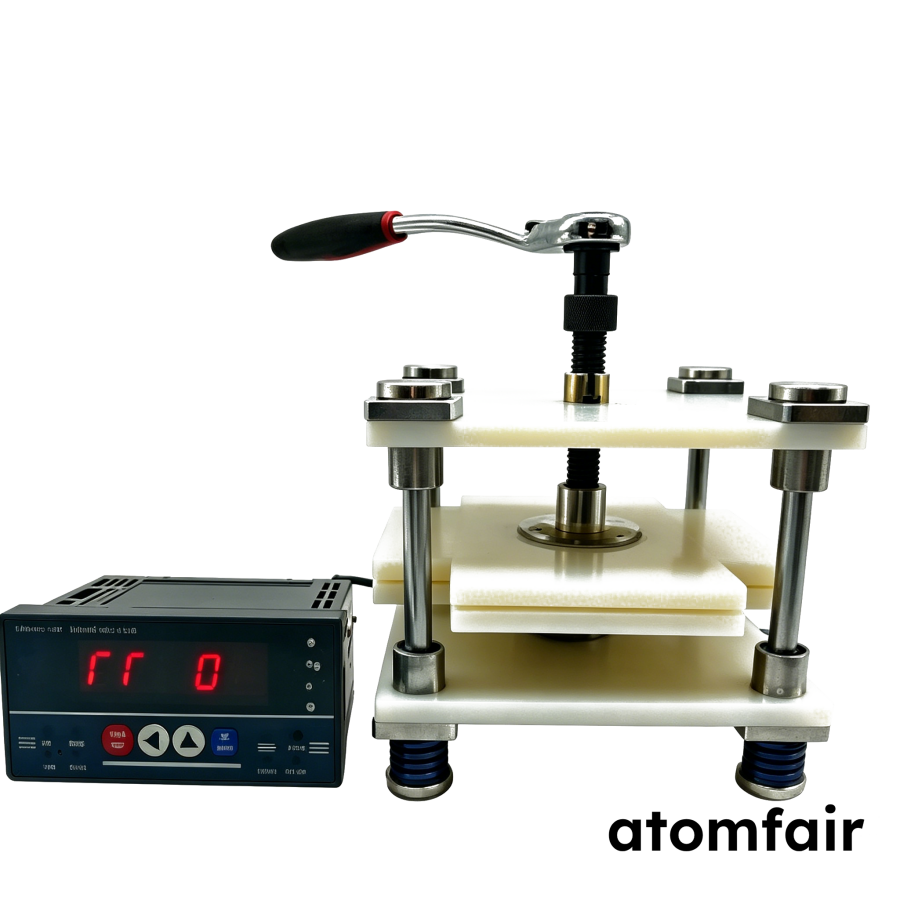
The ATOMFAIR® PP 4-Layer Pouch Cell Test Fixture (Model: ATM-PCBT-PP-4L) is an advanced battery cycle test clamping device engineered for real-time pressure monitoring during electrochemical characterization. Constructed from PP (Polypropylene) with a four-layer structure upgraded from the three-layer version, this fixture features an integrated pressure sensor as an essential structural component and a single nut locking design for uniform pressure distribution. Standard working pressure is 350 kg (customizable up to 500 kg), compatible with battery thicknesses from 0.1–2.5 cm. Full material customization is available; contact inquiry@atomfair.com for tailored configurations.

1. Basic Product Parameters

Item Specification
Product Name Pouch Cell Battery Cycle Test Fixture (PP Four-Layer with Pressure Sensor Version)
Model ATM-PCBT-PP-4L
Main Material PP (Polypropylene) (standard, full material customization available)
Structure Design Four-layer structure (upgraded from the three-layer fixture with an additional layer); pressure sensor is an essential structural component (retained from the three-layer version); adopted single nut design to make pressure distribution more uniform, stable structure, and real-time pressure monitoring available
Standard Working Pressure 350 kg (customizable up to 500 kg, adapted to the load-bearing capacity of the PP four-layer structure, optimized pressure distribution by single nut design)
Compatible Battery Thickness 0.1–2.5 cm (four-layer structure supports testing thicker batteries or multiple batteries simultaneously)
Clamping Method Single nut locking + die spring buffer + four-layer synchronous clamping; single nut design ensures more uniform pressure distribution, scratch-proof to protect battery cells
Customization Service Fixture size, four-layer spacing, and pressure level can be customized according to battery dimensions and test requirements; surface treatment can be customized (corresponding to original anodizing color customization, adapted to PP material characteristics)

2. Fixture Size & Maximum Theoretical Load

Rule: Max. cell length & width = Fixture length & width − 30 mm; Four-layer spacing can be adjusted according to cell thickness.
Fixture Size (mm) Max. Theoretical Load (kg) Max. Compatible Cell Size (mm) Description
10*78*105 350 ≤12*48*75 Suitable for mini small cells, ultra-lightweight PP material, four-layer structure (upgraded from three-layer), single nut design for uniform pressure, stable performance
10*90*107 350 ≤12*60*77 Compact size, ultra-lightweight PP design, four-layer synchronous clamping, single nut locking ensures uniform pressure, suitable for cycle testing
10*100*130 350 ≤12*70*100 Suitable for standard medium-sized cells, universally used in laboratories, ultra-lightweight PP, single nut design for more uniform pressure distribution
10*120*160 500 ≤28*90*130 Standard high-pressure type (max 500 kg), PP four-layer reinforced structure, single nut locking, inherent insulating performance (no need for anodizing)
12*120*160 500 ≤26*90*130 Reinforced high-pressure type, max load 500 kg, wear-resistant PP material, stable four-layer structure, single nut design for uniform pressure, ultra-lightweight and easy to operate
10*150*180 500 ≤28*120*150 Suitable for large-capacity cells, PP four-layer structure (upgraded from three-layer), strong load-bearing capacity, single nut locking ensures uniform pressure, with inherent insulating performance
12*150*180 500 ≤26*120*150 Top-level high-load version (max 500 kg for PP four-layer), single nut design for uniform pressure distribution, ultra-lightweight PP and scratch-proof to protect battery film

3. Optional Materials & Core Advantages

Material Category Optional Material Core Advantages (Combined with Four-Layer Structure & Single Nut Design)
PP (Default) PP (Polypropylene) Ultra-lightweight; cost-effective; fully electrolyte-resistant (no swelling); high toughness; scratch-proof to protect battery film; four-layer structure (upgraded from three-layer) with built-in pressure sensor for real-time pressure monitoring; single nut design ensures more uniform pressure, suitable for four-layer low-pressure to high-pressure cycle testing
Aluminum Alloy 7075-T6 Aluminum Alloy Lightweight; highest strength among aluminum alloys; good rigidity and precise positioning; insulated after anodizing; scratch-proof; four-layer structure (upgraded from three-layer) with built-in pressure sensor for real-time pressure monitoring; single nut design ensures more uniform pressure, suitable for precision cycle testing
Aluminum Alloy 6061-T6 Aluminum Alloy Lightweight; easy to operate; good overall performance; easy to process and weld; insulated after anodizing; general electrolyte resistance; four-layer structure + single nut design ensures uniform pressure, cost-effective option
Stainless Steel 304 Stainless Steel Cost-effective; resistant to regular electrolyte contact; non-magnetic; high load capacity; scratch-proof, optional for scenarios requiring higher corrosion resistance
Stainless Steel 316 Stainless Steel Optimal electrolyte corrosion resistance; suitable for leakage/immersion testing; non-magnetic; compatible with high pressure, optional for harsh testing scenarios
PP/HDPE PP (Polypropylene) Ultra-lightweight; cost-effective; fully electrolyte-resistant (no swelling); high toughness; scratch-proof to protect battery film, optional for four-layer low-pressure testing (consistent with default PP material, for category completeness)
Engineering Plastic PEEK (Polyetheretherketone) Ultra-lightweight; optimal electrolyte resistance (no swelling); insulating and non-magnetic; wide temperature resistance range; extremely high precision, suitable for four-layer precision testing
Carbon Steel Carbon Steel Lowest cost; strong load-bearing capacity; four-layer structure improves rigidity, suitable for cost-sensitive four-layer high-pressure testing
Acrylic Acrylic (PMMA) Lightweight; high transparency for visual observation; insulating and non-magnetic; easy to process, optional for four-layer observation-type testing

Key Features & Advantages

  • Four-Layer Structure with Integrated Pressure Sensor: Upgraded from the three-layer design with an additional layer; the pressure sensor is an essential structural component enabling real-time pressure data acquisition via external equipment.
  • Single Nut Locking Design: Delivers more uniform pressure distribution compared to conventional multi-nut configurations, ensuring consistent and reproducible battery cycle test data.
  • Ultra-Lightweight PP Construction: Cost-effective polypropylene material with inherent insulating performance (no anodizing required), fully electrolyte-resistant without swelling, and scratch-proof to protect battery films.
  • Flexible Customization: Fixture size, four-layer spacing, pressure level, and material selection (PP, 7075-T6/6061-T6 aluminum, 304/316 SS, PEEK, carbon steel, acrylic) can all be tailored to specific test requirements.

4. Important Notes
  1. Size Rule: Cell length & width = Fixture length & width − 30 mm; Four-layer spacing can be adjusted according to cell thickness, providing safe clamping space, and more uniform pressure distribution is achieved through the single nut design to ensure stable battery cycle test data.
  2. The PP four-layer fixture is upgraded from the three-layer fixture, with an additional layer added to the original three-layer structure; the pressure sensor is still an essential structural component, and the sensor data cable can be connected to external acquisition equipment to realize real-time monitoring of test pressure. The core improvement is the adoption of a single nut locking design, which makes the pressure distribution more uniform compared with the three-layer version. It is ultra-lightweight, easy to operate, has inherent insulating performance (no need for anodizing), excellent rigidity, outstanding load-bearing performance (max 500 kg), fully electrolyte-resistant (no swelling), scratch-proof to protect battery film, and does not interfere with test data.
  3. Fixture size, four-layer spacing, material and pressure level can be customized according to different battery cycle test requirements; PP is recommended for cost-sensitive, electrolyte-resistant testing scenarios, while 7075-T6 aluminum alloy is suitable for high-precision, high-strength testing scenarios; the four-layer structure supports testing thicker batteries.
For any questions or customization needs, please contact: inquiry@atomfair.com
TAILORED SOLUTIONS FOR RESEARCH
Contact our engineering team for technical support or official quotations.
EMAIL: inquiry@atomfair.com
Manufacturer: Atomfair LLC
Brand: ATOMFAIR®

This fixture accommodates pouch cells with thickness 0.1–2.5 cm and applies a standard working pressure of 350 kg via a single nut locking mechanism. The four-layer PP structure supports synchronous clamping and real-time pressure monitoring through an integrated sensor.

  • Battery thickness constraint: Compatible battery thickness ranges from 0.1 to 2.5 cm.
  • Working pressure constraint: Standard working pressure is 350 kg, customizable up to 500 kg within the fixture's load-bearing capacity.
  • Cell size constraint: Maximum cell length and width equal fixture dimensions minus 30 mm.
  • Clamping method description: Single nut locking combined with die spring buffer ensures uniform pressure distribution.
  • Material and customization constraint: Fixture is made of PP (polypropylene) and supports custom sizing, spacing, pressure, and surface treatment.

What are the trade-offs of using a polypropylene (PP) fixture compared to an aluminum fixture for pouch cell cycle testing under high clamping pressure?

PP is inherently insulating and lightweight, eliminating the need for anodizing and reducing fixture mass, but its load-bearing capacity is lower than aluminum's. The standard working pressure is 350 kg, customizable to 500 kg for the PP four-layer reinforced structure; at higher pressures, PP may have less rigidity than aluminum, though the single nut design distributes pressure uniformly to mitigate deformation.

How does the four-layer clamping structure accommodate pouch cells of varying thicknesses and sizes, and what are the dimensional constraints for custom cell sizes?

The four-layer spacing is adjustable based on cell thickness, supporting batteries from 0.1 to 2.5 cm. The maximum cell length and width are defined as fixture length/width minus 30 mm, as per the product specification table. For example, a 10x78x105 mm fixture accommodates cells ≤12x48x75 mm, and the largest 12x120x160 mm size accepts cells ≤28x90x130 mm.

What specific handling precautions should be taken when using the single nut locking mechanism with the die spring buffer to avoid damaging the pouch cell during clamping?

The single nut locking mechanism applies force uniformly through the die spring buffer, which acts as a cushion to prevent sudden impact. The scratch-proof design protects battery cells. Proper procedure requires tightening the nut gradually to allow the spring to compress evenly, ensuring pressure distribution remains uniform across the four layers. The standard working pressure is 350 kg, and the fixture's PP material is inherently insulating, so no additional grounding precautions are needed.

This PP four-layer fixture integrates a pressure sensor and single-nut locking for uniform clamping of pouch cells up to 2.5 cm thick, supporting working pressures up to 500 kg. Its lightweight design offers customization options but requires cells to be at least 30 mm smaller than fixture dimensions.

Positive

  • Integrated pressure sensor: The pressure sensor is an essential structural component enabling real-time pressure monitoring during cycling tests, providing direct feedback on cell swelling or clamping force variation.
  • Uniform pressure distribution: Single-nut locking combined with a die spring buffer and four-layer synchronous clamping ensures uniform pressure across the cell surface, reducing localized stress and protecting battery cells from damage.

Trade-offs

  • Limited maximum working pressure: Standard working pressure is 350 kg and can be customized up to 500 kg, but the PP four-layer structure's load-bearing capacity sets an upper limit that may not suffice for applications requiring very high compressive forces.
  • Cell size must be 30 mm smaller: To fit properly, the maximum cell length and width must be at least 30 mm less than the corresponding fixture dimensions, restricting the usable cell sizes for a given fixture size.

Every advanced material, component, equipment, and instrument in our catalog is backed by rigorous testing. We maintain strict internal quality management frameworks and align with CE conformity metrics to deliver transparent, reproducible performance data via our public open-science repository.

To request raw batch performance data, submit formal vendor registration paperwork, or execute a fast-turnaround R&D manufacturing loop, contact us at inquiry@atomfair.com.

Item is dispatched under the Atomfair Shipping & Delivery Framework (Free worldwide shipping on orders over $59 USD). Return is governed by the Atomfair Return & Refund Policy (7-day technical return window).