Description
ATOMFAIR® ATM-PCBT-AL-3L ALUMINUM ALLOY THREE-LAYER BATTERY TEST FIXTURERESEARCH GRADE MATERIAL
|
|||||||||||||||||||||||||||||||||||||||||||
|
|||||||||||||||||||||||||||||||||||||||||||
|
TAILORED SOLUTIONS FOR RESEARCH
Contact our engineering team for technical support or custom institutional quotations.
EMAIL: inquiry@atomfair.com
|
|||||||||||||||||||||||||||||||||||||||||||
|
Manufacturer: Atomfair LLC
Brand: ATOMFAIR®
|
|||||||||||||||||||||||||||||||||||||||||||
The fixture requires careful material selection based on electrolyte compatibility and pressure rating. Proper alignment during clamping is essential to prevent short circuits or cell damage from uneven force distribution.
- Material Compatibility: The fixture's aluminum alloy must be selected for compatibility with the electrolyte chemistry to avoid corrosion over extended cycling.
- Pressure Limits: Standard working pressure is 350 kg, with a maximum of 500 kg for reinforced variants to prevent structural failure or permanent deformation.
- Surface Protection: Anodized surfaces require careful handling to maintain insulation and avoid scratching the pouch cell, which could cause mechanical damage or short circuits.
- Spacing Adjustment: Layer spacing must be precisely set to accommodate cell thickness between 0.1 and 2 cm for uniform pressure distribution across the electrode stack.
- Insulation Requirement: The fixture must remain electrically insulated after anodizing to prevent short circuits during cycling, especially at elevated working pressures.
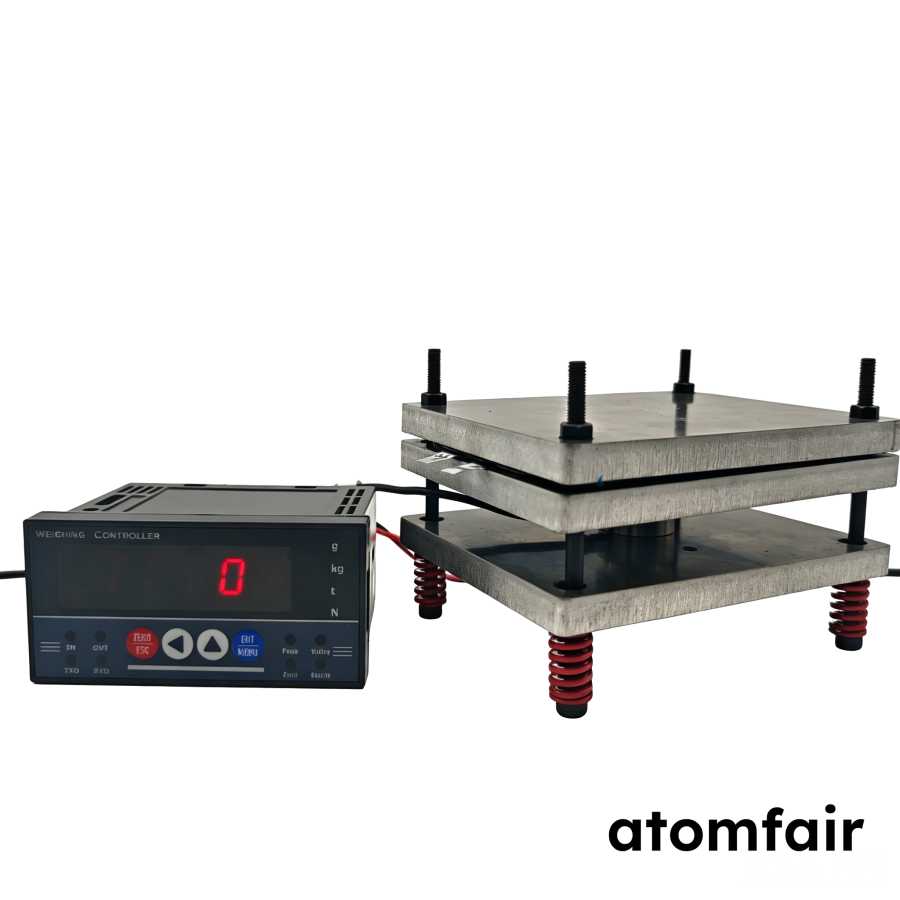
This fixture enables uniform pressure application during pouch cell cycling tests. The three-layer design with integrated pressure sensor allows real-time monitoring of clamping force.
- Adjust Layer Spacing
Adjust the three-layer spacing to match the pouch cell thickness using the screw adjustment mechanism for uniform pressure distribution. - Insert Pouch Cell
Insert the pouch cell into the fixture ensuring proper alignment between the layers to avoid edge compression or misalignment. - Apply and Monitor Clamping Pressure
Tighten the four corner screws sequentially to apply the desired clamping pressure while monitoring the pressure sensor reading for real-time feedback.
What is the advantage of choosing 7075-T6 aluminum alloy over 6061-T6 for the pouch cell test fixture?
7075-T6 aluminum alloy provides the highest strength and rigidity among aluminum alloys, ensuring precise positioning and uniform pressure distribution in the three-layer structure, while 6061-T6 offers a cost-effective alternative with good overall performance but lower load-bearing capacity. Both options are insulated after anodizing and scratch-proof, but 7075-T6 is recommended for high-precision, high-strength testing scenarios.
What are the maximum cell dimensions that can be accommodated by the ATM-PCBT-AL-3L fixture?
The maximum compatible cell size depends on the fixture variant selected; for the largest fixture size (12×150×180 mm), cells up to 26×120×150 mm are supported, following the rule that cell length and width are 30 mm less than fixture dimensions. The three-layer spacing can be adjusted according to cell thickness from 0.1 to 2 cm.
How does the built-in pressure sensor work and what external equipment is needed?
The pressure sensor is integrated as an essential structural component of the three-layer fixture, and its data cable connects to external data acquisition equipment, enabling real-time monitoring of applied pressure during battery cycle testing. The sensor is not optional; it is part of the core upgrade from the two-layer fixture to ensure uniform pressure distribution and stable test data.
This aluminum alloy three-layer fixture integrates a pressure sensor for real-time monitoring, enabling precise control of applied pressure during pouch cell cycling. Its uniform clamping mechanism and customizable dimensions support a wide range of battery sizes, though external data acquisition is required for pressure readout.
Positive
- Real-time pressure monitoring via integrated sensor: The built-in pressure sensor is an essential structural component enabling continuous measurement of applied pressure during cycling, critical for studying pressure effects on battery performance and ensuring test reproducibility.
- Uniform pressure with three-layer clamping: The three-layer design with four-corner screw locking and die spring buffer ensures even pressure distribution across the pouch cell surface, preventing localized stress that could distort electrochemical data or damage the cell.
Trade-offs
- Requires external data acquisition: The pressure sensor is an integral fixture component but requires connection to external data acquisition equipment to read and record pressure signals, adding hardware and wiring complexity for real-time monitoring.
- Cell size limited by fixture footprint: Cell length and width must be 30 mm smaller than fixture dimensions, reducing usable cell area; for example, a 150×180 mm fixture accommodates cells only up to 120×150 mm, which may be inefficient for space-constrained setups.
Every advanced material, component, equipment, and instrument in our catalog is backed by rigorous testing. We maintain strict internal quality management frameworks and align with CE conformity metrics to deliver transparent, reproducible performance data via our public open-science repository.
To request raw batch performance data, submit formal vendor registration paperwork, or execute a fast-turnaround R&D manufacturing loop, contact us at inquiry@atomfair.com.
Item is dispatched under the Atomfair Shipping & Delivery Framework (Free worldwide shipping on orders over $59 USD). Return is governed by the Atomfair Return & Refund Policy (7-day technical return window).