Description
ATOMFAIR® ATM-PCBT-SS-3L STAINLESS STEEL THREE-LAYER BATTERY TEST FIXTURERESEARCH GRADE MATERIAL
|
|||||||||||||||||||||||||||||||||||||||||||
|
|||||||||||||||||||||||||||||||||||||||||||
|
TAILORED SOLUTIONS FOR RESEARCH
Contact our engineering team for technical support or custom institutional quotations.
EMAIL: inquiry@atomfair.com
|
|||||||||||||||||||||||||||||||||||||||||||
|
Manufacturer: Atomfair LLC
Brand: ATOMFAIR®
|
|||||||||||||||||||||||||||||||||||||||||||
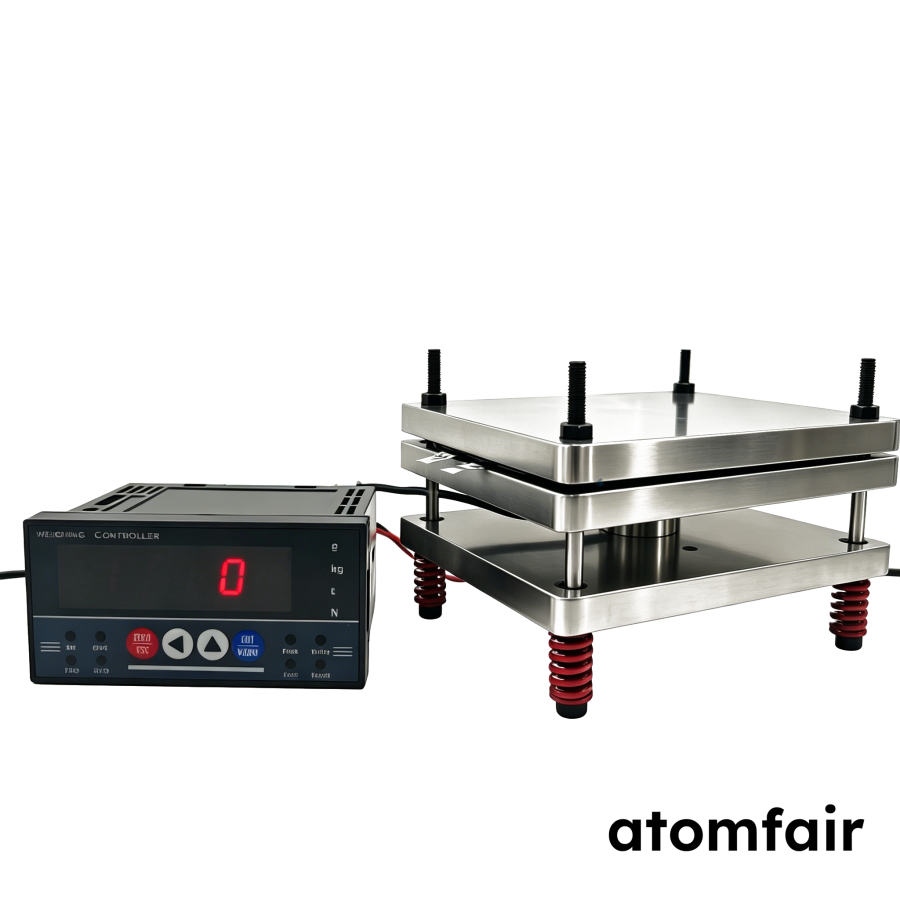
This fixture requires material selection (304 or 316 stainless steel) based on electrolyte corrosivity to prevent long-term degradation under cyclic testing. Uniform pressure distribution must be maintained via the three-layer structure and die spring buffer to avoid cell deformation and ensure consistent test results.
- Material compatibility: Choose 304 stainless steel for standard electrolytes or 316 for aggressive electrolytes to mitigate corrosion risk.
- Clamping force regulation: Set clamping force within 400–600 kg using the four-corner screw locking with die spring buffer for even pressure.
- Cell thickness adaptation: Adjust three-layer spacing to accommodate cell thickness between 0.1–2 cm to prevent over-compression or insufficient clamping.
- Pressure sensor integration: Connect the pressure sensor to a data acquisition system and calibrate to enable real-time pressure monitoring during cycling.
- Fixture sizing rule: Ensure cell length and width are at least 30 mm smaller than the fixture dimensions to allow proper fit and uniform pressure distribution.
This procedure describes the steps to safely mount a pouch cell in the three-layer fixture with pressure sensor for cycle testing. Proper clamping ensures uniform pressure and accurate data acquisition.
Required Equipment: Stainless steel three-layer fixture (with pressure sensor), Hex key set or torque wrench for screw adjustment, Pressure sensor display or data acquisition unit
- Configure fixture
Select the appropriate stainless steel material and adjust the three-layer spacing to match the cell thickness. - Load cell
Position the pouch cell centrally on the bottom plate and place the middle and top layers, ensuring the pressure sensor layer is correctly seated. - Apply clamping force
Tighten the four corner screws uniformly using a cross-pattern sequence to achieve the target clamping force between 400 and 600 kg. - Monitor pressure
Connect the pressure sensor to the data acquisition system and verify real-time pressure readout before initiating the cycle test.
What is the maximum working pressure difference between the standard 400 kg configuration and the customizable 600 kg option, and how does the three-layer structure enable this without compromising uniform pressure distribution?
The standard working pressure is 400 kg, but the fixture can be customized up to 600 kg by adapting the load-bearing capacity of the three-layer structure. The three-layer synchronous clamping with 4-corner screw locking and die spring buffer ensures uniform pressure distribution even at the higher load, as confirmed by the size table showing multiple fixtures rated for 600 kg maximum theoretical load. This trade-off allows higher pressure testing for thicker or larger cells while maintaining structural rigidity and consistent force across the pouch cell surface.
What is the exact size rule for fitting a pouch cell into the ATM-PCBT-SS-3L fixture, and how does the adjustable three-layer spacing accommodate varying cell thicknesses?
The cell length and width must be exactly 30 mm less than the fixture's length and width to ensure safe clamping and uniform pressure distribution. The three-layer spacing can be adjusted according to cell thickness within the 0.1–2 cm compatible range, allowing the fixture to accommodate a wide variety of pouch cell formats while maintaining synchronized pressure across all three layers. This size rule and adjustable spacing are explicitly listed in the product specifications and apply to all available fixture dimensions.
How should the pressure sensor data cable be integrated with external acquisition equipment for real-time monitoring, and what material is recommended for long-term immersion testing scenarios to prevent corrosion?
The pressure sensor data cable can be connected directly to external acquisition equipment to enable real-time monitoring of test pressure during cycling, as stated in the product notes. For leakage or immersion testing scenarios, 316 stainless steel is specifically recommended due to its optimal electrolyte corrosion resistance, ensuring the fixture maintains integrity during prolonged contact with aggressive electrolyte chemistries.
The Atomfair three-layer stainless steel pouch cell fixture integrates a pressure sensor for real-time clamping force monitoring, enabling precise correlation of pressure with electrochemical performance during cycle testing. Its synchronous clamping mechanism ensures uniform pressure distribution, but requires exactly sized fixtures per cell dimensions and external data acquisition for sensor readout.
Positive
- Real-time pressure monitoring: Integrated pressure sensor enables continuous measurement of clamping force during cycling, allowing correlation of pressure changes with battery degradation and improving test reliability.
- Uniform three-layer clamping: The 4-corner screw locking with die spring buffer and three-layer synchronous design ensures even pressure distribution across the pouch cell, minimizing edge stress and improving cycle test consistency.
Trade-offs
- Requires external data acquisition: The pressure sensor outputs via data cable to external acquisition equipment; the fixture itself does not include logging or display, requiring additional instrumentation for real-time monitoring.
- Size-specific cell compatibility: Cell dimensions must be exactly 30 mm less than fixture length and width in both dimensions; any change in cell size requires a different fixture, limiting flexibility for variable cell formats.
Every advanced material, component, equipment, and instrument in our catalog is backed by rigorous testing. We maintain strict internal quality management frameworks and align with CE conformity metrics to deliver transparent, reproducible performance data via our public open-science repository.
To request raw batch performance data, submit formal vendor registration paperwork, or execute a fast-turnaround R&D manufacturing loop, contact us at inquiry@atomfair.com.
Item is dispatched under the Atomfair Shipping & Delivery Framework (Free worldwide shipping on orders over $59 USD). Return is governed by the Atomfair Return & Refund Policy (7-day technical return window).