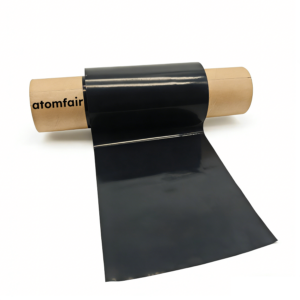
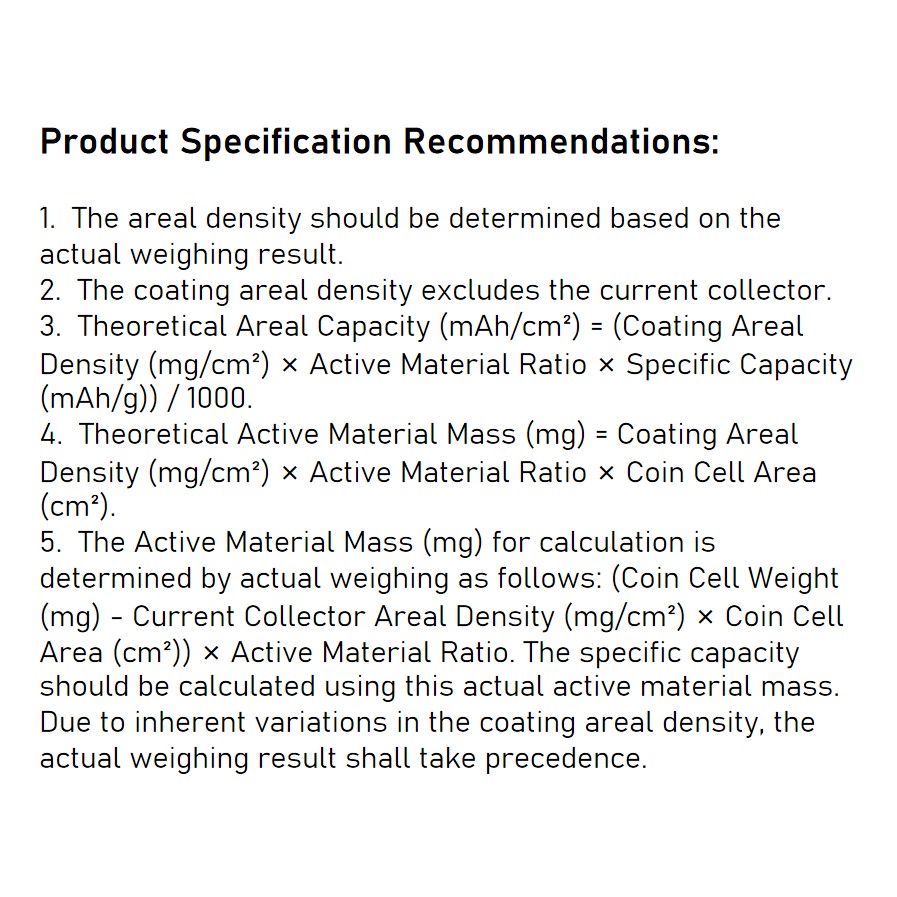
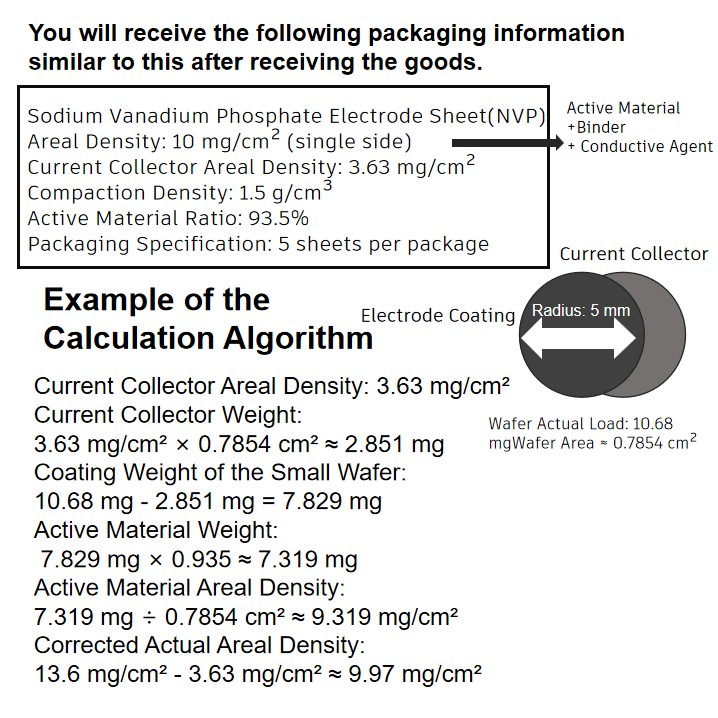
Description
ATOMFAIR® NI90-D01 HIGH-NICKEL NICKEL-COBALT-MANGANESE LITHIUM OXIDE (NI90) ELECTRODE SHEETRESEARCH GRADE MATERIAL
|
||||||||||||||||||||||||||||||||||||||||||||||
|
||||||||||||||||||||||||||||||||||||||||||||||
|
|||
|
TAILORED SOLUTIONS FOR RESEARCH
Contact our engineering team for technical support or official institutional quotations.
EMAIL: inquiry@atomfair.com
|
|||
|
Manufacturer: ATOMFAIR LLC
Brand: ATOMFAIR®
|
High-nickel NCM cathodes are susceptible to moisture and oxygen, necessitating storage in an inert atmosphere (e.g., argon-filled glovebox) to maintain electrochemical performance. Mechanical integrity of the double-side coating depends on avoiding flexural stress and contact with sharp objects.
- Moisture Sensitivity: Exposure to ambient humidity causes lithium hydroxide formation on the particle surface, leading to capacity fade and gas evolution.
- Oxygen Sensitivity: Prolonged air exposure at elevated temperatures can oxidize the nickel content, reducing the reversible capacity of the cathode.
- Coating Adhesion: The electrode coating may delaminate from the carbon-coated aluminum substrate if subjected to rapid thermal cycling or aggressive calendaring.
- Contamination Risk: Foreign particles introduced during handling can cause internal short circuits in assembled cells, requiring cleanroom conditions.
- Electrolyte Compatibility: The cathode is designed for use with carbonate-based electrolytes; contact with acidic or aqueous solvents will degrade the active material.
These steps ensure safe handling and prevent degradation of the high-nickel cathode material prior to cell assembly. Always work in a dry, oxygen-free environment to preserve electrode integrity.
Required Equipment: Argon-filled glovebox (<0.1 ppm H2O, <0.1 ppm O2), Vacuum sealer with desiccant pouch, Ceramic-tipped scissors or precision guillotine, Anti-static tweezers with PTFE tips
- Inspect incoming packaging
Inspect the vacuum-sealed pouch for any puncture or loss of seal before opening to confirm the electrode sheets have not been exposed to ambient air. - Transfer to glovebox antechamber
Transfer the sealed pouch into the glovebox antechamber and perform at least three purge-refill cycles using high-purity argon to eliminate residual oxygen and moisture. - Open pouch inside glovebox
Open the pouch only inside the glovebox main chamber and visually inspect each sheet for wrinkles, tears, or discoloration indicative of degradation. - Cut to desired dimensions
Cut the electrode sheets to the required electrode dimensions using ceramic-tipped scissors, ensuring a clean edge without burrs that could cause short circuits. - Store unused sheets
Store unused cut pieces or full sheets in a sealed container within the glovebox, protected from light and with additional desiccant if long-term storage is planned.
How is the electrode sheet baking time determined?
The electrode sheet is baked under vacuum at 100°C for exactly 12 hours, as specified in the product's standard protocol. This dry time ensures complete removal of residual solvent without degrading the Ni90 active material, which has a 97.4% active material ratio and a compaction density of 3.3 g/cm³.
How does the 57 mg/cm² areal loading of the Ni90 cathode affect rate capability compared to standard loadings?
The high 57 mg/cm² areal loading is optimized for energy density but will reduce rate capability at moderate to high C-rates due to increased ionic transport resistance. To mitigate this, the electrode's 3.3 g/cm³ compaction density and 200 mAh/g capacity provide a baseline; pairing with low-viscosity electrolytes and thin separators is recommended for improved rate performance.
What electrolyte and separator specifications are required for stable cycling of Ni90 double-side coated electrodes?
This Ni90 electrode, coated on 12 μm carbon-coated aluminum foil with an areal density of 3.2 mg/cm², requires a high-voltage-stable electrolyte (e.g., LiPF6 in EC/DMC with FEC additive) to prevent nickel dissolution. The separator must be thermally stable above 100°C and mechanically robust to handle the double-side coating thickness during cell assembly and vacuum baking.
This Ni90 double-side coated cathode sheet delivers a high active material ratio of 97.4% and areal loading of 57 mg/cm², suitable for high-energy lithium-ion battery R&D. However, users must account for the 12-hour vacuum baking requirement and that it is intended for laboratory research only.
Positive
- High active material loading: With a 97.40% active material ratio and 57 mg/cm² double-side coating density, this electrode provides high areal capacity of 200 mAh/g, enabling energy-dense cell testing.
- Customizable electrode parameters: Coating thickness, width, and aluminum foil substrate dimensions can be tailored to user specifications, allowing flexibility for diverse experimental setups and cell formats.
Trade-offs
- 12-hour vacuum baking required: Before use, the electrode sheet must undergo vacuum baking at 100°C for 12 hours to remove residual solvents and moisture, adding preparation time and requiring vacuum oven infrastructure.
- Laboratory research use only: This product is explicitly sold for laboratory research and material evaluation, not for commercial battery manufacturing, which may limit its applicability for scaled-up or production-level testing.
Every advanced material, component, equipment, and instrument in our catalog is backed by rigorous testing. We maintain strict internal quality management frameworks and align with CE conformity metrics to deliver transparent, reproducible performance data via our public open-science repository.
To request raw batch performance data, submit formal vendor registration paperwork, or execute a fast-turnaround R&D manufacturing loop, contact us at inquiry@atomfair.com.
Item is dispatched under the Atomfair Shipping & Delivery Framework (Free worldwide shipping on orders over $59 USD). Return is governed by the Atomfair Return & Refund Policy (7-day technical return window).