Description
ATOMFAIR® ATM-PCBT-AL-4L ALUMINUM ALLOY BATTERY CYCLE TEST FIXTURERESEARCH GRADE MATERIAL
|
|||||||||||||||||||||||||||||||||||||||||||
|
|||||||||||||||||||||||||||||||||||||||||||
|
TAILORED SOLUTIONS FOR RESEARCH
Contact our engineering team for technical support or custom institutional quotations.
EMAIL: inquiry@atomfair.com
|
|||||||||||||||||||||||||||||||||||||||||||
|
Manufacturer: Atomfair LLC
Brand: ATOMFAIR®
|
|||||||||||||||||||||||||||||||||||||||||||
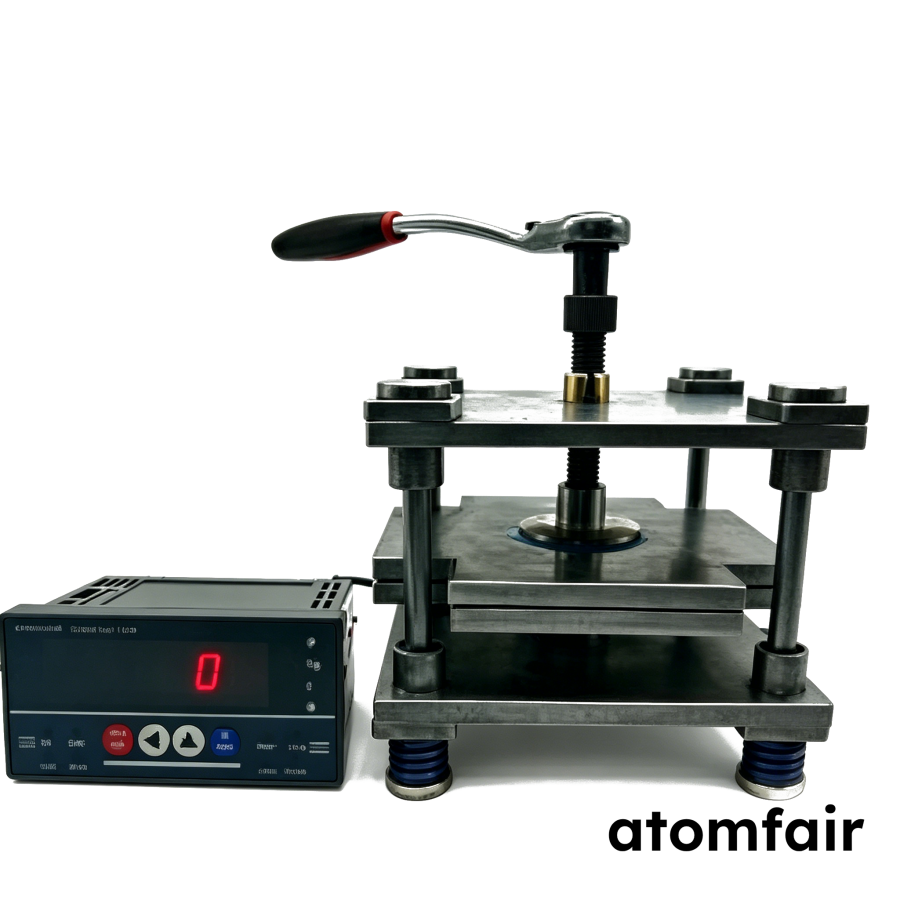
This test fixture is designed for pouch cell battery cycling with integrated pressure sensing. The aluminum alloy four-layer structure accommodates battery thicknesses from 0.1 to 2.5 cm and applies uniform clamping pressure up to 350 kg (customizable to 500 kg).
- Battery Thickness Constraint: The fixture supports battery thicknesses between 0.1 and 2.5 cm, with adjustable four-layer spacing.
- Working Pressure Constraint: Standard working pressure is 350 kg, customizable up to 500 kg, with pressure monitoring via integrated sensor.
- Cell Size Limitation: Maximum compatible cell dimensions are determined by subtracting 30 mm from the fixture's length and width.
- Material Selection: Available in 7075-T6 or 6061-T6 aluminum alloy, with full material customization option.
- Clamping Uniformity Requirement: The single nut design with die spring buffer ensures uniform pressure distribution and scratch-proof clamping.
This procedure describes the correct setup and clamping of a pouch cell within the four-layer fixture. Proper adjustment ensures uniform pressure distribution and accurate pressure monitoring.
- Adjust Layer Spacing
Adjust the four-layer spacing to match the thickness of the pouch cell within the 0.1 to 2.5 cm range. - Insert Pouch Cell
Place the pouch cell between the layers ensuring alignment with the pressure sensor. - Tighten the Nut
Tighten the single nut gradually until the die spring buffer compresses and indicates the desired preload. - Monitor Pressure
Monitor the pressure reading from the integrated sensor to confirm the working pressure of 350 kg or the customized value. - Verify Uniformity
Verify uniform pressure distribution by checking the single nut's position and the spring buffer's compression.
Does integrating the pressure sensor as an essential structural component limit the maximum working pressure of the four-layer aluminum alloy fixture?
Yes, the pressure sensor is an essential structural component retained from the three-layer version, and the four-layer aluminum alloy structure is designed to support a maximum working pressure up to 500kg when customized. The standard working pressure is 350kg, but the fixture can be customized to 500kg while maintaining uniform pressure distribution through the single nut design.
What are the exact dimensional constraints for fitting a pouch cell into the ATM-PCBT-AL-4L fixture, and can multiple cells be tested simultaneously?
The maximum cell length and width must be 30 mm less than the chosen fixture dimensions, and the four-layer spacing can be adjusted to accommodate battery thicknesses from 0.1 to 2.5 cm. The four-layer structure supports testing thicker batteries or multiple batteries simultaneously due to the adjustable spacing and single nut synchronous clamping.
What are the key handling and safety considerations when using the aluminum alloy fixture for pouch cell cycle testing with electrolyte exposure?
The default 7075-T6 aluminum alloy is insulated after anodizing and scratch-proof to protect battery cells, but it is not specified for direct electrolyte immersion. For applications requiring higher electrolyte resistance, 316 stainless steel or PEEK materials are recommended as they offer optimal electrolyte corrosion resistance and no swelling. The fixture uses a single nut locking mechanism with a die spring buffer to ensure uniform pressure and prevent damage during cycling.
The Atomfair ATM-PCBT-AL-4L four-layer pouch cell fixture integrates a single-nut locking mechanism for uniform pressure distribution and a built-in pressure sensor for real-time monitoring, enabling stable cycle testing across varying cell thicknesses. Its aluminum alloy construction offers lightweight handling, but load is capped at 500 kg and default material corrosion resistance is limited, necessitating careful material selection for aggressive electrolyte environments.
Positive
- Uniform pressure via single nut clamping: Four-layer synchronous locking with a single nut and die spring buffer distributes force evenly across the cell stack, reducing localized stress and improving cycle test data consistency.
- Real-time pressure monitoring: Integrated pressure sensor as an essential structural component enables direct connection to external acquisition equipment for live force measurement during cycling, supporting process control.
Trade-offs
- Maximum load limited to 500 kg: Even the reinforced aluminum alloy four-layer structure supports a maximum theoretical load of 500 kg, which may be insufficient for applications requiring higher static pressure on thicker or stacked cells.
- Default material corrosion resistance trade-off: The standard 7075-T6 or 6061-T6 aluminum alloys offer only general electrolyte resistance; for aggressive electrolyte contact, more resistant materials like 316 stainless steel or PEEK are recommended, increasing cost or weight.
Every advanced material, component, equipment, and instrument in our catalog is backed by rigorous testing. We maintain strict internal quality management frameworks and align with CE conformity metrics to deliver transparent, reproducible performance data via our public open-science repository.
To request raw batch performance data, submit formal vendor registration paperwork, or execute a fast-turnaround R&D manufacturing loop, contact us at inquiry@atomfair.com.
Item is dispatched under the Atomfair Shipping & Delivery Framework (Free worldwide shipping on orders over $59 USD). Return is governed by the Atomfair Return & Refund Policy (7-day technical return window).