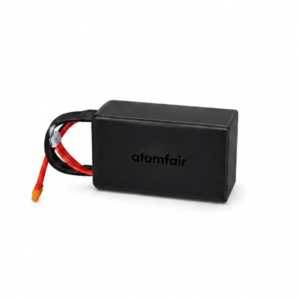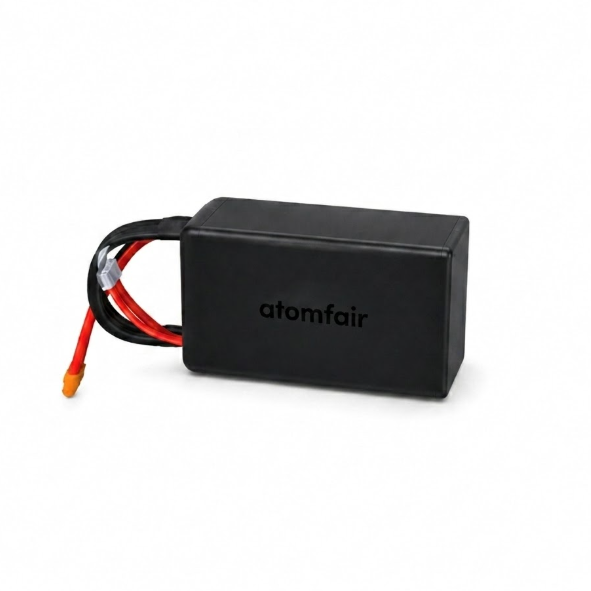
Description
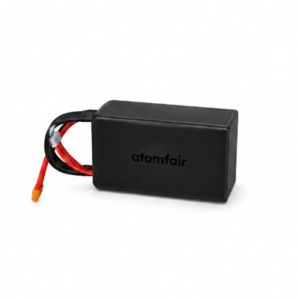
41.6V 233.1Ah ROBOT BATTERY SYSTEM | ATOMFAIRCOMMERCIAL GRADE · PRODUCTION
|
|||||||||||||||||||||||||||||||||
|
|||||||||||||||||||||||||||||||||
|
TAILORED SOLUTIONS FOR RESEARCH
Contact our engineering team for technical support or official institutional quotations.
EMAIL: inquiry@atomfair.com
|
|||||||||||||||||||||||||||||||||
|
Manufacturer: Atomfair LLC
Brand: ATOMFAIR®
|
Charge only within 0°C to 50°C and discharge only within -20°C to 50°C to prevent thermal damage. Do not exceed the peak charge current of 233 A or peak discharge current of 466 A to avoid electrical overstress.
- Storage Condition: Store the battery system within -30°C to 60°C and unlimited relative humidity to maintain electrochemical stability.
- Altitude Limit: Operate the battery system at altitudes no greater than 2000 meters to ensure proper thermal management and safety.
- Mechanical Integrity: Secure the 50 kg chassis against vibration and shock during transport and operation to prevent internal cell damage.
Inspect the battery chassis for physical damage before installation to ensure structural integrity. Connect the battery to the AGV charging dock within the specified temperature and current limits to avoid thermal runaway.
Required Equipment: Insulated torque wrench, Multimeter with DC clamp, Thermal imaging camera
- Inspect chassis
Inspect the battery chassis for cracks, dents, or leakage before handling. - Verify ambient temperature
Verify the ambient temperature is within the charging range of 0°C to 50°C before connecting the charger. - Connect charging cable
Connect the charging cable to the battery input terminals using an insulated torque wrench to ensure secure contact. - Set charge current limit
Set the charger output current to no more than 116 A continuous or 233 A peak to comply with rated limits. - Monitor thermal profile
Monitor the battery surface temperature with a thermal imaging camera during the first charge cycle. - Verify voltage window
Verify the battery voltage stays within the operational window of 32.5 V to 47.45 V during discharge. - Secure for transport
Secure the battery in shock-insulated packaging and store at -30°C to 60°C when not in use.
What is the trade-off between the rated and peak discharge currents for continuous high-rate AGV operations?
The rated continuous discharge current is 233A (1C), while the peak discharge limit is 466A (2C) for transient bursts. Sustained operation at peak current exceeds the rated design envelope, and the battery must remain within the -20°C to 50°C discharge temperature range to maintain thermal stability. No cycle life data is provided, so the primary constraint is adhering to the current and thermal limits to avoid protective shutdown or degradation.
What voltage and current parameters must an AGV super charging station support to be compatible with this 41.6V battery system?
The charging station must operate within the battery's operational voltage window of 32.5V to 47.45V DC and deliver a rated charge current of 116A (peak 233A at 1C). The battery is specifically engineered for super charging robot applications, so any station that cannot stay within these voltage and current limits will not be compatible. No communication protocol details are specified beyond these electrical parameters.
What storage conditions and safety measures are required for the 41.6V 233.1Ah robot battery system when not in use?
The battery must be stored within -30°C to 60°C with no humidity restrictions, and at altitudes ≤2000 meters. It weighs approximately 50 kg, so proper lifting equipment is recommended for handling. Safety precautions include never exceeding peak current ratings, maintaining ventilation during use, and following manufacturer storage guidelines to prevent damage.
This 41.6V 233.1Ah condensed core battery delivers 9.7kWh with a 466A peak discharge for high-rate AGV applications, but its 50 kg mass and mandatory charging temperature window (0-50°C) impose handling and environmental constraints.
Positive
- Ultra-low internal resistance design: Integrated condensed core technology provides ultra-low internal resistance and excellent thermal stability, enabling high-rate charge/discharge cycles required for AGV super charging robot operations.
- High peak discharge capability: Rated discharge of 233A and peak burst of 466A (2C) ensures rapid power delivery for demanding automated guided vehicle turnaround sequences in continuous 24/7 industrial environments.
Trade-offs
- Substantial chassis mass: Total equipment mass of 50±5 kg requires robust facility mounting, reinforced AGV chassis integration, and mechanical handling equipment for installation and maintenance.
- Restricted charging temperature range: Charging is limited to 0°C to 50°C; operation below freezing requires preconditioning or heater systems, adding infrastructure complexity for cold warehouse or outdoor deployments.
Every advanced material, component, equipment, and instrument in our catalog is backed by rigorous testing. We maintain strict internal quality management frameworks and align with CE conformity metrics to deliver transparent, reproducible performance data via our public open-science repository.
To request raw batch performance data, submit formal vendor registration paperwork, or execute a fast-turnaround R&D manufacturing loop, contact us at inquiry@atomfair.com.
Item is dispatched under the Atomfair Shipping & Delivery Framework (Free worldwide shipping on orders over $59 USD excl. heavy equipment). Return is governed by the Atomfair Return & Refund Policy (7-day technical return window).