Description
ATOMFAIR® SINGLE-AXIS CONSTANT-PRESSURE SOLID-STATE BATTERY TEST MOLDRESEARCH GRADE MATERIAL
|
|||||||||||||||||||||||||
|
|||||||||||||||||||||||||
|
TAILORED SOLUTIONS FOR RESEARCH
If you’re interested, have any questions, or have specific customization requirements, please feel free to contact us.
EMAIL: inquiry@atomfair.com
|
|||||||||||||||||||||||||
|
Manufacturer: Atomfair LLC
Brand: ATOMFAIR®
|
This test mold must be stored in a dry, clean environment to prevent contamination of the ceramic sleeve and mirror-polished column head. Failure modes include sealing degradation under repetitive pressure cycles and material adhesion if temperature or pressure limits are exceeded.
- Temperature Limit: The mold is rated for continuous operation up to 210 °C; exceeding this temperature may risk deformation of the PEEK shell and loss of sealing integrity.
- Pressure Limit: Applied pressure must remain within 0–20 MPa, as higher loads can cause catastrophic failure of the ceramic sleeve or thread components.
- Sealing Constraint: The dual thread-and-sealing-ring system requires periodic inspection for wear or cross-threading to maintain airtight reliability during air-exposed testing.
- Cleanliness Requirement: Residual powder or electrolyte on the ceramic sleeve or column head can cause uneven stress distribution and adhesion, necessitating thorough cleaning after each use.
Assemble the mold components and load the solid‑state battery sample before applying controlled uniaxial pressure. Monitor pressure and temperature throughout the test to remain within rated limits.
Required Equipment: Press machine with pressure transducer, Torque wrench for sealing ring, Temperature probe or thermocouple, Cleanroom-grade wipes and solvent
- Clean all components
Wipe the ceramic sleeve, column head, and sealing surfaces with solvent and lint-free wipes to remove any debris or residue. - Insert the sample into the sleeve
Place the solid‑state battery material into the ceramic sleeve, ensuring it is centered and aligned with the column head. - Assemble the mold body
Slide the outer PEEK shell over the sleeve and tighten the thread mechanism by hand, then use the torque wrench to apply the specified seating torque on the sealing ring. - Position the mold in the press
Align the assembled mold between the press platens, ensuring the single-axis loading axis is perpendicular to the sample plane. - Apply initial pressure
Increase the press force slowly to a preload of 1–2 MPa to seat the components and verify even load distribution via the pressure transducer. - Set final test pressure
Raise the pressure to the target value (e.g., 10 MPa) at a controlled ramp rate, monitoring the temperature to ensure it stays below 210 °C. - Monitor and record data
Maintain constant pressure for the desired test duration, logging any deviation in load or temperature, then depressurize slowly and disassemble after cooling.
What is the trade-off between using a thinner versus thicker ceramic test sleeve on pressure distribution and sample volume capacity?
Thinner ceramic sleeves (5 mm) improve pressure uniformity but reduce sample volume, while thicker sleeves (20 mm) increase capacity at the cost of stress heterogeneity. The standard 10 mm sleeve provides a balanced trade-off, and the mold's single-axis pressurization with mirror-polished column head helps maintain even stress across the entire 0–20 MPa range.
What electrode pellet diameters are supported by this test mold, and can it be adapted for non-standard cell geometries?
The standard inner test sleeve supports electrodes with a diameter of 10 mm, and customizable sleeves from 5 mm to 20 mm are available for non-standard pellet sizes. The mold is specifically designed for planar all-solid-state lithium metal batteries; adapting to pouch or coin cell geometries would require additional fixture modifications.
What cleaning and maintenance procedures are recommended for the ceramic sleeve and mirror-polished electrode posts to ensure long-term performance?
The ceramic sleeve can be cleaned with a soft cloth and solvent due to its non-stick property and 0.08 μm inner surface finish; avoid hard brushes to prevent scratching. The mirror-polished column head should be wiped gently after each test to maintain its smooth surface and ensure consistent pressure distribution. The modular design allows full disassembly for thorough cleaning of all components.
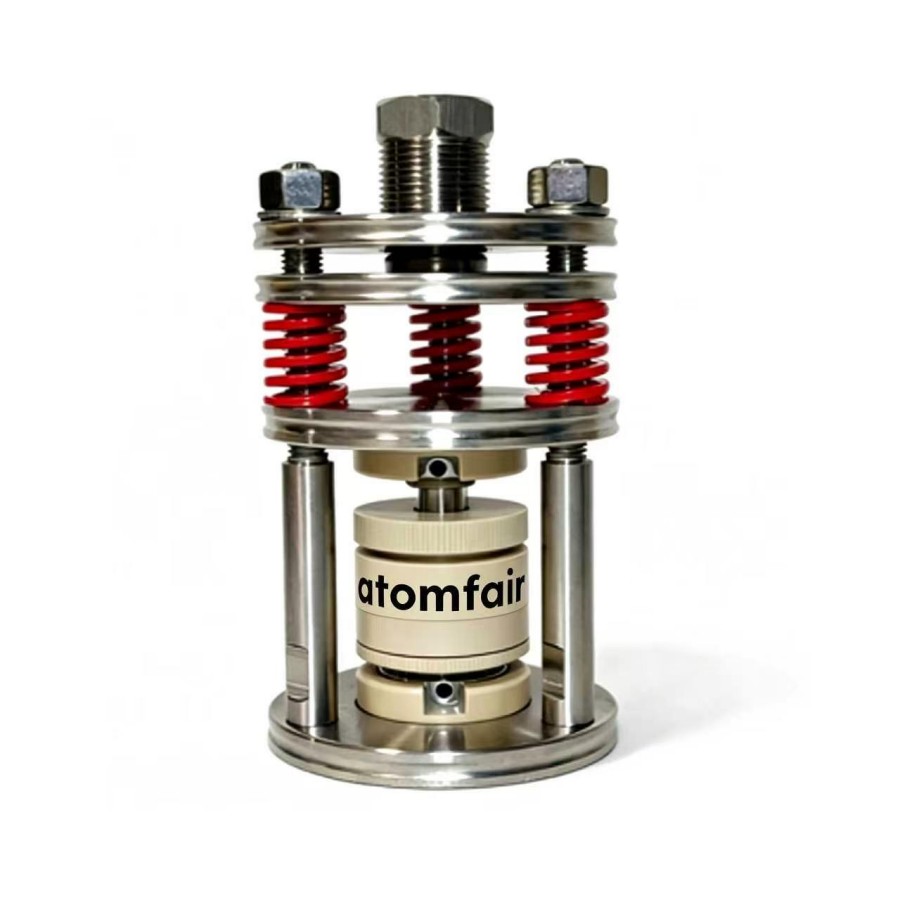
This single-axis constant-pressure solid-state battery test mold is engineered for all-solid-state lithium metal battery R&D, featuring a ceramic sleeve for high-temperature stability, precision pressure control up to 20 MPa, and modular design for easy assembly. Key operational constraints include a 210°C temperature limit and customization requirements for non-standard sleeve thicknesses.
Positive
- Ceramic sleeve for high-temperature stability: The ceramic inner test sleeve provides high-temperature resistance up to 210°C, non-stick properties to powder materials, easy cleaning, and long-term stable performance for solid-state battery testing.
- Precision pressure control with single-axis design: Single-axis pressurization delivers uniform pressure distribution from 0 to 20 MPa with precision controllable pressure, enabling consistent and repeatable test conditions.
Trade-offs
- Temperature limit of 210°C: The maximum operating temperature of 210°C may restrict applications in high-temperature solid-state battery testing that require elevated thermal conditions beyond this limit.
- Customizable sleeve thickness requires custom order: While the standard ceramic sleeve is 10 mm, other thicknesses from 5 to 20 mm require customization, which may involve longer procurement lead times and additional coordination with the manufacturer.
Every advanced material, component, equipment, and instrument in our catalog is backed by rigorous testing. We maintain strict internal quality management frameworks and align with CE conformity metrics to deliver transparent, reproducible performance data via our public open-science repository.
To request raw batch performance data, submit formal vendor registration paperwork, or execute a fast-turnaround R&D manufacturing loop, contact us at inquiry@atomfair.com.
Item is dispatched under the Atomfair Shipping & Delivery Framework (Free worldwide shipping on orders over $59 USD). Return is governed by the Atomfair Return & Refund Policy (7-day technical return window).