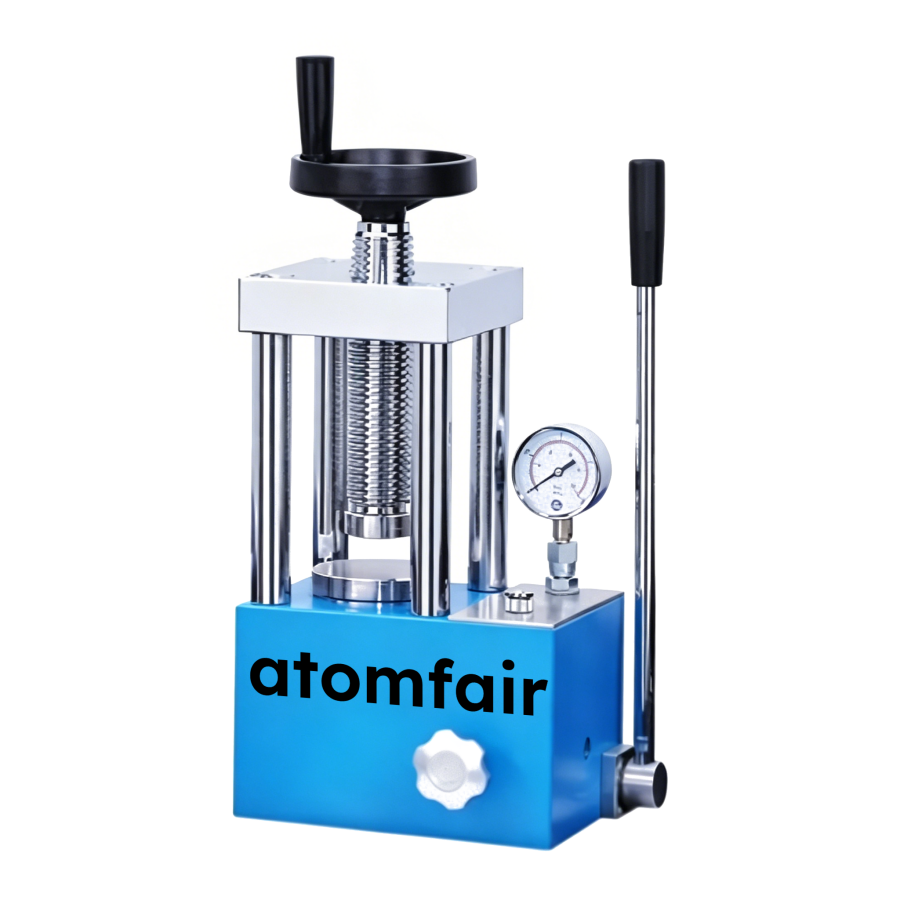
Description
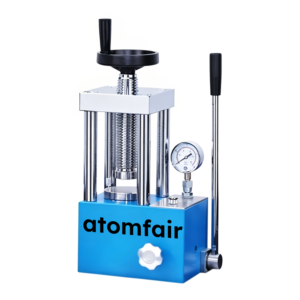
PTP-691 Manual Powder Pellet Press (0 – 60 Ton)HEAVY-DUTY INDUSTRIAL COMPACTION HARDWARE
|
|||||||||||||||||||||||||
|
|||||||||||||||||||||||||
|
TAILORED SOLUTIONS FOR PRODUCTION
Contact our engineering team for technical support or official commercial quotations.
EMAIL: INQUIRY@ATOMFAIR.COM
|
|||||||||||||||||||||||||
|
Manufacturer: PRODUCTION DIVISION · ADVANCED ENERGY STORAGE DIVISION
Brand: INDUSTRIAL TESTING HARDWARE
Specifications are representative and subject to change without notice. For the latest version and compliance certificates, contact official sales channel.
|
The press operates within a 0–60 ton compression range and requires pressure monitoring to prevent structural overload. Die alignment and piston stroke limits must be observed to avoid mechanical failure.
- Pressure Limit: Do not apply pressure exceeding 60 tons to prevent damage to the frame or piston.
- Die Clearance: Use dies that fit within the 185 mm × 250 mm column clearance to avoid obstruction.
- Piston Stroke: Ensure the total sample and die height does not exceed the 50 mm ram displacement.
This manual hydraulic press compresses powder samples into pellets by applying up to 60 tons of force via a hand pump. Operators must load the die, pump gradually, monitor pressure, and release after the required dwell.
Required Equipment: Hydraulic hand pump, Pressure gauge
- Position the die
Place the industrial testing die set onto the press platform centered under the piston. - Load the sample
Fill the die cavity with the powder sample and assemble the die components securely. - Apply pressure
Operate the hydraulic hand pump to raise the pressure gradually to the desired tonnage. - Hold pressure
Monitor the pressure gauge and maintain the target pressure for the specified dwell time. - Release pressure
Open the release valve to slowly decompress the system and then remove the finished pellet.
How does the 60-ton capacity of the PTP-691 affect pellet quality for high-density ores compared to lower-tonnage presses?
The PTP-691's massive 60-ton capacity, combined with an oversized 150mm piston, uniformly distributes linear load over a 50mm stroke to produce reliable, flat, and non-crumbling pellet surfaces even for high-density ores and metallic fragments. Lower-tonnage presses cannot achieve the necessary force to consolidate extremely rigid compounds, leading to structural cracking or incomplete compaction.
Can the PTP-691 accommodate heated dies for thermosetting sample preparation?
Yes, the PTP-691 can accept heated compression dies because its internal column clearance is an ultra-wide 185mm × 250mm, specifically designed to accommodate large-diameter industrial tooling setups. The product description directs users to explore the catalog for heated dies and other specialized tooling, confirming compatibility while noting the press itself is a manual, unpowered hydraulic system.
What workbench specifications are required to safely install the PTP-691?
The installation workbench must be flat and horizontal to ensure safe operation, and it must be capable of sustaining the press's 150 kg rigid frame weight. The press has external dimensions of 405mm × 240mm × 565mm, so the workbench must provide sufficient surface area and clearance for manual handle operation, and operators must never exceed the 60-ton load limit to preserve hydraulic line and seal integrity.
The PTP-691 manual powder pellet press delivers 60-ton industrial-grade compaction via a 150 mm piston and reinforced 150 kg frame, enabling reliable pelletizing of high-hardness ores and ceramics, though operators must respect the load limit and ensure a stable workbench to accommodate its mass.
Positive
- 60-ton hydraulic capacity for hard materials: Specifically engineered to process high-hardness minerals, ceramics, and metallic powders that require extreme force to consolidate successfully.
- Reinforced 150 kg solid enclosure: Heavy structural configuration minimizes torque deflection under continuous high-load manual cycles, optimizing long-term tool lifespan.
Trade-offs
- Heavy bench required for 150 kg load: The 150 kg framework demands that the laboratory workbench be capable of safely sustaining the static and dynamic load to prevent instability.
- Manual handle overload risk: Exceeding the 60-ton maximum load limit risks hydraulic line damage and seal integrity failure; operators must carefully monitor applied force.
Every advanced material, component, equipment, and instrument in our catalog is backed by rigorous testing. We maintain strict internal quality management frameworks and align with CE conformity metrics to deliver transparent, reproducible performance data via our public open-science repository.
To request raw batch performance data, submit formal vendor registration paperwork, or execute a fast-turnaround R&D manufacturing loop, contact us at inquiry@atomfair.com.
Item is dispatched under the Atomfair Shipping & Delivery Framework (Free worldwide shipping on orders over $59 USD). Return is governed by the Atomfair Return & Refund Policy (7-day technical return window).