Description
ATOMFAIR® ATM-PCBT-SS POUCH CELL BATTERY TEST FIXTURE (STAINLESS STEEL VERSION)RESEARCH GRADE MATERIAL
|
|||||||||||||||||||||||||||||||||||||||||||
|
|||||||||||||||||||||||||||||||||||||||||||
|
TAILORED SOLUTIONS FOR RESEARCH
Contact our engineering team for technical support, personalized configuration variants, or custom institutional quotations.
EMAIL: inquiry@atomfair.com
|
|||||||||||||||||||||||||||||||||||||||||||
|
Manufacturer: Atomfair LLC
Brand: ATOMFAIR®
|
|||||||||||||||||||||||||||||||||||||||||||
This fixture applies a calibrated clamping force to pouch cells during cycle testing. Material selection must account for electrolyte exposure and load requirements.
- Load Capacity: Maximum theoretical load varies by fixture size, with standard models supporting 300 kg and reinforced versions up to 500 kg.
- Dimensional Compatibility: The maximum pouch cell size must be at least 30 mm smaller than the fixture's length and width in both dimensions.
- Material Corrosion Resistance: Stainless steel 316 offers the best electrolyte corrosion resistance, while PEEK and PPS provide excellent chemical resistance without swelling.
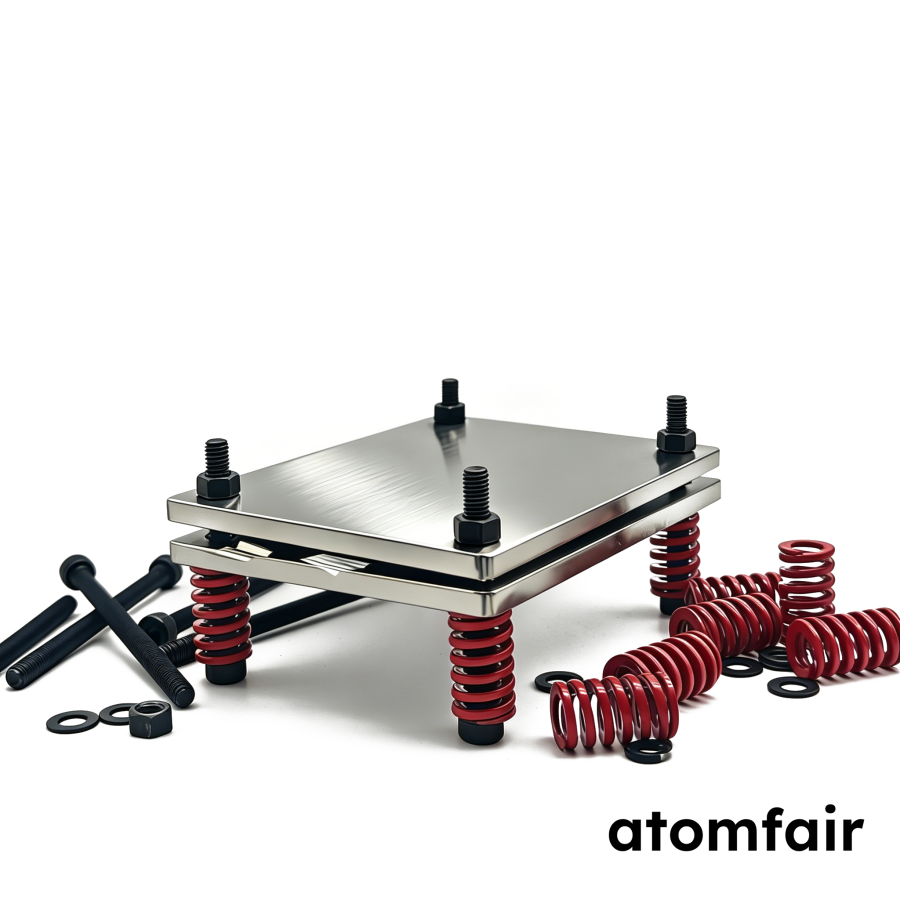
- Clamping Mechanism: Four-corner screw locking with a die spring buffer ensures even pressure distribution and consistent clamping force during cycling.
- Customization Availability: Fixture dimensions and material can be customized to match specific cell geometries and testing environments.
This procedure describes the preparation of the stainless steel test fixture for pouch cell cycling. Proper alignment and uniform tightening ensure reproducible pressure and safe operation.
- Select Fixture Size
Select a fixture size whose internal area is at least 30 mm longer and wider than the pouch cell dimensions. - Position the Pouch Cell
Place the pouch cell centrally between the two clamping plates with the tabs aligned to the fixture edge. - Apply Clamping Pressure
Tighten each of the four corner screws sequentially and evenly until the die spring buffer compresses and the desired working pressure is reached.
What are the performance trade-offs between 304 and 316 stainless steel for the pouch cell fixture in long-term cycling tests?
316 stainless steel offers superior corrosion resistance against electrolyte leakage and immersion, with stable performance across high and low temperature ranges, making it optimal for prolonged cycling tests. 304 stainless steel is cost-effective and resists regular electrolyte contact but provides lower corrosion resistance. Both are non-magnetic and support maximum loads up to 500 kg in appropriate fixture sizes.
What is the maximum pouch cell size that can be used with the 120×160 mm stainless steel fixture?
The maximum compatible cell dimensions are ≤90 mm × 130 mm (length × width) with a thickness of 0.1–2 cm, calculated by subtracting 30 mm from the fixture length and width per the sizing rule. This clearance ensures safe clamping space and stable, reproducible cycle test data.
How does the die spring buffer mechanism prevent cell damage during high-pressure cycling tests?
The 4-corner screw locking paired with die spring buffers provides compliant force control that compensates for pouch cell expansion and contraction during cycling, maintaining uniform pressure without over-compression. This design prevents pressure drift and mechanical damage, ensuring stable long-term cycle testing data.
This stainless steel pouch cell test fixture provides high rigidity and non-magnetic operation for stable battery cycle testing, but requires precise fixture size matching to cell dimensions and may need customization for non-standard cell sizes.
Positive
- High rigidity and load capacity: Stainless steel construction offers higher rigidity and load capacity up to 500 kg, ensuring dimensional stability under long-term high-pressure cycling tests.
- Non-magnetic for data integrity: The stainless steel fixture is non-magnetic, preventing any interference with battery test data during cycling.
Trade-offs
- Precise cell size matching required: The fixture size must be selected such that cell length and width are exactly 30 mm less than the fixture dimensions, limiting off-the-shelf compatibility to a specific cell size per fixture.
- Customization needed for non-standard cells: Cells that do not fit within the standard size options require custom fixture sizing, which involves contacting the supplier and potentially longer lead times.
Every advanced material, component, equipment, and instrument in our catalog is backed by rigorous testing. We maintain strict internal quality management frameworks and align with CE conformity metrics to deliver transparent, reproducible performance data via our public open-science repository.
To request raw batch performance data, submit formal vendor registration paperwork, or execute a fast-turnaround R&D manufacturing loop, contact us at inquiry@atomfair.com.
Item is dispatched under the Atomfair Shipping & Delivery Framework (Free worldwide shipping on orders over $59 USD). Return is governed by the Atomfair Return & Refund Policy (7-day technical return window).