Description
ATOMFAIR® ATM-PCBT-CS POUCH CELL BATTERY TEST FIXTURE (BASIC VERSION)RESEARCH GRADE MATERIAL
|
|||||||||||||||||||||||||||||||||||||||||||
|
|||||||||||||||||||||||||||||||||||||||||||
|
TAILORED SOLUTIONS FOR RESEARCH
Contact our engineering team for technical support or custom institutional quotations.
EMAIL: inquiry@atomfair.com
|
|||||||||||||||||||||||||||||||||||||||||||
|
Manufacturer: Atomfair LLC
Brand: ATOMFAIR®
|
|||||||||||||||||||||||||||||||||||||||||||
The fixture accommodates pouch cells with thickness from 0.1 to 2.5 cm and applies working pressure up to 300 kg (standard) or 450 kg (reinforced models). Cell length and width must be at least 15 mm less than the fixture internal dimensions to ensure proper seating.
- Material Compatibility: Optional stainless steel and plastic materials offer electrolyte resistance; the carbon steel version is not stated to be electrolyte-resistant.
- Pressure Capacity: Standard working pressure is 300 kg, with some fixture sizes supporting up to 450 kg maximum theoretical load.
- Dimensional Fit: Maximum cell length and width are fixture internal dimensions minus 30 mm, ensuring the cell fits within the clamping area.
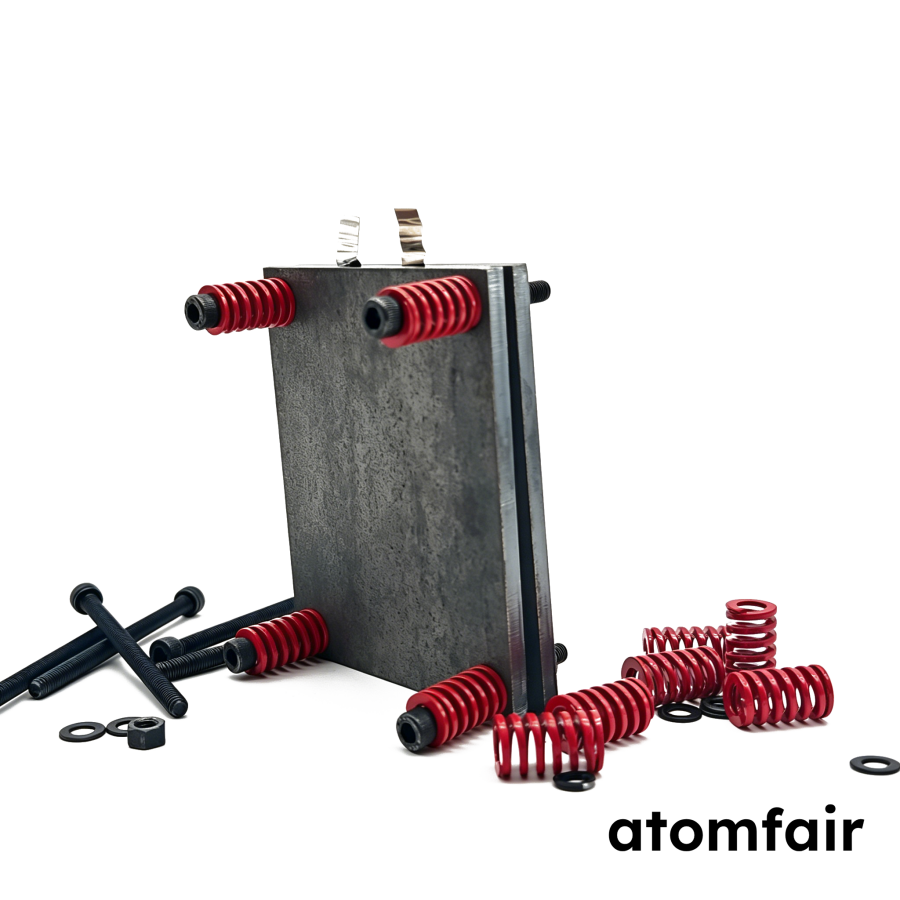
- Clamping Mechanism: The fixture uses four-corner screw locking with a die spring buffer for high rigidity and stable clamping.
Select the appropriate fixture size based on the pouch cell dimensions, ensuring at least 15 mm clearance on each side. Place the cell centrally between the plates, then tighten the four-corner screws in a cross-pattern to the desired working pressure.
- Select Fixture Size
Measure the pouch cell dimensions and choose a fixture size where the cell length and width are at least 15 mm smaller than the fixture internal dimensions. - Position the Cell
Place the pouch cell centrally between the fixture plates, ensuring it aligns with the die spring buffer for even pressure distribution. - Apply Clamping Pressure
Tighten the four-corner screws in a cross-pattern gradually until the desired working pressure, up to 300 kg standard, is reached.
What is the maximum working pressure of the carbon steel fixture, and how does it compare to the 316 stainless steel option for high-pressure pouch cell cycling?
The carbon steel ATM-PCBT-CS has a standard working pressure of 300 kg, customizable up to 450 kg. In comparison, the 316 stainless steel option supports pressures from 0 to 500 kg, offering a higher maximum load capacity and superior electrolyte corrosion resistance. However, the carbon steel version provides the lowest cost and high rigidity, making it a cost-effective choice for most high-pressure testing scenarios where electrolyte leakage is not a primary concern.
What cell dimensions are compatible with the ATM-PCBT-CS fixture, and how does the 30 mm sizing rule affect cell selection?
The fixture accommodates battery thicknesses from 0.1 to 2.5 cm, and the cell length and width must be exactly 30 mm less than the fixture's internal dimensions to ensure safe clamping space. For example, the 8*120*160 mm fixture fits cells up to 25 mm thick by 90 mm by 130 mm, providing stable, repeatable clamping for cycle testing without edge damage or data variability.
Is the carbon steel fixture suitable for testing cells that may leak electrolyte, or should a corrosion-resistant material like 316 stainless steel be used?
The carbon steel fixture is not rated for electrolyte contact and lacks corrosion resistance. For cells prone to leakage or immersion testing, the 316 stainless steel option is explicitly recommended as it offers the best electrolyte corrosion resistance, remains non-magnetic, and is stable at high and low temperatures, ensuring fixture longevity and test integrity.
The Atomfair ATM-PCBT-CS carbon steel pouch cell fixture delivers high-load capacity and rigidity for cycle testing up to 450 kg, but the standard 30 mm sizing margin and material-specific corrosion vulnerability require careful selection for electrolyte-prone environments.
Positive
- Ultra-high load capacity and rigidity: Rated for up to 450 kg working pressure, the carbon steel design provides mechanical stability and wear resistance essential for high-pressure battery cycle testing, as listed in the fixture size table.
- Wide customization for materials and dimensions: The fixture is available in over ten material options (including stainless steel, aluminum, and engineering plastics) and all sizes, thicknesses, and pressure levels can be customized to match specific cell requirements, as explicitly stated in the product notes.
Trade-offs
- Limited max load on smaller sizes: Standard fixtures sized 8*78*105, 8*90*107, and 8*100*130 have a maximum theoretical load of 300 kg only, while the 450 kg capacity is restricted to larger fixture sizes (≥120*160 mm), per the size table.
- Fixture-to-cell sizing margin required: The specification mandates cell length and width be 30 mm less than the fixture dimensions, reducing usable space and potentially necessitating custom sizes for non-standard cell geometries, as stated in the key notes.
Every advanced material, component, equipment, and instrument in our catalog is backed by rigorous testing. We maintain strict internal quality management frameworks and align with CE conformity metrics to deliver transparent, reproducible performance data via our public open-science repository.
To request raw batch performance data, submit formal vendor registration paperwork, or execute a fast-turnaround R&D manufacturing loop, contact us at inquiry@atomfair.com.
Item is dispatched under the Atomfair Shipping & Delivery Framework (Free worldwide shipping on orders over $59 USD). Return is governed by the Atomfair Return & Refund Policy (7-day technical return window).