Description
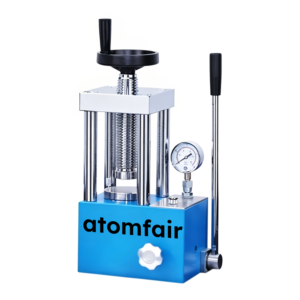
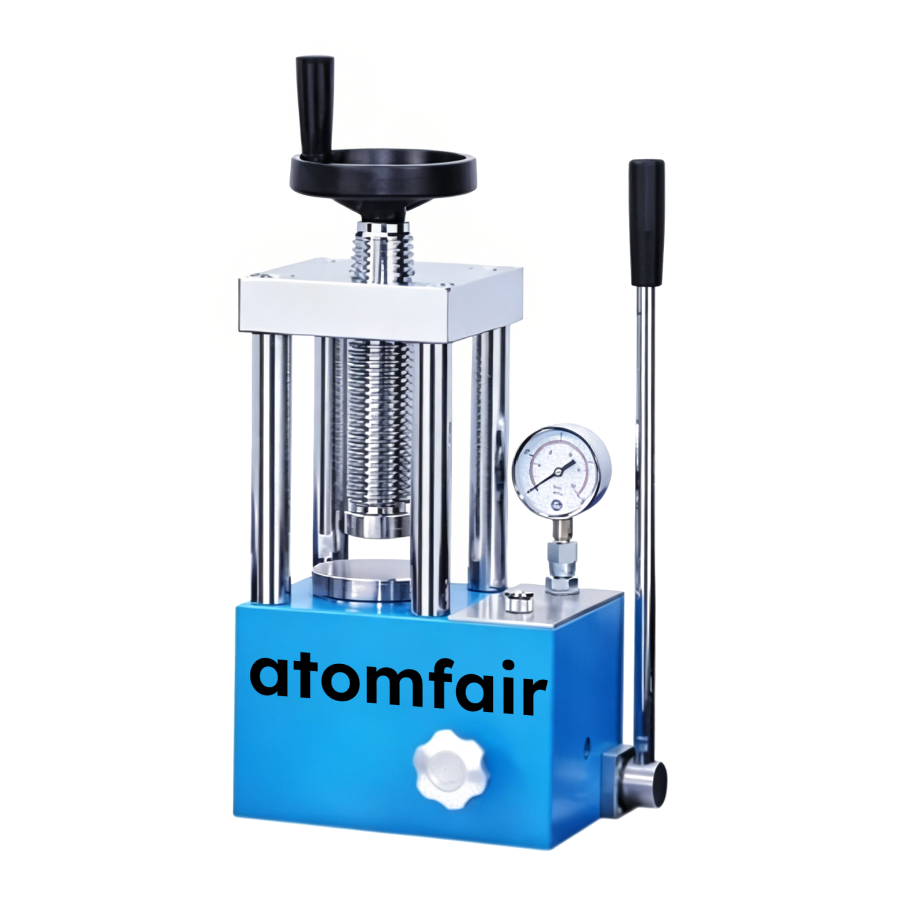
PTP-473 Manual Powder Pellet Press (0 – 40 Ton)VERSATILE HEAVY-DUTY MANUAL COMPACTION HARDWARE
|
|||||||||||||||||||||||||
|
|||||||||||||||||||||||||
|
TAILORED SOLUTIONS FOR RESEARCH
Contact our engineering team for technical support or official commercial quotations.
EMAIL: INQUIRY@ATOMFAIR.COM
|
|||||||||||||||||||||||||
|
Manufacturer: PRODUCTION DIVISION · ADVANCED ENERGY STORAGE DIVISION
Brand: INDUSTRIAL TESTING HARDWARE
Specifications are representative and subject to change without notice. For the latest version and compliance certificates, contact official sales channel.
|
The PTP-473 press must be operated on a stable, level surface and never subjected to loads exceeding 40 tons. The hydraulic system requires periodic inspection for fluid leaks and piston alignment to ensure consistent force application.
- Maximum load safety limit: Do not apply load exceeding the rated 40-ton compression capacity to prevent structural failure.
This manual press uses a hydraulic lever to apply controlled compression for forming pellets. Proper die alignment and gradual pressure application are critical to achieve uniform, crack-free pellets.
Required Equipment: Hydraulic pressure gauge
- Inspect the press and die
Inspect the hydraulic ram, die set, and work area for debris, damage, or fluid leaks before operation. - Center the die
Center the powder-filled die cavity precisely under the piston to ensure uniform load distribution. - Apply compression gradually
Pump the hydraulic lever steadily until the target tonnage is reached, monitoring the pressure gauge for consistency. - Hold pressure
Maintain the applied pressure for the required dwell time to allow particle rearrangement and compaction. - Release pressure and retract
Release the pressure slowly by opening the release valve, then raise the piston clear of the die assembly. - Extract the pellet
Remove the formed pellet from the die using the appropriate extraction tooling to avoid damage.
How does the 130 mm piston diameter affect the pressing pressure compared to smaller-diameter hydraulic presses?
The 130 mm oversized piston distributes the applied force over a larger area, which reduces the specific pressure (force per unit area) at the sample surface for a given tonnage compared to a smaller piston. This design prioritizes the ability to compact larger surface area specimens uniformly, as stated in the product description, at the expense of achieving very high pressures on small dies.
What is the maximum die size that can be used with the PTP-473 press?
The internal column clearance is 106 mm × 185 mm, which defines the maximum footprint of any die or mold assembly that can be placed between the columns. Dies larger than these dimensions will not physically fit within the press frame.
What workbench and safety precautions are required for operating the PTP-473 manual press?
The workbench must be capable of safely supporting the 80 kg net weight of the press and must be flat and balanced. Operators must never actuate the handle beyond the 40-ton maximum limit to preserve structural alignment and seal integrity, as specified in the operational compliance notice.
The PTP-473 manual pellet press offers a 40-ton capacity with a 130 mm piston for large-diameter sample compaction, but requires careful load management and a sturdy bench due to its 80 kg weight.
Positive
- Calibrated 40-Ton Manual Load: Provides serious physical force to effortlessly compress routine powders and medium-hardness industrial compounds, enabling reliable sample preparation.
- Rigid Four-Column Alignment Frame: Distributes high mechanical pressures evenly across the compression plane, ensuring uniform sample thickness and preventing matrix cracking.
Trade-offs
- Overload Risk Beyond 40-Ton Limit: Exceeding the 40-ton maximum can compromise structural integrity and seal tolerances, requiring careful operator monitoring during use.
- Heavy 80 kg Framework Requires Stable Bench: The 80 kg mass demands a robust, flat workbench to ensure safe operation and prevent instability during manual cycling.
Every advanced material, component, equipment, and instrument in our catalog is backed by rigorous testing. We maintain strict internal quality management frameworks and align with CE conformity metrics to deliver transparent, reproducible performance data via our public open-science repository.
To request raw batch performance data, submit formal vendor registration paperwork, or execute a fast-turnaround R&D manufacturing loop, contact us at inquiry@atomfair.com.
Item is dispatched under the Atomfair Shipping & Delivery Framework (Free worldwide shipping on orders over $59 USD). Return is governed by the Atomfair Return & Refund Policy (7-day technical return window).