Product Overview
|
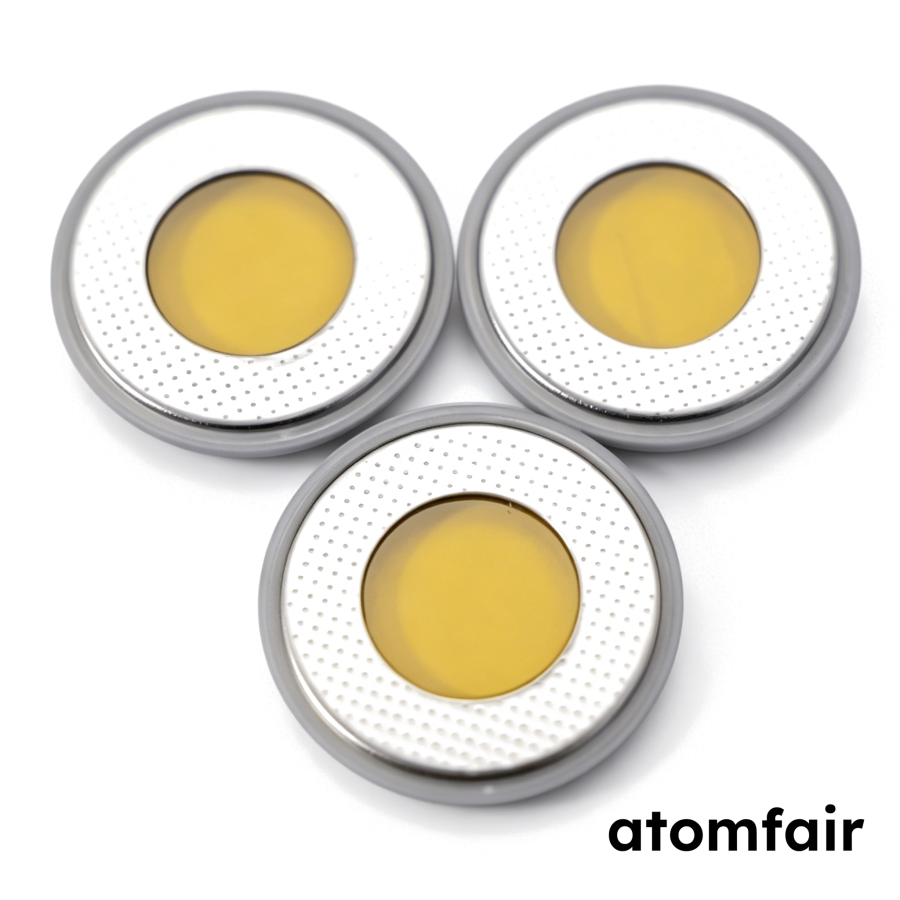
| Kapton window coin cell cases for in-situ battery characterization. Features polyimide (Kapton) film windows with thickness 25–50 μm and optical transmittance ≥85% on 316L/304 stainless steel substrates, 15.8 × 0.5 mm spacers, and 15.4 × 1.1 mm springs. Engineered with superior electrolyte corrosion resistance to enable real-time optical observation, delivering standardized hardware support for in-situ optical characterization, in-situ Raman/IR spectroscopy, and in-situ microscopy observation. If you require other sizes, models, and materials, please email inquiry@atomfair.com for customization. |
ATOMFAIR® Kapton Window Coin Cell Case Sets
|
| ITEM |
DESCRIPTION |
| Product Name |
ATOMFAIR® Kapton Window Coin Cell Case Sets |
| Model |
CR2032 |
| Window Material & Properties |
Polyimide (Kapton) Film, Thickness 25–50 μm, Optical Transmittance ≥85%, Electrolyte Corrosion Resistant |
| Case Material |
316L/304 Stainless Steel with Kapton Window |
| Included Components |
Kapton Window Positive Case + Negative Case + 15.8 × 0.5 mm Spacers + 15.4 × 1.1 mm Springs |
| Packaging Specification |
5 Sets/Pack |
| Intended Use |
In-situ optical characterization, in-situ Raman/IR spectroscopy, in-situ microscopy observation, and real-time electrochemical monitoring in academic R&D |
| Customization Options |
For other sizes, models, and materials, please email inquiry@atomfair.com to request customization. |
|
Research-Grade Core Quality Advantages
|
- Uniform High-Precision Tolerance Control: All component dimensions strictly controlled within ±0.02 mm, ensuring perfect matching across different batches and components, completely eliminating assembly gaps and uneven pressure issues caused by dimensional errors.
- Full Material Gradient Coverage: Provides a complete material selection from basic to high-end, allowing flexible selection based on corrosivity, voltage range, and testing precision requirements of your experimental system, avoiding experimental failure due to mismatched consumables.
- Rigorous Electrochemical Compatibility Verification: All materials have undergone constant potential polarization, cyclic voltammetry, and other electrochemical tests to ensure no side reactions within a -0.5 V to 5.0 V voltage range, guaranteeing no interference with battery performance test results.
- Standardized Batch Production: Fully automated production and quality control ensures highly consistent product performance within and across batches, effectively reducing experimental systematic errors.
|
|
APPLICATION SCOPE: Precision assembly and real-time monitoring for in-situ optical characterization, in-situ Raman/IR spectroscopy, in-situ microscopy observation, and advanced electrochemical research requiring optical access to active materials during cycling.
PACKAGING: 5 sets/pack. 100% dimensional inspection, window optical clarity verification, sealing performance testing, and appearance inspection before shipment, ensuring oil-free, burr-free, and impurity-free conditions. Can be used directly for battery assembly inside gloveboxes.
IMPORTANT NOTICE: This series is a one-stop assembly solution for coin cells dedicated to electrochemical research. Default accompanying accessories are made of 304 stainless steel. If other materials or special dimensions are required, please email inquiry@atomfair.com for customization.
|
| This series is a one-stop assembly solution for coin cells dedicated to electrochemical research, comprehensively covering the three mainstream models CR2032, CR2025, and CR2016. It provides a full material and specification selection of three core components—positive/negative electrode cases, conductive spacers, and elastic springs. Independent purchase of single components is supported, and pre-matched complete assembly kits are also available. Fully compatible with all cutting-edge research systems, including conventional lithium-ion batteries, sodium-ion batteries, all-solid-state batteries, lithium-air batteries, and high-voltage batteries, it provides standardized hardware support for the accuracy and reproducibility of experimental data. |
Important Note: Default accompanying accessories are made of 304 stainless steel. For accessories made of other materials, please email inquiry@atomfair.com for customization.
I. Positive/Negative Electrode Cases
|
| Type Classification |
Material / Special Structure |
Compatible Models |
Core Performance Parameters |
Optimal Application Scenarios |
| Basic Universal |
304 Stainless Steel |
CR2032/CR2025/CR2016 |
Dimensional Tolerance ±0.02 mm
Sealing Pressure ≥5 MPa
Operating Temp. -40°C to 120°C |
Conventional Li-ion/Na-ion batteries, aqueous battery basic testing, batch prototype preparation |
| Basic Universal |
316L Stainless Steel |
CR2032/CR2025/CR2016 |
Dimensional Tolerance ±0.02 mm
Sealing Pressure ≥6 MPa
Operating Temp. -40°C to 150°C |
Sulfide solid-state batteries, high-voltage batteries (>4.5 V), long-term cycling tests, highly corrosive systems |
| High-Performance Coated |
Aluminum Coated |
CR2032/CR2025/CR2016 |
Coating Thickness 5–10 μm
Adhesion ≥5B Grade
Volume Resistivity ≤3×10⁻⁸ Ω·m |
Lightweight batteries, low contact resistance precision testing, systems sensitive to metal ion contamination |
| High-Performance Coated |
Titanium Coated |
CR2032/CR2025/CR2016 |
Coating Thickness 3–8 μm
Excellent Biocompatibility
Resistant to Strong Acid/Base Corrosion |
Bio-batteries, aqueous zinc batteries, strongly acidic/alkaline electrolyte systems |
| High-Performance Coated |
Nickel Coated |
CR2032/CR2025/CR2016 |
Coating Thickness 5–12 μm
Excellent Weldability
Atmospheric Corrosion Resistant |
Battery structures requiring tab welding, pilot-scale batch production, routine electrochemical testing |
| High-Performance Coated |
Gold Coated |
CR2032/CR2025/CR2016 |
Coating Thickness 0.5–2 μm
Contact Resistance ≤1 mΩ
Superior Chemical Stability |
Ultra-precision electrochemical testing, EIS testing, micro-current testing, in-situ characterization |
| Specialized Research |
Li-Air Mesh Type |
CR2032/CR2025/CR2016 |
Pore Size 0.2–0.5 μm
Waterproof Rating IP67
Uniform Gas Distribution Design |
Lithium-air batteries, lithium-oxygen batteries, gas-involved reaction battery systems |
| Specialized Research |
Kapton Window Type |
CR2032/CR2025/CR2016 |
Window Thickness 25–50 μm
Optical Transmittance ≥85%
Electrolyte Corrosion Resistant |
In-situ optical characterization, in-situ Raman/IR spectroscopy, in-situ microscopy observation |
|
II. Conductive Spacers
|
| Default Size: Φ15.8 × 0.5 mm, compatible with the internal dimensions of all CR20 series cell cases. Other thicknesses and special sizes are customizable; please email inquiry@atomfair.com for customization. |
| Material |
Available Size (Diameter × Thickness) |
Core Performance Parameters |
Optimal Application Scenarios |
| 99.5% Industrial Pure Aluminum |
Φ15.8 × 0.5 mm (Default) |
Dimensional Tolerance ±0.02 mm
Volume Resistivity 2.7×10⁻⁸ Ω·m
No Electrochemical Side Reactions |
Precision experiments requiring high contact resistance, conventional Li-ion/Na-ion batteries |
| 304 Stainless Steel |
Φ15.8 × 0.5 mm (Default) |
Dimensional Tolerance ±0.02 mm
High Mechanical Strength
General Corrosion Resistant |
Most routine testing scenarios, aqueous batteries, low-to-medium voltage systems |
| 316L Stainless Steel |
Φ15.8 × 0.5 mm (Default) |
Dimensional Tolerance ±0.02 mm
Sulfide/Chloride Ion Corrosion Resistant
High Temperature Resistant |
Sulfide solid-state batteries, high-voltage batteries, highly corrosive systems, long-term cycling tests |
|
III. Elastic Springs
|
| Default Size: φ15.4 × 0.3 mm, compatible with the internal dimensions of all CR20 series cell cases. Other heights and special sizes are customizable; please email inquiry@atomfair.com for customization. |
| Spring Type |
Available Materials |
Available Size (Diameter × Free Height) |
Core Performance Parameters |
Optimal Application Scenarios |
| Wave Spring (Belleville) |
Al Coated / 304 SS / 316L SS / Au Coated SS |
φ15.4 × 1.1 mm (Default) |
Spring Force Range 5 N–30 N
Large Contact Area
Small Footprint
Fatigue Life ≥10,000 cycles |
Most routine testing, thin electrodes, low-loading batteries; universal preferred choice |
| Conical Spring |
Al Coated / 304 SS / 316L SS / Au Coated SS |
φ15.4 × 1.1 mm (Default) |
Spring Force Range 10 N–50 N
Good Self-Centering
Strong Anti-Buckling
Fatigue Life ≥10,000 cycles |
Thick electrodes, high-loading batteries, vibration environment testing, systems requiring precise pressure control |
|
IV. Complete Assembly Kit Specifications
|
| Kit Type |
Included Components |
Corresponding Battery Model |
Configurable Options |
| Standard Assembly Kit |
Positive Case + Negative Case + Spacer + Spring |
CR2032/CR2025/CR2016 |
All materials freely combinable
Spacer thickness customizable
Spring height customizable |
| Li-Air Dedicated Kit |
Mesh Positive Case + Negative Case + Waterproof Breathable Membrane + Spacer + Spring |
CR2032/CR2025/CR2016 |
304/316L SS material optional
Spacer thickness customizable
Spring height customizable |
| In-Situ Characterization Kit |
Kapton Window Cell Case + Gold Coated Spacer + Gold Coated Spring |
CR2032/CR2025/CR2016 |
Window thickness optional
Spacer thickness customizable
Spring height customizable |
|
International Quality Standards
|
- Stainless steel materials comply with ASTM A240 international standard.
- Pure aluminum materials comply with ASTM B209 international standard.
- All coating thicknesses are uniform, with adhesion meeting ASTM B571 standard.
- 100% dimensional inspection, sealing performance testing, and appearance inspection before shipment.
- Oil-free, burr-free, and impurity-free; ready for direct use in glovebox battery assembly.
|
|