Description
ATOMFAIR® CR1016 COIN CELL CASE 304 STAINLESS STEEL — CAT. NO. AF-CR1016-304RESEARCH GRADE MATERIAL
|
|||||||||||||||||||||||||||||
|
|||||||||||||||||||||||||||||
|
TAILORED SOLUTIONS FOR RESEARCH
Contact our engineering team for technical support or official quotations.
EMAIL: inquiry@atomfair.com
|
This housing requires careful handling to maintain sealing integrity and dimensional precision. Environmental exposure to moisture or corrosive agents can compromise the O-ring and stainless steel surface.
- Sealing Integrity: Inspect the pre-fitted O-ring for damage or debris before each use to ensure leak-proof performance.
- Material Compatibility: Avoid contact with strong acids or chloride-rich electrolytes that may accelerate corrosion of 304 stainless steel.
- Storage Conditions: Store in a dry, temperature-controlled environment (20–25°C) to prevent O-ring embrittlement and surface oxidation.
- Dimensional Tolerance: Use only with components meeting ISO 286 tolerances to avoid deformation during crimping or pressing.
This procedure describes the correct assembly of the CR1016 case with an integrated O-ring for electrochemical testing. Proper sealing prevents electrolyte leakage and ensures reproducible cell performance.
Required Equipment: CR1016 coin cell case with O-ring, Coin cell crimping press or hand crimper
- Inspect O-ring
Examine the pre-fitted O-ring for any cuts, tears, or contaminants and confirm it sits evenly in the groove. - Assemble cell components
Place the electrode stack and separator inside the bottom case, ensuring proper alignment and no short circuits. - Position top cap
Set the top cap (with O-ring) onto the assembly, aligning the edges uniformly to avoid cross-threading. - Crimp the case
Apply steady pressure using a coin cell crimping tool until the case lip is fully folded and the O-ring is compressed.
How does the corrosion resistance of bare 304 stainless steel in ATOMFAIR CR1016 coin cell cases compare to gold-plated or aluminum-coated variants for organic electrolyte testing?
Bare 304 SS provides baseline corrosion resistance per ASTM A240, but precision gold plating (ASTM B456) offers superior chemical inertness against aggressive organic electrolytes, while aluminum coating (ASTM B209) enhances cathode compatibility at the risk of galvanic interactions. The custom finish options are available but require validation against specific electrolyte chemistries, as no quantitative corrosion rates are supplied.
Are the ATOMFAIR CR1016 coin cell cases directly compatible with standard CR1016 electrode punch sets and crimping dies without requiring additional modifications?
Yes, the cases are engineered to professional dimensional boundaries with strict ISO 286 tolerance tracking, ensuring direct modular integration with standard CR1016 button battery housing configurations. The 10.0 mm diameter × 1.6 mm thickness matches industry-standard CR1016 specifications, and the high-precision machining mitigates assembly clearance errors during continuous crimps.
What storage conditions are recommended for ATOMFAIR CR1016 coin cell cases to prevent surface passivation or humidity buildup before final assembly?
The cases are hermetically shipped in high-density vacuum trays containing 100 complete hardware sets per sealed protective package to block surface passivation and humidity trace buildup. For extended storage, keep in the original vacuum-sealed packaging in a dry, ambient environment; avoid exposure to corrosive atmospheres, as the 304 stainless steel and pre-fitted O-ring maintain integrity under standard lab conditions.
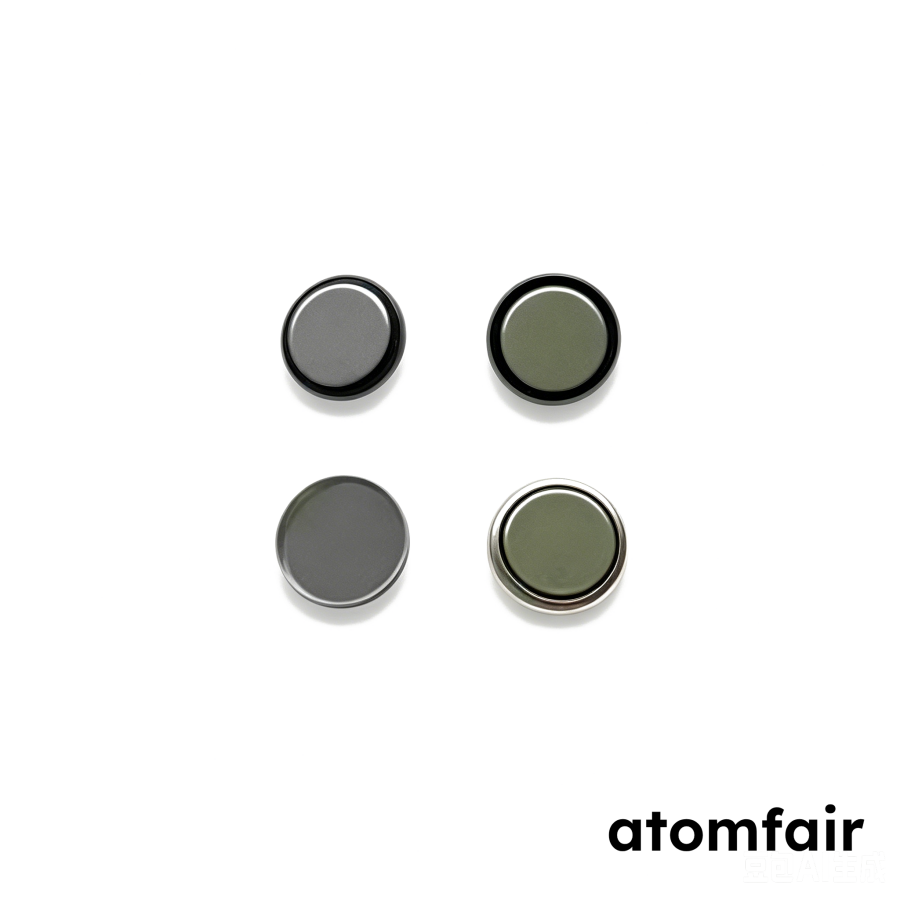
The CR1016 coin cell case provides a high-precision 304 stainless steel housing with a pre-fitted elastomeric O-ring for leak-proof sealing, ideal for micro-sensor and low-power battery testing. Its 10×1.6 mm compact dimensions restrict electrode capacity, and the standard steel may require additional coatings for aggressive electrolyte environments.
Positive
- Leak-Proof Sealing with O-Ring: The pre-integrated elastomeric O-ring restricts electrolyte evaporation and blocks atmospheric ingress, maintaining cell health over long cycling lifetimes.
- High-Precision Dimensional Consistency: Strict ISO 286 tolerance tracking mitigates assembly clearance errors and interface contact instability during continuous crimping operations.
Trade-offs
- Standard 304 Steel May Need Coating: For aggressive electrolytes, the base 304 stainless steel may require custom gold plating or aluminum coating to prevent corrosion, as offered in finish options.
- Small Form Factor Limits Electrode Capacity: The 10×1.6 mm size restricts electrode material loading and energy capacity, making it suitable only for micro-sensor and low-power applications.
Every advanced material, component, equipment, and instrument in our catalog is backed by rigorous testing. We maintain strict internal quality management frameworks and align with CE conformity metrics to deliver transparent, reproducible performance data via our public open-science repository.
To request raw batch performance data, submit formal vendor registration paperwork, or execute a fast-turnaround R&D manufacturing loop, contact us at inquiry@atomfair.com.
Item is dispatched under the Atomfair Shipping & Delivery Framework (Free worldwide shipping on orders over $59 USD). Return is governed by the Atomfair Return & Refund Policy (7-day technical return window).