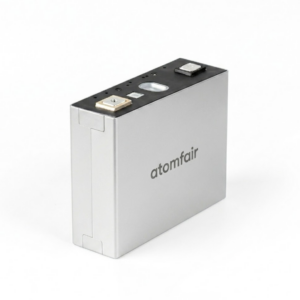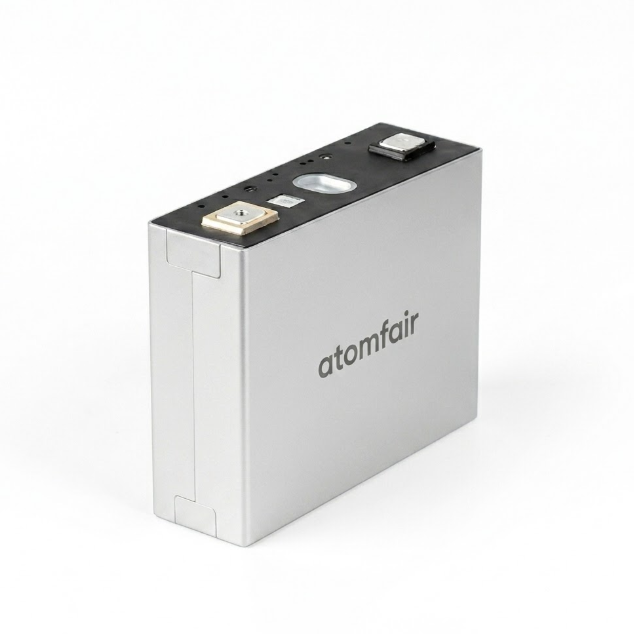
Description
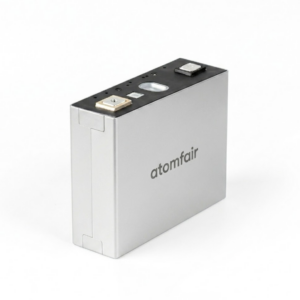
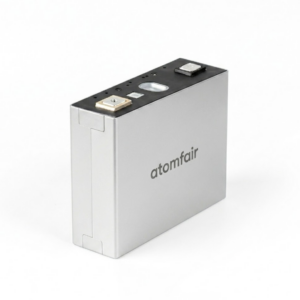
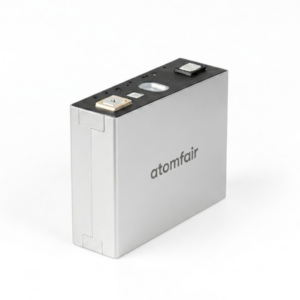
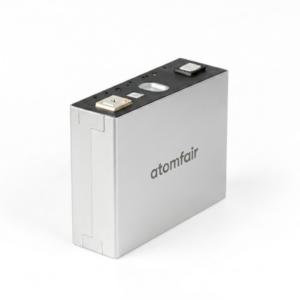
3.20V 392Ah LFP Prismatic Cell | ATOMFAIRCOMMERCIAL GRADE · PRODUCTION
|
|||||||||||||||||||||||||
|
|||||||||||||||||||||||||
|
TAILORED SOLUTIONS FOR RESEARCH
Contact our engineering team for technical support or official institutional quotations.
EMAIL: INQUIRY@ATOMFAIR.COM
|
|||||||||||||||||||||||||
|
MANUFACTURER: ATOMFAIR LLC
BRAND: ATOMFAIR®
|
This large-format LFP prismatic cell requires careful environmental and electrical control to ensure safety and longevity. Improper handling may lead to thermal runaway or permanent capacity loss.
- Storage Environment: Store the cell at a stable ambient temperature near 25°C to minimize degradation over time.
- Electrical Safety: Prevent short circuits by keeping terminals insulated with non-conductive caps during storage.
- Charge Rate Limitation: Do not exceed the specified 0.5C continuous charge rate to avoid overheating.
- Mechanical Integrity: Avoid dropping or puncturing the aluminum case to prevent internal damage.
- Discharge Cutoff: Stop discharge before the cell voltage falls below the safe cutoff limit to prevent irreversible capacity loss.
This procedure outlines the initial handling and electrical connection of the ultra-capacity LFP cell for ESS integration. Follow each step sequentially to prevent damage and ensure safe operation.
Required Equipment: Insulated gloves, Digital multimeter
- Visual Inspection
Inspect the cell casing for any mechanical damage or swelling before handling. - Voltage Measurement
Measure the open-circuit voltage using a digital multimeter to confirm the cell is within its resting voltage range. - Terminal Cleaning
Clean the terminal surfaces with a dry lint-free cloth to ensure low-resistance electrical contact. - Busbar Attachment
Attach the busbar to the positive terminal first, then the negative terminal, using the provided fasteners. - Torque Application
Torque the busbar bolts to the value specified in the cell datasheet to maintain optimal contact pressure. - Insulation Verification
Verify the insulation between adjacent terminals and the cell casing using a multimeter set to resistance mode. - Record Initial Data
Record the initial voltage and torque values for future maintenance reference.
What is the cycle life trade-off if I operate this 392Ah LFP cell above 0.5C continuous discharge?
The cell is optimized for 0.5C continuous discharge and charging, delivering ≥8000 cycles at 0.5C/0.5C, 100% DOD with 70% retention. Exceeding the 0.5C rate will accelerate capacity fade and reduce cycle life below the warranted 8000-cycle threshold because the chemistry and mechanical design are not specified for high-rate duty.
Can this 3.2V 392Ah LFP prismatic cell be directly integrated into an existing 48V rack-mounted ESS designed for cylindrical cells?
No, direct integration into a rack designed for cylindrical cells is not feasible due to the cell's prismatic format—75.0 × 182.0 × 224.5 mm including terminal—and its 7.0 kg weight. The cell requires a BMS rated for 392Ah capacity and 0.5C continuous current, and its mechanical footprint differs entirely from cylindrical cell holders.
What are the mandatory storage and handling requirements for these 392Ah LFP cells before commissioning?
Cells must be stored in humidity-controlled vacuum sealed packaging with individual cell isolation in anti-static foam lined cartons to prevent moisture ingress and physical damage. Prior to first use, each cell should be conditioned under standard ambient conditions, and a dedicated BMS with over-discharge and short-circuit protection must always be employed during commissioning.
The 3.20V 392Ah LFP prismatic cell delivers ultra-high capacity (392Ah) and energy density (184Wh/kg) for stationary ESS, with ≥8000 cycles at 100% DOD and intrinsic LFP safety, but its 0.5C maximum charge/discharge rate restricts it to low-power applications, and it mandates a dedicated BMS plus strict voltage/temperature control for safe operation.
Positive
- Ultra-High Capacity and Energy Density: Nominal 392Ah capacity and 184Wh/kg energy density reduce total cell count and system footprint, enabling more compact ESS designs and lower balance-of-system costs.
- Exceptional Cycle Life and Intrinsic Safety: Rated for ≥8000 cycles at 0.5C/0.5C, 100% DOD with 70% retention, combined with LFP chemistry's thermal stability, offers reliable long-term operation and minimized thermal runaway risk in stationary storage.
Trade-offs
- Limited 0.5C Charge/Discharge Rate: Max continuous charge and discharge are both constrained to 0.5C (196A), making the cell unsuitable for high-power or fast-charging applications beyond typical ESS duty cycles.
- Requires Dedicated BMS and Controlled Environment: Operation demands a dedicated BMS with protection functions, strict adherence to recommended voltage and temperature ranges, and avoidance of mechanical abuse, over-discharge, or short circuits to maintain performance and safety.
Every advanced material, component, equipment, and instrument in our catalog is backed by rigorous testing. We maintain strict internal quality management frameworks and align with CE conformity metrics to deliver transparent, reproducible performance data via our public open-science repository.
To request raw batch performance data, submit formal vendor registration paperwork, or execute a fast-turnaround R&D manufacturing loop, contact us at inquiry@atomfair.com.
Item is dispatched under the Atomfair Shipping & Delivery Framework (Free worldwide shipping on orders over $59 USD). Return is governed by the Atomfair Return & Refund Policy (7-day technical return window).