Description
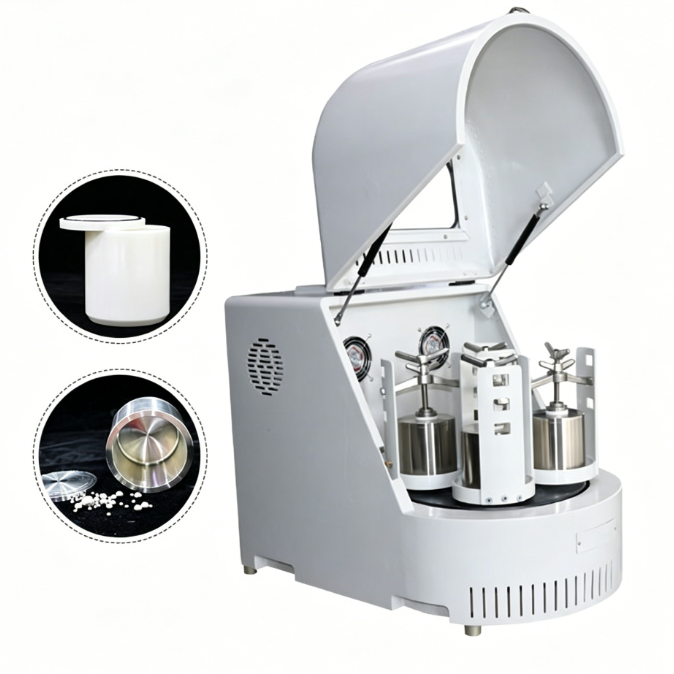
PBM-(8-12)A VERTICAL SEMI-CIRCULAR PLANETARY BALL MILL 1.5KWLABORATORY GRADE EQUIPMENT
|
||||||||||||||||||||||||||||||||||||||||||||||||||||||||||||||||||||||||||||||||||||||||||||||||||||||||||||||||||||||||||||||||||||||||||||||||
|
||||||||||||||||||||||||||||||||||||||||||||||||||||||||||||||||||||||||||||||||||||||||||||||||||||||||||||||||||||||||||||||||||||||||||||||||
|
TAILORED SOLUTIONS FOR RESEARCH
Contact our engineering team for technical support or official quotations.
EMAIL: inquiry@atomfair.com
|
||||||||||||||||||||||||||||||||||||||||||||||||||||||||||||||||||||||||||||||||||||||||||||||||||||||||||||||||||||||||||||||||||||||||||||||||
|
Manufacturer: Atomfair LLC
Brand: ATOMFAIR®
|
The equipment requires vacuum-compatible ball milling jars for grinding under reduced pressure to prevent sample contamination. Safety devices must be verified operational prior to each use to mitigate risks from high-speed planetary motion and electrical hazards.
- Vacuum Jar Seal: Vacuum ball milling jars must be adequately sealed to maintain vacuum conditions during the grinding process.
- Grinding Ball Integrity: Grinding balls and jar linings must be selected to withstand the high-energy impacts without fracturing or contaminating the sample.
- Load Balance: Jars must be evenly loaded and symmetrically mounted on the planetary disk to prevent imbalance and excessive vibration.
This procedure describes the safe initialization and operation of the planetary ball mill for ultrafine grinding. The steps cover jar preparation, sealing, mounting, and the grinding cycle.
Required Equipment: Planetary ball mill unit with motor drive, Semicircular ball milling jars with lids, Grinding balls of appropriate material and size
- Load jars
Load the sample material and grinding balls into each ball milling jar, filling to no more than two-thirds of the jar volume. - Seal jars
Seal the jar lids tightly, and if vacuum grinding is required, connect the vacuum valve and evacuate the jar to the desired vacuum level. - Mount jars on planetary disk
Mount the sealed jars onto the planetary disk in diametrically opposite positions to ensure balanced rotation. - Activate motor
Start the motor drive to initiate planetary motion (revolution plus rotation) and allow the grinding cycle to proceed for the desired duration. - Stop and cool
After the set time, stop the motor and allow the mill to come to a complete halt before opening the lid to retrieve the ground sample.
When selecting jar materials for the Atomfair XQM-(8-12)A, how does the choice between stainless steel and ceramic jars affect grinding efficiency and sample contamination risk?
Stainless steel jars provide high impact energy for hard materials but risk iron contamination, whereas ceramic jars minimize metal contamination for high-purity applications such as electronic ceramics or battery materials. The mill supports jar materials including stainless steel, ceramics, and polyurethane, allowing users to tailor the trade-off between grinding efficiency and contamination based on the desired final particle size down to 0.1 micron.
Can the Atomfair XQM-(8-12)A be used for vacuum-assisted grinding of air-sensitive battery materials, and what infrastructure is required?
Yes, when equipped with optional vacuum ball milling jars, the mill can grind samples in a vacuum state, making it suitable for air-sensitive battery precursors and other reactive materials. The four-jar configuration allows simultaneous processing of up to four samples under vacuum, and no additional infrastructure beyond the vacuum jar accessory is required because the integrated variable frequency speed regulation and safety features support sealed operation.
What safety precautions are integrated into the Atomfair XQM-(8-12)A to prevent accidents during high-energy milling of potentially combustible powders?
The mill includes an emergency stop function, motor overload protection, and safety switches as standard, all complying with noise control standards. These protections allow immediate shutdown and prevent motor burnout when processing reactive or combustible powders, and the stable transmission from precision gears and low-noise design further enhance safe laboratory operation.
The Atomfair XQM-(8-12)A semi-circular planetary ball mill delivers high-efficiency ultrafine grinding via planetary motion, achieving particle sizes down to 0.1 micron. However, its design prioritizes small-batch precision work and requires optional vacuum jars for inert atmosphere processing, which limits throughput and adds procurement considerations.
Positive
- High energy density planetary grinding: The composite revolution and rotation motion provides significantly higher energy density than traditional mills, enabling efficient ultrafine grinding.
- Uniform particle size control: Three-dimensional motion ensures thorough mixing and narrow particle size distribution down to 0.1 micron, critical for advanced materials research.
Trade-offs
- Small batch capacity limitation: Designed for small-batch, high-precision experiments; not intended for continuous production-scale milling due to limited throughput.
- Vacuum grinding requires optional jars: While the mill can grind in vacuum, it requires purchasing optional vacuum ball milling jars, adding cost and lead time for users needing inert atmosphere processing.
Every advanced material, component, equipment, and instrument in our catalog is backed by rigorous testing. We maintain strict internal quality management frameworks and align with CE conformity metrics to deliver transparent, reproducible performance data via our public open-science repository.
To request raw batch performance data, submit formal vendor registration paperwork, or execute a fast-turnaround R&D manufacturing loop, contact us at inquiry@atomfair.com.
Item is dispatched under the Atomfair Shipping & Delivery Framework (Free worldwide shipping on orders over $59 USD). Return is governed by the Atomfair Return & Refund Policy (7-day technical return window).