YSZ Zirconia Grinding Balls 5mm 1kg Mohs 8.5 Density 6.0 Nano Grinding

$119.00

Institutional Procurement & Supply Compliance: As a verified US supplier, Atomfair accepts formal institutional Purchase Orders (POs), contract billing schedules, and custom procurement loops for university and national laboratories, and corporate R&D departments globally.

YSZ yttria-stabilized zirconia grinding balls, 5mm, 1kg. ZrO₂ ≥ 94.8%, Mohs 8.5, density 6.0 g/cm³. Phase transformation toughened, 10⁻⁷ g/h wear rate. Nano grinding, Li-ion battery, MLCC, pharmaceutical. Φ0.1-30mm. Research grade.

Description

YSZ ZIRCONIA GRINDING BALLS 5MM 1KG MOHS 8.5 DENSITY 6.0 NANO GRINDING

RESEARCH GRADE MATERIAL

Product Overview

ATOMFAIR® Yttria-Stabilized Zirconia Grinding Balls (YSZ, Y-TZP zirconia beads) are manufactured from high-purity zirconium dioxide (ZrO₂ ≥ 94.8%) stabilized with yttrium oxide (Y₂O₃ ≈ 5.2%) via isostatic pressing followed by high-temperature densification sintering above 1400°C and mirror finishing. With YSZ 94.8% ZrO₂ Mohs 8.5 density 6.0 g/cm³ specifications—1.6× the density of alumina and 2.2× that of agate—these grinding balls deliver exceptional impact and shear forces at equivalent rotation speeds. Purpose-built for nano-scale ultrafine grinding high purity applications, the unique phase transformation toughened 10⁻⁷ g/h wear rate mechanism—based on tetragonal-to-monoclinic phase transformation—prevents edge chipping, spalling, and delamination even under high-speed planetary milling and large ball-to-powder ratio conditions. The wear rate of approximately 10⁻⁷ g/h is merely one-third that of alumina balls, with only trace zirconium release and absolutely no iron, aluminum, nickel, or cobalt metal contamination—making YSZ the preferred grinding medium for lithium battery materials, electronic ceramics, and pharmaceutical products with stringent impurity control requirements. This listing is priced for 5 mm diameter, 1 kg net weight. Standard sizes from Φ0.1 mm to Φ30 mm are available; custom sizes upon request at inquiry@atomfair.com.

Technical Specifications

PARAMETER DETAILS
Material High-Purity Zirconium Dioxide (ZrO₂ ≥ 94.8%) + Yttrium Oxide (Y₂O₃ ≈ 5.2%) Stabilizer
Ceramic Type Tetragonal Phase Transformation Toughened Ceramic (Y-TZP)
Manufacturing Process Isostatic Pressing + 1400°C High-Temperature Densification Sintering + Mirror Polishing
Listing Specification Φ5 mm Diameter, 1 kg Net Weight
Custom Diameter Range Φ0.1 mm–Φ30 mm (Ultra-Fine Microbeads Customizable)
Density 6.0 g/cm³ (1.6× Alumina, 2.2× Agate)
Hardness Mohs 8.5, Vickers HV ≥ 1250, HRA ≈ 87 (Second Only to WC Carbide and Corundum)
Fracture Toughness ≥ 8 MPa·m¹ᐟ² (Unique Phase Transformation Toughening, Impact-Resistant, Non-Cracking)
Sphericity > 0.97; Mirror Surface, Zero Pitting and Porosity, Non-Stick
Wear Rate ≈ 10⁻⁷ g/h (ppm-Level Ultra-Low Loss; 1/3 of Alumina, 1/2 of Zirconium Silicate)
Maximum Operating Temperature 600°C (Strength and Hardness Maintained from Ambient to 600°C)
Chemical Resistance Resistant to Most Strong Acids, Strong Alkalis, and Organic Solvents (Only HF Causes Slow Long-Term Corrosion)
Impurity Release Trace Zr Only; Absolutely No Fe, Al, Cr Metal Contamination
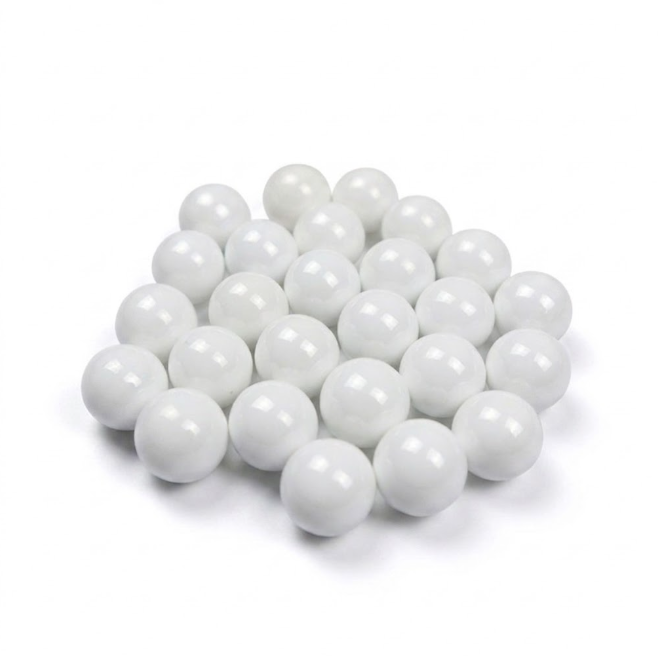
Appearance Milky White Smooth Spheres with Pearl Luster (Slight Batch Color Variation Does Not Affect Performance)
Custom Configurations Custom diameters (Φ0.1 mm–Φ30 mm) and batch quantities are available upon request. Please contact us via email at inquiry@atomfair.com.

Key Features & Advantages

  • High Density (6.0 g/cm³) for Superior Nano-Scale Grinding Efficiency: Density far exceeding agate, alumina, and PU media delivers stronger impact and shear forces at equivalent rotation speeds, enabling micron-to-nanometer particle refinement with significantly reduced grinding time.
  • Phase Transformation Toughened—Ultra-High Toughness Prevents Fracture: The unique tetragonal-to-monoclinic phase transformation mechanism absorbs impact stress, preventing edge chipping, spalling, and delamination even under high-speed planetary milling and large ball-to-powder ratios. Continuous production replacement cycles exceed alumina balls by 2×, delivering lower long-term consumable costs.
  • Ultra-Low Contamination—Preferred for High-Purity Powders: Free from Fe, Al, Ni, and Co metal impurities; releases only trace zirconium. Perfectly suited for lithium battery materials, electronic ceramics, and pharmaceuticals with stringent impurity control requirements.
  • Dense Mirror Surface with Non-Stick Easy-Cleaning Properties: Pore-free mirror-polished surface resists adhesion of viscous slurries and pigments, eliminates cross-contamination between samples, and dramatically reduces cleaning workload—ideal for multi-material research environments.

APPLICATION SCOPE: New energy lithium battery (primary application): NCM ternary materials, LFP lithium iron phosphate, silicon-carbon anode materials, and conductive agent ultrafine grinding and dispersion—eliminates iron and aluminum impurity interference with electrochemical performance. Electronic ceramics: MLCC dielectric powders, piezoelectric ceramics, magnetic powders, and high-purity electronic raw materials—ensures uniform particle size with zero metal contamination. Pharmaceutical, food, and cosmetics: medicinal powders, functional foods, and nano-scale cosmetic colorants—meets hygiene and high-purity requirements. High-end inks, coatings, and pigments: nano-color pastes and industrial dyes—preserves color purity without foreign impurity influence on hue. General medium-to-high hardness minerals: quartz, feldspar, refractory materials, and rare-earth oxides—balances grinding efficiency with low contamination. Research laboratory general use: most powder ultrafine grinding and mechanical alloying pretreatment—combines purity with grinding capability. Compatible with planetary ball mills, stirred sand mills, vibratory mills, roller ball mills, and nano-grinding equipment for both dry and wet operation.
OPTIMAL JAR PAIRING: Best paired with zirconia ball mill jars for homogeneous material matching that prevents excessive jar wear. Follow the principle: zirconia jars with zirconia balls for optimal performance and longest service life.
IMPORTANT NOTICE: Prohibit prolonged use in lower-hardness jars: do not use zirconia balls long-term in agate, nylon, PTFE, or PU jars—high-hardness zirconia balls will scratch and wear soft jar bodies, introducing jar debris contamination into samples. Follow the optimal zirconia jar + zirconia ball configuration. Avoid rapid thermal shock: direct water cooling of high-temperature jars after grinding or rapid heating during frozen grinding will cause invisible internal cracking in balls, leading to progressive fracture. Hydrofluoric acid caution: prolonged immersion in high-concentration HF will slowly corrode zirconia crystal structure, generating zirconium impurities. Ultra-hard material limitation: for materials exceeding Mohs 9 (silicon carbide, diamond, etc.), prolonged grinding will accelerate zirconia ball wear—prefer WC cemented carbide balls for ultra-hard powders. Replace damaged balls immediately: discard balls showing chipping or large amounts of white debris to prevent excess zirconium impurity contamination. Not suitable for trace metal element detection experiments: for geological and heavy metal analysis applications, agate balls are preferred as zirconium release may interfere with trace element detection data. For custom sizes and specifications, contact us at inquiry@atomfair.com.
TAILORED SOLUTIONS FOR RESEARCH
Contact our engineering team for technical support or official quotations.
EMAIL: inquiry@atomfair.com
Manufacturer: Atomfair LLC
Brand: ATOMFAIR®

The yttria-stabilized zirconia grinding balls impose specific operational constraints including a maximum temperature of 600°C and chemical inertness to prevent metal contamination. Proper mill type selection and loading conditions are required to achieve the specified wear resistance and avoid degradation.

  • Temperature Stability Constraint: The grinding media maintain structural integrity up to 600°C and must not be exposed to temperatures exceeding this threshold.
  • Chemical Inertness Constraint: The media are chemically passive and do not introduce metal ions, making them suitable for high-purity milling applications.
  • Wear Resistance Constraint: The media exhibit ultra-low wear rates under standard milling conditions, but excessive loading or improper mill speed may accelerate wear.
  • Electrical and Magnetic Properties: The media are non-magnetic and electrically insulating, preventing interference with sensitive electronic or magnetic separation processes.
  • Milling Equipment Compatibility: The media are optimized for use in high-energy planetary mills, attrition mills, and horizontal sand mills.

How does the specific gravity of yttria-stabilized zirconia grinding balls compare to basic zirconium silicate media, and what performance advantage does this provide?

Yttria-stabilized zirconia TZP grinding balls achieve a specific gravity 1.6 times that of basic zirconium silicate media, as stated in the product specifications. This higher density enables significantly faster particle size reduction and improved kinetic grinding efficiency under uniform mill operating parameters, directly reducing processing time and energy consumption.

What container material should be used with these grinding balls to prevent metal contamination during milling?

High-purity ceramic container hulls such as corundum (alumina) or zirconia jars are recommended to fully eliminate metal-ion pickup during milling. The product is engineered for extreme chemical passivity and metal-free processing, but pairing it with compatible ceramic jars ensures that no metallic contamination is introduced from the container walls.

What is the maximum operating temperature at which yttria-stabilized zirconia grinding balls maintain their structural hardness and mechanical integrity?

Yttria-stabilized TZP grinding balls maintain structural hardness and mechanical profile integrity up to 600°C. This high-temperature tolerance is enabled by the tetragonal zirconia polycrystal (TZP) matrix and yttria stabilization, which prevent phase transformation and loss of mechanical properties even under extreme thermal loads.

This yttria-stabilized TZP zirconia grinding media offers a high-density (≥6.0 g/cm³), ultra-low-wear milling substrate with a Mohs hardness of 8.5 and Vickers hardness ≥1250 HV, designed to suppress metal-ion contamination in high-purity milling applications up to 600°C. Its superior fracture toughness and chemical passivity make it suitable for lithium-ion battery compounds, electronic ceramics, and pharmaceutical micronization, though it requires compatible ceramic container hulls and careful mill loading to achieve optimal performance.

Positive

  • Ultra-low contamination milling: The yttria-stabilized TZP matrix completely suppresses metal ion introduction, maintaining structural hardness and chemical passivity even at extreme temperatures up to 600°C, ensuring high-purity material processing.
  • High kinetic grinding efficiency: With a specific gravity 1.6 times that of basic zirconium silicate media and a Mohs hardness of 8.5, these microspheres achieve rapid particle size reduction under uniform run parameters, reducing operational costs through superior wear resistance.

Trade-offs

  • Requires compatible ceramic container hulls: To fully eliminate metal-ion pickup profiles, this media must be paired with high-purity ceramic container hulls such as corundum or zirconia jars, adding infrastructure requirements for optimal performance.
  • Default size and weight constraints: Orders are fulfilled with a standard specification of Φ 12 mm diameter and 1 kg unit weight by default; alternative sizes or custom configurations require contacting support, which may delay procurement for specialized workflows.

Every advanced material, component, equipment, and instrument in our catalog is backed by rigorous testing. We maintain strict internal quality management frameworks and align with CE conformity metrics to deliver transparent, reproducible performance data via our public open-science repository.

To request raw batch performance data, submit formal vendor registration paperwork, or execute a fast-turnaround R&D manufacturing loop, contact us at inquiry@atomfair.com.

Item is dispatched under the Atomfair Shipping & Delivery Framework (Free worldwide shipping on orders over $59 USD). Return is governed by the Atomfair Return & Refund Policy (7-day technical return window).