Description
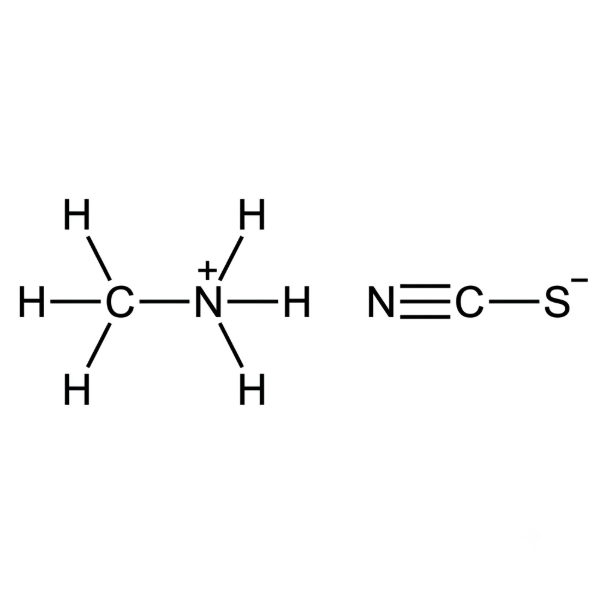
METHYLAMMONIUM THIOCYANATE C₂H₆N₂S 99% MASCN CAS 61540-63-4RESEARCH GRADE MATERIAL
|
|||||||||||||||||||||||||||
|
|||||||||||||||||||||||||||
|
TAILORED SOLUTIONS FOR RESEARCH
Contact our engineering team for technical support or official quotations.
EMAIL: inquiry@atomfair.com
|
|||||||||||||||||||||||||||
|
Manufacturer: Atomfair LLC
Brand: ATOMFAIR®
|
This document outlines the critical environmental and processing constraints for methylammonium thiocyanate (MASCN). The material requires strict protection from light, moisture, and oxygen to prevent deliquescence and hydrolysis that degrade precursor stoichiometry.
- Inert Atmosphere Glovebox Requirement: Handle the powder within an inert-atmosphere glovebox with H2O < 1 ppm and O2 < 1 ppm to avoid moisture and oxygen exposure.
- Light-Sensitive Storage: Store the material in light-protective packaging and a dark environment to prevent photodegradation.
- Moisture Prevention: Tighten the container cap immediately after each use and transfer to a desiccated storage environment to prevent moisture ingress.
- Incompatible Substances: Do not store the compound together with strong oxidizing agents or acidic reagents to avoid hazardous reactions.
- Solvent Compatibility: The compound is freely soluble in water, ethanol, liquid ammonia, acetone, pyridine, and liquid sulfur dioxide for precursor solution formulation.
This procedure describes the safe handling and storage of methylammonium thiocyanate for perovskite precursor preparation. Proper glovebox usage and moisture control are essential to maintain material integrity.
Required Equipment: Inert-Atmosphere Glovebox, Light-Protective Storage Container, Desiccator, Protective Gloves
- Transfer to Glovebox
Transfer the sealed container to an inert-atmosphere glovebox before opening to prevent moisture exposure. - Weigh Material
Weigh the required amount of powder inside the glovebox using a clean spatula and container. - Reseal Container
Tighten the container cap securely immediately after use to prevent moisture ingress from ambient air. - Store Material
Store the material in a light-protected, desiccated environment at room temperature, away from oxidizing agents and acids.
How does the crystallization retardation effect of MASCN impact the processing time for perovskite thin films?
The thiocyanate anion in MASCN retards perovskite crystallization to promote controlled nucleation and growth, which can increase processing time compared to conventional films. However, this trade-off yields larger grain sizes, reduced grain boundary density, and fewer internal defects, ultimately enhancing charge carrier mobility and power conversion efficiency.
What deposition techniques are compatible with MASCN as a perovskite crystallization additive?
MASCN is compatible with both one-step and two-step deposition protocols for perovskite thin films. It is specifically designed for spin-coating and precursor solution blending preparation techniques, making it suitable for standard laboratory fabrication of photovoltaic devices and photodetectors.
What are the critical storage conditions required to maintain methylammonium thiocyanate integrity?
Methylammonium thiocyanate must be stored in a light-protected, dry, sealed container at room temperature to prevent photodegradation and moisture ingress. It is hygroscopic and light-sensitive; exposure to atmospheric moisture causes deliquescence and hydrolysis, irreversibly degrading precursor stoichiometry. Handling should be performed in an inert-atmosphere glovebox with H2O < 1 ppm and O2 < 1 ppm.
This 99% purity Methylammonium Thiocyanate (MASCN) additive modulates perovskite crystallization kinetics to promote larger grain sizes and reduce internal film defects, enhancing charge carrier mobility and power conversion efficiency in solar cells. However, its extreme hygroscopicity and light sensitivity demand storage under inert, dry, light-protected conditions and glovebox handling during solution preparation.
Positive
- Crystallization kinetics modulation: The thiocyanate anion retards perovskite crystallization, promoting controlled nucleation and growth that yields larger grain sizes, reduced grain boundary density, and fewer internal film defects compared to conventional processing.
- Enhanced carrier mobility and efficiency: By reducing internal defects and optimizing grain morphology, MASCN additive treatment directly improves charge carrier mobility and suppresses non-radiative recombination, contributing to higher power conversion efficiency in perovskite photovoltaic devices.
Trade-offs
- Hygroscopic and light-sensitive stability: The compound is hygroscopic and light-sensitive; exposure to atmospheric moisture causes deliquescence and hydrolysis, irreversibly degrading precursor stoichiometry. Storage must be light-protected, dry, and sealed at room temperature, with immediate transfer to a desiccated environment upon receipt.
- Requires inert-atmosphere glovebox handling: During precursor solution preparation, the white powder must be handled within an inert-atmosphere glovebox (H₂O < 1 ppm, O₂ < 1 ppm) to prevent moisture ingress. The container must be tightened immediately after each use to maintain material integrity.
Every advanced material, component, equipment, and instrument in our catalog is backed by rigorous testing. We maintain strict internal quality management frameworks and align with CE conformity metrics to deliver transparent, reproducible performance data via our public open-science repository.
To request raw batch performance data, submit formal vendor registration paperwork, or execute a fast-turnaround R&D manufacturing loop, contact us at inquiry@atomfair.com.
Item is dispatched under the Atomfair Shipping & Delivery Framework (Free worldwide shipping on orders over $59 USD). Return is governed by the Atomfair Return & Refund Policy (7-day technical return window).