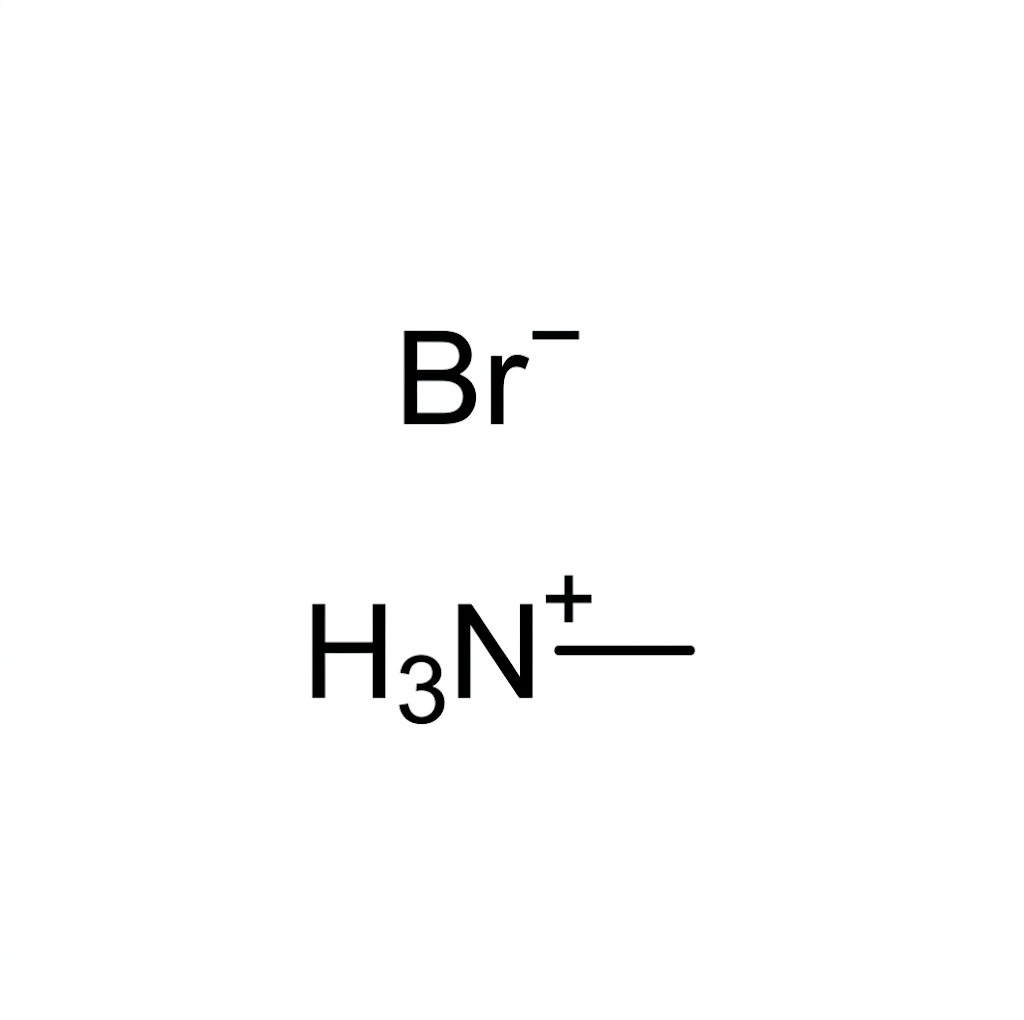
METHYLAMMONIUM BROMIDE CH₃NH₃BR 99% CAS 6876-37-5RESEARCH GRADE MATERIAL
|
|||||||||||||||||||||||||
|
|||||||||||||||||||||||||
|
TAILORED SOLUTIONS FOR RESEARCH
Contact our engineering team for technical support or official quotations.
EMAIL: inquiry@atomfair.com
|
|||||||||||||||||||||||||
|
Manufacturer: Atomfair LLC
Brand: ATOMFAIR®
|
Methylammonium bromide must be stored under inert atmosphere, protected from light, and sealed at room temperature to prevent moisture-induced deliquescence and hydrolysis. Exposure to atmospheric moisture or light irreversibly degrades precursor stoichiometry, compromising perovskite device reproducibility.
- Inert Atmosphere Storage: Store the material in a desiccator or nitrogen-filled glovebox with H₂O below 1 ppm and O₂ below 1 ppm to maintain structural integrity.
- Light Protection: Protect the white crystalline solid from ambient light at all times to prevent photodegradation.
- Moisture Sensitivity: Atmospheric moisture causes deliquescence and hydrolysis, irreversibly altering the stoichiometric ratio for perovskite precursor solutions.
- Oxidizer Avoidance: Avoid exposure to strong oxidizing agents, as they may induce hazardous reactions.
Proper handling of this hygroscopic salt requires exclusive use within an inert-atmosphere glovebox and immediate dissolution in anhydrous solvent. These steps ensure stoichiometric accuracy and prevent degradation for perovskite solar cell fabrication.
Required Equipment: Inert-atmosphere glovebox (H₂O < 1 ppm, O₂ < 1 ppm), Desiccator or nitrogen-filled storage container, Light-protective packaging
- Transfer to Glovebox
Transfer the sealed container of methylammonium bromide into an inert-atmosphere glovebox with H₂O and O₂ levels below 1 ppm. - Weigh Required Amount
Weigh the desired quantity of white crystalline solid using a precision balance inside the glovebox. - Dissolve in Anhydrous Solvent
Dissolve the weighed solid in anhydrous solvent immediately to prevent moisture absorption. - Use Immediately
Use the precursor solution promptly after dissolution to maintain stoichiometric integrity for perovskite film deposition.
How does the >99% purity of methylammonium bromide affect stoichiometric control in mixed-halide perovskite formulations?
The >99% purity minimizes extrinsic ionic impurities in perovskite thin films, enabling reproducible device performance. With a defined molecular weight of 111.97 g/mol, the precursor allows accurate tuning of bromide-iodide ratios in mixed-halide formulations, which is critical for bandgap engineering in perovskite solar cells.
Can methylammonium bromide be used in two-step sequential deposition protocols for perovskite thin films?
Yes, it is utilized in two-step sequential deposition protocols where the precursor solution is spin-coated onto pre-deposited films for in-situ perovskite conversion. It also functions as the organic cation component in two-dimensional perovskite phases when combined with longer-chain alkylammonium spacer cations.
What are the required storage and handling conditions for methylammonium bromide to prevent degradation?
Store in a desiccator or nitrogen-filled glovebox protected from ambient light at room temperature. The material is hygroscopic and light-sensitive; exposure to moisture causes deliquescence and hydrolysis, irreversibly degrading precursor stoichiometry. Handle exclusively within an inert-atmosphere glovebox (H₂O < 1 ppm, O₂ < 1 ppm) and dissolve in anhydrous solvent immediately prior to use.
Methylammonium Bromide (CH₃NH₃Br, 99% purity) is a research-grade organohalide salt optimized as a bromide source for MAPbBr₃ and mixed-halide perovskite formulations. Its high purity and defined molecular weight enable reproducible stoichiometric tuning, but the material's hygroscopic and light-sensitive nature mandates strict inert-atmosphere handling and light-protected dry storage to prevent degradation.
Positive
- High purity >99% for reproducibility: The >99% purity minimizes extrinsic ionic impurities in perovskite thin films, supporting consistent device performance across experiments.
- Precise stoichiometric control: With a defined molecular weight of 111.97 g/mol, the precursor enables accurate tuning of bromide-iodide ratios in mixed-halide perovskite formulations.
Trade-offs
- Hygroscopic and light-sensitive storage: The material requires strict light-protected, dry, sealed storage under inert atmosphere at room temperature; exposure to moisture causes deliquescence and irreversible stoichiometric degradation.
- Inert-atmosphere handling required: Precursor solution preparation must be performed exclusively in a glovebox with H₂O < 1 ppm and O₂ < 1 ppm, using anhydrous solvent immediately prior to use.
Every advanced material, component, equipment, and instrument in our catalog is backed by rigorous testing. We maintain strict internal quality management frameworks and align with CE conformity metrics to deliver transparent, reproducible performance data via our public open-science repository.
To request raw batch performance data, submit formal vendor registration paperwork, or execute a fast-turnaround R&D manufacturing loop, contact us at inquiry@atomfair.com.
Item is dispatched under the Atomfair Shipping & Delivery Framework (Free worldwide shipping on orders over $59 USD excl. heavy equipment). Return is governed by the Atomfair Return & Refund Policy (7-day technical return window).