Description
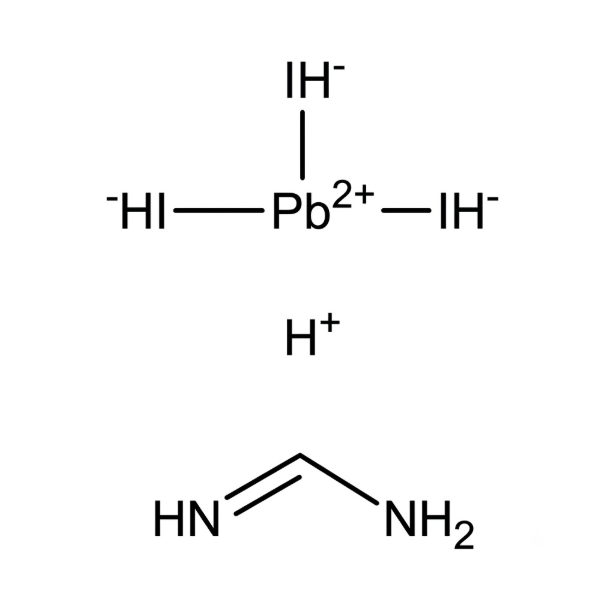
FORMAMIDINIUM LEAD TRIIODIDE FAPbI₃ 99.9% PURE PHASERESEARCH GRADE MATERIAL
|
|||||||||||||||||||||||
|
|||||||||||||||||||||||
|
TAILORED SOLUTIONS FOR RESEARCH
Contact our engineering team for technical support or official quotations.
EMAIL: inquiry@atomfair.com
|
|||||||||||||||||||||||
|
Manufacturer: Atomfair LLC
Brand: ATOMFAIR®
|
This material is extremely hygroscopic and undergoes rapid hydrolysis upon moisture exposure, requiring strict environmental control. Storage must be under inert atmosphere with complete moisture exclusion, light protection, and temperature stability at room temperature.
- Storage Conditions: Store sealed under inert atmosphere (glovebox H₂O < 1 ppm, O₂ < 1 ppm), protected from light, at room temperature, with no exposure to moisture.
- Handling Requirements: Transfer immediately into an inert-atmosphere glovebox upon receipt and perform all operations inside the glovebox to prevent hydrolysis.
- Degradation Risk: Moisture exposure causes rapid hydrolysis of FAPbI₃, leading to decomposition and loss of functional properties.
- Containment and Waste: Waste must be classified as hazardous due to lead content and disposed of according to local chemical waste regulations.
- Co-storage Prohibition: Do not store with water, alcohols, or acidic reagents to avoid reactive degradation.
This procedure outlines safe receipt, storage, and handling of FAPbI₃ to prevent moisture-induced degradation and hazardous exposure. All steps must be performed using appropriate protective equipment and an inert-atmosphere glovebox.
Required Equipment: Inert-atmosphere glovebox (H₂O < 1 ppm, O₂ < 1 ppm), Protective gloves (nitrile or equivalent), Light-protective, moisture-barrier sealed container
- Inspect incoming package
Inspect the sealed packaging for any damage or moisture indicator upon receipt before transferring to glovebox. - Transfer to glovebox
Transfer the sealed container directly into an inert-atmosphere glovebox without opening in ambient air. - Open container
Open the container only inside the glovebox to avoid any exposure to atmospheric moisture. - Use material
Perform all weighing, mixing, or deposition steps inside the glovebox while maintaining inert conditions. - Reseal container
Reseal the container immediately after each use to preserve the inert atmosphere inside. - Dispose of waste
Collect all waste in designated hazardous waste containers and dispose of according to lead-containing waste regulations.
For intrinsic carrier transport studies, what are the trade-offs between using the 5 g powder (4× purified) versus the 5 g single crystal (5× purified) form of FAPbI₃?
The single crystal variant (5× purified) offers significantly lower defect density, making it essential for intrinsic carrier transport measurements, photophysical mechanism studies, and high-performance photodetector fabrication. The powder form (4× purified) is optimized for solution spin-coating and co-blending thin-film preparation, but its higher defect density from fewer purification cycles and polycrystalline nature introduces grain boundary effects absent in the single crystal. For fundamental transport studies, the single crystal is the definitive reference standard.
What inert atmosphere conditions are required to prevent degradation of FAPbI₃ during device fabrication?
All operations must be conducted within an inert-atmosphere glovebox with H₂O <1 ppm and O₂ <1 ppm because FAPbI₃ is extremely hygroscopic and undergoes rapid hydrolysis upon moisture exposure. The material is sealed under inert atmosphere in light-protective moisture-barrier packaging and must be transferred immediately to the glovebox upon receipt. Failure to maintain these stringent conditions will compromise material integrity, introduce extrinsic defects, and invalidate experimental data.
What are the critical storage and disposal requirements for FAPbI₃ to ensure lab safety and regulatory compliance?
Store in a light-protected, moisture-free sealed container at room temperature, strictly prohibiting co-storage with water, alcohols, or acidic reagents. Because the material contains lead, all experimental waste must be classified, collected, and disposed of in accordance with hazardous chemical waste regulations. Wear protective gloves throughout all procedures, avoid direct skin contact, and consult the Safety Data Sheet prior to use for detailed handling guidance.
This FAPbI₃ perovskite material is offered in two distinct morphologies—powder (4× purified) for solution-based thin-film processing and single crystal (5× purified) for ultra-low defect density studies—both at >99.9% purity, but requires strict inert-atmosphere handling due to extreme hygroscopicity and rapid hydrolysis upon moisture exposure.
Positive
- Dual morphology for research flexibility: Powder form (4× purified) is optimized for solution spin-coating and co-blending thin-film preparation; single crystal form (5× purified) provides ultra-low defect density essential for intrinsic carrier transport measurements, photophysical mechanism studies, and high-performance photodetector fabrication.
- Excellent thermal stability for elevated studies: Formamidinium-based perovskite exhibits superior thermal resistance compared to methylammonium-based compositions, enabling reliable experimental data acquisition under elevated temperature conditions and prolonged illumination protocols.
Trade-offs
- Extreme moisture sensitivity requires glovebox: FAPbI₃ is extremely hygroscopic and undergoes rapid hydrolysis upon moisture exposure; all operations must be conducted within an inert-atmosphere glovebox (H₂O < 1 ppm, O₂ < 1 ppm) and immediate transfer from sealed packaging is required upon receipt.
- Lead-containing hazardous waste disposal: This material contains lead; all experimental waste must be classified, collected, and disposed of in accordance with hazardous chemical waste regulations, adding operational overhead for laboratory compliance.
Every advanced material, component, equipment, and instrument in our catalog is backed by rigorous testing. We maintain strict internal quality management frameworks and align with CE conformity metrics to deliver transparent, reproducible performance data via our public open-science repository.
To request raw batch performance data, submit formal vendor registration paperwork, or execute a fast-turnaround R&D manufacturing loop, contact us at inquiry@atomfair.com.
Item is dispatched under the Atomfair Shipping & Delivery Framework (Free worldwide shipping on orders over $59 USD). Return is governed by the Atomfair Return & Refund Policy (7-day technical return window).