Description
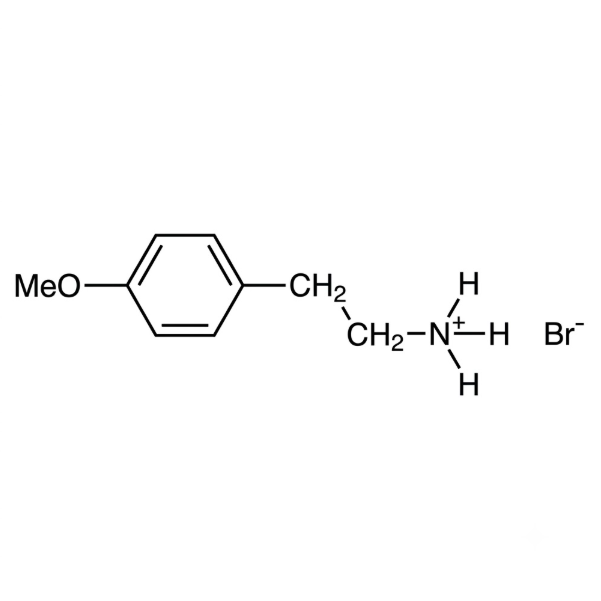
4-METHOXY-PHENETHYLAMMONIUM BROMIDE C₉H₁₄BRNO 99% 4MEO-PEABRRESEARCH GRADE MATERIAL
|
|||||||||||||||||||||||||||
|
|||||||||||||||||||||||||||
|
TAILORED SOLUTIONS FOR RESEARCH
Contact our engineering team for technical support or official quotations.
EMAIL: inquiry@atomfair.com
|
|||||||||||||||||||||||||||
|
Manufacturer: Atomfair LLC
Brand: ATOMFAIR®
|
This material requires strict moisture and light protection to prevent deliquescence and hydrolysis. Handling must be performed under inert atmosphere with H₂O < 1 ppm and O₂ < 1 ppm in a glovebox.
- Storage Conditions: Store in a light-protected, moisture-free, sealed container at room temperature, away from strong oxidizing agents and acidic reagents.
- Glovebox Requirement: Weigh and dissolve the white solid only inside an inert-atmosphere glovebox (H₂O < 1 ppm, O₂ < 1 ppm) to prevent degradation.
- Post-Use Sealing: Tighten the container cap immediately after each use to avoid moisture ingress from ambient air.
- Compatibility Warnings: Do not store or handle together with strong oxidizing agents or acidic reagents to avoid hazardous reactions.
This procedure outlines the essential steps for safely handling and storing this hygroscopic, light-sensitive compound. Following these steps prevents material degradation and maintains stoichiometric integrity for perovskite synthesis.
Required Equipment: Inert-atmosphere glovebox (H₂O < 1 ppm, O₂ < 1 ppm), Light-protective packaging or amber vials, Desiccator with anhydrous desiccant, Protective gloves (nitrile or equivalent)
- Transfer to glovebox
Transfer the sealed light-protective package containing the white solid into an inert-atmosphere glovebox immediately upon receipt. - Weigh under inert atmosphere
Weigh the desired quantity of 4-methoxy-phenethylammonium bromide inside the glovebox, ensuring H₂O and O₂ levels remain below 1 ppm. - Tighten container cap
Tighten the container cap immediately after each use to prevent moisture ingress from ambient air. - Store in light-protected desiccator
Store the tightly sealed container inside a light-protected desiccator with anhydrous desiccant at room temperature, away from oxidizing or acidic reagents.
What performance trade-off does the methoxy substitution in 4MeO-PEABr introduce compared to unsubstituted PEABr in 2D perovskite devices?
The methoxy substitution provides enhanced dipole modulation and dual-function passivation, but it introduces stringent handling requirements due to its hygroscopic and light-sensitive nature. The product description states that 4MeO-PEABr is 'hygroscopic and light-sensitive' and requires handling in an inert-atmosphere glovebox with H₂O and O₂ below 1 ppm to prevent deliquescence and hydrolysis, which would irreversibly degrade precursor stoichiometry. This trade-off between improved optoelectronic performance and the need for moisture-free processing must be considered when selecting this precursor for 2D perovskite fabrication.
What specific glovebox conditions are required when handling 4MeO-PEABr to prevent precursor degradation during solution preparation?
The precursor must be handled within an inert-atmosphere glovebox with H₂O < 1 ppm and O₂ < 1 ppm. The product description explicitly states that 'when preparing precursor solutions, handle the white solid within an inert-atmosphere glovebox (H₂O < 1 ppm, O₂ < 1 ppm)' to avoid moisture-induced deliquescence and hydrolysis, which irreversibly degrade the stoichiometry. These stringent conditions are necessary because the material is hygroscopic and will absorb atmospheric moisture if not protected.
What storage conditions are critical to prevent irreversible degradation of 4MeO-PEABr, and why is it essential to avoid moisture exposure?
The material must be stored light-protected, dry, sealed, at room temperature. The product description warns that 'exposure to atmospheric moisture will cause deliquescence and hydrolysis, irreversibly degrading precursor stoichiometry.' It is also light-sensitive, so packaging is light-protective, and users must immediately transfer the material to a desiccated, light-protected environment upon receipt to maintain its >99% purity.
4-Methoxy-Phenethylammonium Bromide (4MeO-PEABr) is a research-grade organic bromide salt for 2D perovskite dipole engineering, offering >99% purity and methoxy-functionalized modulation of intermolecular interactions. Its hygroscopic and light-sensitive nature mandates inert-atmosphere glovebox handling and strict light-protected, dry storage to prevent deliquescence and stoichiometric degradation.
Positive
- Methoxy-functionalized dipole engineering: The electron-donating methoxy substituent on the aromatic ring modulates molecular dipole interactions within the perovskite lattice, providing an additional structural parameter beyond spacer length for tuning optoelectronic properties in 2D perovskite systems.
- Dual-function passivation with dipole modulation: Simultaneously passivates grain boundary and surface defects via the ammonium head group while the methoxy-substituted aromatic tail modifies the local electronic environment, combining structural and electronic passivation mechanisms.
Trade-offs
- Hygroscopic and light-sensitive storage required: The compound is hygroscopic and light-sensitive; exposure to atmospheric moisture causes deliquescence and hydrolysis, irreversibly degrading precursor stoichiometry. Storage must be light-protected, sealed, and dry at room temperature.
- Inert-atmosphere glovebox handling necessary: Precursor solutions must be prepared inside an inert-atmosphere glovebox (H2O < 1 ppm, O2 < 1 ppm) to prevent moisture ingress. This imposes infrastructure and expertise requirements typical of air-sensitive materials research.
Every advanced material, component, equipment, and instrument in our catalog is backed by rigorous testing. We maintain strict internal quality management frameworks and align with CE conformity metrics to deliver transparent, reproducible performance data via our public open-science repository.
To request raw batch performance data, submit formal vendor registration paperwork, or execute a fast-turnaround R&D manufacturing loop, contact us at inquiry@atomfair.com.
Item is dispatched under the Atomfair Shipping & Delivery Framework (Free worldwide shipping on orders over $59 USD). Return is governed by the Atomfair Return & Refund Policy (7-day technical return window).