
A recent Nature paper reports an electrolyte strategy that guides lithium to deposit and dissolve as a dense planar layer on bare copper. The work matters because anode-free lithium metal cells can only become practical if lithium inventory is controlled at high areal capacity and in pouch-cell formats, not only in small laboratory half-cells.
| Source paper | Planar Li deposition and dissolution enable practical anode-free pouch cells |
|---|---|
| Journal | Nature, volume 652, pages 1211-1218 |
| Publication date | 17 March 2026 online; issue dated 30 July 2026 |
| Authors | Lei Liu, Yuxuan Xiang, Xingyu Lu and Jianhui Wang |
| Main system | Anode-free lithium metal pouch cell using NCM811 cathode, bare Cu current collector and a BAFF electrolyte design |
| Key reported metrics | Planar Li deposition and dissolution at 5.6 mAh cm-2, above 99.85% Coulombic efficiency in a 500-cycle Li||Cu test, and a 2.7 Ah anode-free pouch cell retaining 80% capacity over 90 cycles under the reported test conditions. |
What Problem Does This Paper Solve?
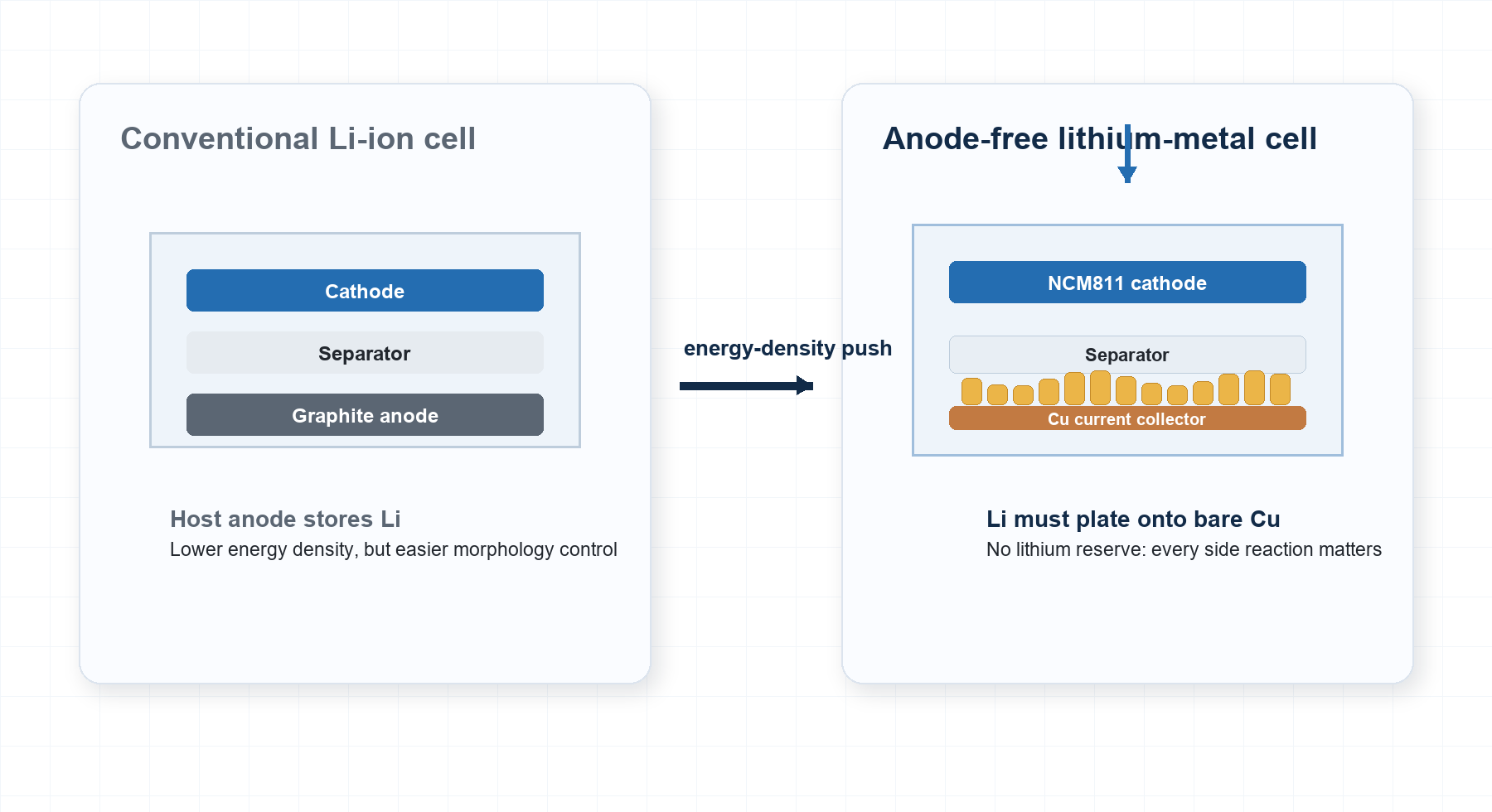
Anode-free lithium metal cells start without excess lithium metal at the negative electrode. During the first charge, lithium is extracted from the cathode and plated onto a bare current collector, typically copper. In principle, this architecture improves cell-level energy density because it removes the thick lithium foil used in conventional lithium metal cells. In practice, the same design is unforgiving: every cycle consumes part of the finite lithium inventory through dead lithium formation, unstable SEI growth, electrolyte reduction and nonuniform stripping.
The central problem is therefore not simply whether lithium can plate on copper. It is whether lithium can repeatedly plate and strip as a compact, connected, electrochemically accessible layer at practical areal capacity. If the deposit becomes mossy or dendritic, the local current distribution becomes uneven, fresh surface area keeps appearing, and the SEI consumes lithium and electrolyte faster than the cell can tolerate. The Nature paper addresses this failure mode by focusing on the morphology and chemistry of the lithium-electrolyte interface.
What Exactly Did The Authors Do?
The authors designed an electrolyte referred to as BAFF, described in the paper as a system built from lithium difluoro(oxalato)borate and N,N-dimethyltrifluoroacetamide. The design goal was to form a B-F polymer-rich SEI at the lithium interface. Such an interphase is intended to guide more homogeneous lithium-ion transport, reduce uncontrolled side reactions and mechanically support planar lithium deposition.
This is important because electrolyte design in lithium metal batteries is often judged by short-term Coulombic efficiency or by dendrite suppression in simplified cells. Here, the paper connects electrolyte chemistry to a more demanding set of conditions: high areal capacity, a bare copper host, NCM811 full-cell chemistry and an anode-free pouch-cell demonstration. That makes the paper more than another electrolyte screening study. It asks whether the interphase can preserve lithium inventory under cell formats closer to practical devices.
The reported performance chain is straightforward: BAFF modifies the interfacial chemistry; the modified SEI supports planar lithium deposition and dissolution; planar morphology reduces dead lithium accumulation and uneven stripping; and the cell can retain capacity for longer even without a lithium metal excess reservoir. Each link is essential. If the electrolyte only improves early Coulombic efficiency but fails at high capacity, the practical claim weakens. If the cell cycles only in coin cells but not pouch cells, the result remains difficult to translate.
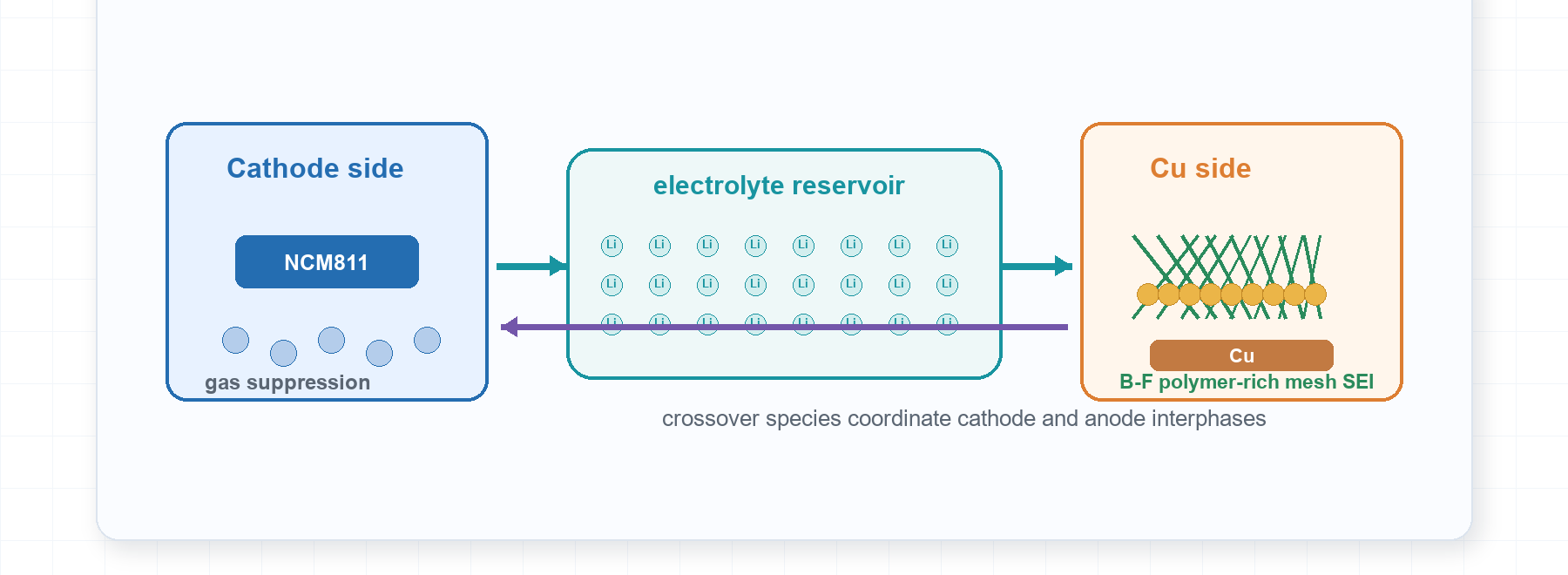
Figure-by-Figure Interpretation
1. Morphology Is The Main Performance Variable
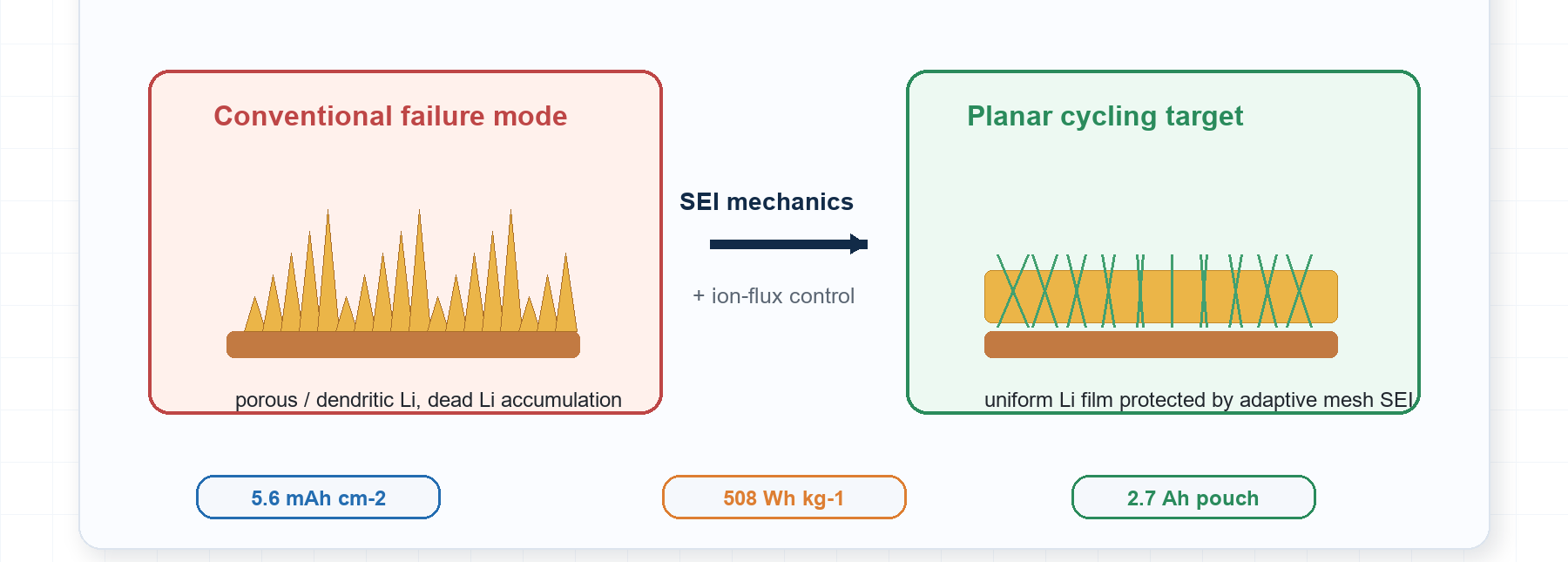
The headline phrase “planar Li deposition and dissolution” should be read literally. In an anode-free cell, the negative electrode is created in situ during charging. The morphology of that created electrode determines how much lithium remains electrochemically reversible. A planar deposit minimizes isolated lithium islands and reduces the growth of high-surface-area structures. A porous deposit, even if it initially stores the same charge, creates more reactive surface and more pathways toward lithium isolation.
For researchers, the practical message is that Li||Cu Coulombic efficiency alone is not enough. The experiment should be paired with morphology checks, interphase analysis and full-cell validation. A high CE number can hide nonuniform stripping, while a smooth deposit at low capacity may fail when moved to 5-6 mAh cm-2. The paper’s reported 5.6 mAh cm-2 condition is therefore central to its relevance.
2. The SEI Is Treated As A Designed Functional Layer
The BAFF formulation is reported to form a B-F polymer-rich SEI. That phrase matters because boron- and fluorine-containing interphase species can change both ion transport and mechanical response. In lithium metal systems, an ideal SEI must block continuous solvent reduction while still allowing lithium ions to pass through evenly. It must also accommodate volume change without cracking into new reactive surfaces.
The paper’s innovation is not simply adding a fluorinated ingredient. It is the attempt to link solvation chemistry, interphase composition and deposit geometry into one design rule. This is a more demanding standard than additive screening, because the electrolyte has to work as a coupled chemical-mechanical system at the current collector interface.
3. Pouch-Cell Validation Raises The Bar
The reported 2.7 Ah anode-free pouch cell is a critical part of the story. Pouch cells introduce practical stresses that are absent or muted in many small-cell studies: electrolyte distribution, stack pressure, gas management, electrode alignment, tab geometry, edge effects and larger current pathways. A design that works only in a tiny coin cell can fail when the cell area and lithium inventory increase.
The paper reports 80% capacity retention over 90 cycles in the pouch-cell format. This is not a final commercial lifetime claim, but it is a meaningful demonstration that the interfacial strategy can survive a more realistic architecture. It also creates a better experimental bridge for groups developing high-energy lithium metal cells, because pouch-cell results expose failure modes that small cells often miss.
Why This Research Is Important And Innovative
The importance of this paper comes from its focus on lithium inventory management. Many high-energy battery concepts look compelling on a materials basis, but become fragile once the lithium excess is removed. Anode-free cells expose that fragility immediately. Every irreversible side reaction reduces the same lithium pool that must sustain future cycles. By showing planar deposition and dissolution at high areal capacity, the paper addresses a bottleneck that is directly connected to energy density and cycle life.
The innovation is also conceptual. Instead of treating the electrolyte as a background medium, the study treats electrolyte design as a way to engineer the negative electrode that forms during operation. This is especially relevant for anode-free formats, where the negative electrode does not exist as a stable manufactured component before cycling. In such cells, electrolyte chemistry helps decide what kind of metal electrode the battery builds for itself.
The study also reinforces a broader direction in lithium metal research: electrolyte, interphase, pressure, current collector and cell format should not be optimized independently. A dense lithium deposit is useful only if it can form at the required capacity, remain connected during stripping, avoid runaway side reactions and operate in a full cell. The Nature paper is strong because it tries to close that loop.
What Remains Uncertain?
The result should be interpreted under the paper’s test conditions. A 2.7 Ah pouch cell retaining 80% capacity over 90 cycles is a serious step, but it is not the same as long-term electric-vehicle qualification. Questions remain about wider temperature ranges, faster charge, abuse tolerance, manufacturability, electrolyte cost, gas generation, storage stability and compatibility with different cathode loadings or separators.
Another open question is how general the BAFF principle is. The paper uses a specific electrolyte chemistry and NCM811-based anode-free configuration. Future work would need to test whether the same interfacial logic transfers to other high-nickel cathodes, different copper surface treatments, varied stack pressures or leaner electrolyte conditions. The mechanism may be robust, but practical translation will depend on these boundary conditions.
From Paper To Experiment: What Should Researchers Track?
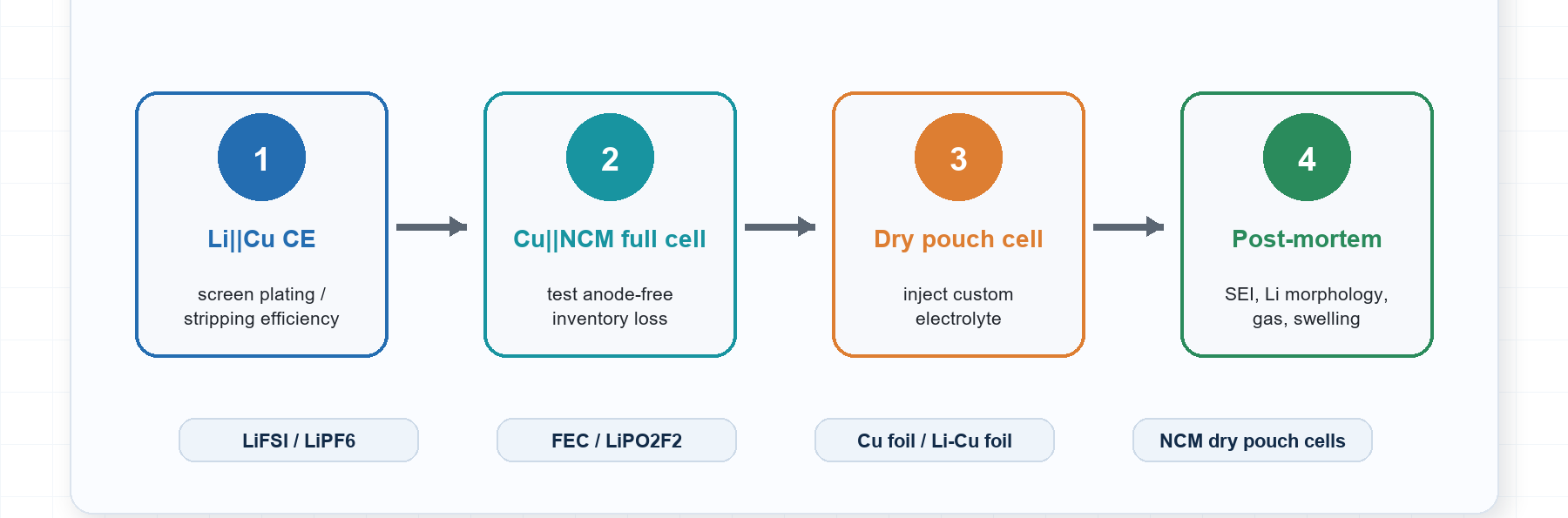
Researchers designing related experiments should track the full chain from formulation to cell failure. At the electrolyte level, water content, salt purity, solvent ratio and additive stability are critical. At the cell level, copper foil surface condition, cathode areal loading, electrolyte amount, separator choice and stack pressure can all influence whether lithium plates as a dense layer or as a porous structure.
Characterization should also be staged. Li||Cu tests can reveal early Coulombic efficiency and deposition morphology. Full cells with NCM811 or another high-energy cathode expose lithium inventory loss under realistic cathode coupling. Pouch cells add information about pressure distribution, edge growth and electrolyte wetting. Post-mortem SEM, XPS, time-of-flight secondary ion mass spectrometry or related analysis can then connect morphology and SEI chemistry back to the original electrolyte design.
Related Materials And Experimental Platform References
For researchers planning related anode-free lithium metal experiments, the most direct material needs are narrow rather than broad. The useful starting point is a controlled electrolyte formulation, a copper host for lithium plating, a high-energy cathode reference and a pouch-cell format that can reveal practical failure modes.
| Research need | Directly related material or platform | Why it fits this paper |
|---|---|---|
| SEI-forming electrolyte chemistry | LiDFOB electrolyte salt | The paper’s BAFF concept is built around boron/fluorine-rich interphase chemistry, making LiDFOB the closest direct material reference. |
| Electrolyte formulation space | Electrolytes, salts, solvents and additives category | Useful when screening solvents, additives or custom formulations around anode-free lithium metal behavior. |
| Anode-free negative electrode host | Battery-grade copper foil | Planar deposition is evaluated on a bare copper current collector, so copper surface quality is part of the experiment. |
| High-energy cathode reference | NCM811 cathode sheet | The pouch-cell demonstration uses an NCM811-based positive electrode, making high-nickel cathode sheets relevant for benchmarking. |
| Pouch-cell validation | NCM622 anode-free dry pouch cell | An anode-free dry pouch format provides a practical platform for electrolyte evaluation before final pouch-cell optimization. |
Conclusion
This Nature paper reframes anode-free lithium metal batteries as an interfacial manufacturing problem that happens during cycling. By using BAFF electrolyte chemistry to support B-F polymer-rich SEI formation, the study reports dense planar lithium deposition and dissolution at a demanding areal capacity and extends the concept to a 2.7 Ah pouch cell. The central scientific contribution is the connection between electrolyte coordination, interphase chemistry, lithium morphology and practical cell format.
The remaining challenge is validation across broader operating conditions, longer cycle life, varied cathodes and manufacturable electrolyte windows. Even so, the work provides a clear experimental message: anode-free cells need more than a high-efficiency electrolyte. They need an electrolyte-current collector-cell architecture combination that builds and preserves a usable lithium electrode over repeated cycles.
Product Link Mapping for Hyperlinks
| Group | Recommended product/page | Atomfair URL | Use in this research context |
|---|---|---|---|
| Electrolyte salt | LiDFOB, 99.5%, battery grade | https://atomfair.com/product/lithium-difluoro-oxalato-borate-99-5-battery/ | Boron/fluorine-containing salt reference for SEI chemistry studies. |
| Electrolyte formulation | Electrolytes, salts, solvents and additives | https://atomfair.com/product-category/battery-materials-components/electrolytes-salts-solvents-additives/ | Category page for related solvent/additive screening around anode-free lithium metal cells. |
| Current collector | Battery-grade copper foil, 9 um | https://atomfair.com/product/copper-foil-9um-200mm-battery-grade/ | Bare Cu host for Li plating/stripping and anode-free cell assembly. |
| Cathode sheet | NCM811 single-sided cathode sheet | https://atomfair.com/product/ncm811-single-sided-cathode-30-mg-cm2/ | High-nickel cathode reference for full-cell or pouch-cell benchmarking. |
| Dry pouch cell | 1 Ah NCM622 anode-free coated copper foil dry pouch cell | https://atomfair.com/product/1ah-ncm622-anodefree-coated-copper-foil/ | Practical dry-cell platform for custom electrolyte injection and anode-free validation. |
For technical questions, quotations, or related research material inquiries, contact Atomfair at inquiry@atomfair.com.
- Quantifying inactive lithium in lithium metal batteries
DOI: 10.1038/s41586-019-1481-z
Directly supports discussion of dead lithium, lithium inventory loss, and the need to distinguish electrochemically isolated lithium from SEI-related irreversible capacity loss. - Non-flammable electrolyte enables Li-metal batteries with aggressive cathode chemistries
DOI: 10.1038/s41565-018-0183-2
Supports discussion of fluorinated electrolyte design, lithium metal interphase chemistry, high-voltage cathode compatibility, and safety considerations in practical lithium metal cells. - Reviving the lithium metal anode for high-energy batteries
DOI: 10.1038/nnano.2017.16
Foundational review covering lithium metal failure modes, SEI design, morphology control, and strategies for enabling dense and reversible lithium plating/stripping.