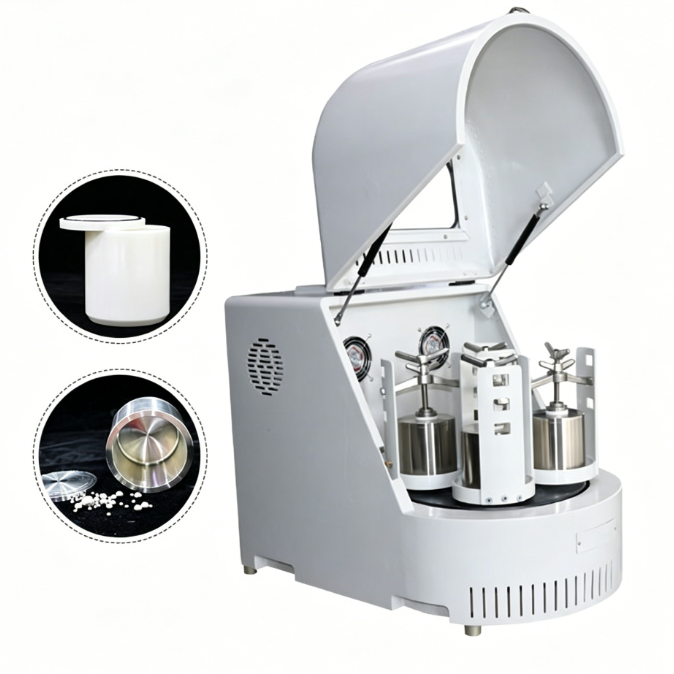
Description
Product Introduction
Operating Principle of Planetary Ball Mill
Application Scope
Product Usage
-
Materials Science Research: Preparation of nanomaterials, composite materials, and ultra-fine metal/non-metal powders.
-
Pharmaceutical Field: Mixing of pharmaceutical ingredients, cell disruption, and biological sample pretreatment.
-
Ceramic & Glass Industry: Uniform dispersion of raw materials and preparation of ceramic slurries such as kaolin.
-
Electronics & Metallurgy: Fine processing of metal powders, semiconductor materials, and magnetic materials.
-
Environmental Protection & Agriculture: Analysis of soil/geological samples, waste treatment, and agricultural product quality testing.
Product Features
-
High Efficiency: The planetary motion mode (revolution + rotation) provides high energy density, significantly improving grinding efficiency compared with traditional equipment.
-
Uniformity: The three-dimensional motion trajectory ensures thorough mixing of materials and a uniform particle size distribution (down to 0.1 micron).
-
Versatility: Supports dry/wet grinding and is compatible with ball milling jars of various materials (e.g., stainless steel, ceramics, polyurethane).
-
Safety & Reliability: Equipped with safety switches, overload protection, and a low-noise design, complying with laboratory safety standards.
-
Intelligent Control: Variable frequency speed regulation, timed forward and reverse rotation, LED display, and programmed operation to improve experimental repeatability.
Core Technical Advantages
-
The full series adopts variable frequency speed regulation technology for stepless speed change.
-
Supports forward and reverse alternating operation for more uniform grinding.
-
Precise setting of running time up to 9999 minutes.
-
Precise coordination of revolution and rotation speeds to ensure the optimal grinding effect.
Safety Protection Design
-
All models comply with noise control standards.
-
Motor overload protection device.
-
Emergency stop function.
-
Wide voltage adaptation range and strong stability.
Application Coverage
-
Meets full-range demands from small-batch laboratory use to industrial production.
-
Compatible with ball milling jars of various specifications, including vacuum ball milling jars.
-
Suitable for materials science, chemistry, pharmacy, and other fields.
Technical Parameters
|
No.
|
Model
|
Style
|
Grinding Jar Rotation Speed (rpm)
|
Grinding Jar Holder Inner Diameter (mm)
|
Motor Power
|
Grinding Jar Revolution Diameter (mm)
|
Overall Dimensions (mm)
|
Net Weight (kg)
|
|---|---|---|---|---|---|---|---|---|
|
1
|
XQM-0.2
|
Micro Type
|
0~1160
|
50
|
90W
|
Φ111
|
420×260×310
|
25
|
|
2
|
XQM-0.2S
|
Micro Glove Box Type
|
0~1160
|
50
|
90W
|
Φ111
|
Main Unit 390×220×270 Control Box 200×180×240
|
29
|
|
3
|
XQM-0.4A
|
Semi-Circular Type
|
0~870
|
80
|
250W
|
Φ140
|
530×300×360
|
34
|
|
4
|
XQM-6
|
—
|
0~670
|
134
|
0.75KW
|
Φ234
|
760×470×580
|
100
|
|
5
|
XQM-4A
|
Semi-Circular Type
|
0~670
|
134
|
0.75KW
|
Φ234
|
760×470×600
|
85
|
|
6
|
XQM-(8-12)
|
—
|
0~580
|
162
|
1.5KW
|
Φ275
|
900×600×640
|
168
|
|
7
|
XQM-(8-12)A
|
Semi-Circular Type
|
0~580
|
162
|
1.5KW
|
Φ275
|
880×560×642
|
150
|
|
8
|
XQM-16A
|
Semi-Circular Type
|
0~510
|
182
|
3KW
|
Φ320
|
950×600×710
|
205
|
|
9
|
XQM-20
|
—
|
0~430
|
222
|
4KW
|
Φ385
|
1200×790×930
|
392
|
|
10
|
XQM-40
|
—
|
0~390
|
250
|
5.5KW
|
Φ430
|
1400×880×1070
|
656
|
|
11
|
XQM-60
|
—
|
0~260 (1:1.5)
|
275
|
7.5KW
|
Φ490
|
1600×1070×1250
|
950
|
|
12
|
XQM-100
|
—
|
0~240 (1:1.5)
|
326
|
11KW
|
Φ578
|
1750×1140×1330
|
1300
|
|
13
|
XQM-200
|
—
|
0~215
|
460
|
22KW
|
Φ738
|
2670×1600×2804
|
2725
|
Working Principle
-
Planetary Motion Mechanism: The turntable drives the ball milling jars to revolve around the main shaft, while the jars rotate at high speed, forming a composite centrifugal force field.
-
Grinding Effect: Grinding balls inside the jar collide with materials at high speed under centrifugal force, generating shearing, impact, and friction forces to achieve crushing and mixing.
-
Parameter Control: Precisely control the finished product particle size by adjusting the rotation speed (e.g., 200-800 rpm), grinding time, and ball-to-material ratio.
Selection Guide
-
Sample Properties: Wear-resistant jars (e.g., tungsten carbide) are required for hard materials; the low-temperature grinding mode is optional for brittle or heat-sensitive materials.
-
Processing Capacity: Choose a single-jar or four-jar configuration according to experimental needs, with the loading capacity not exceeding 2/3 of the jar volume.
-
Grinding Objective: Nanoscale grinding requires a high rotation speed (≥500 rpm) and small-sized grinding balls (e.g., zirconia balls).
-
Equipment Parameters: Focus on motor power (e.g., 0.75-2.2 kW), maximum centrifugal acceleration, and timing function.
-
Safety & Maintenance: Prioritize models with automatic shutdown, fault alarm, and easy disassembly design to reduce maintenance costs.
Supporting Products Supply
The planetary ball mill generates high mechanical energy and electrical hazards during operation. Store the equipment in a dry, clean environment and ensure proper electrical grounding to mitigate risks of shock and fire.
- Mechanical Integrity Check: Inspect the ball milling jars and grinding balls for cracks or excessive wear before each use to prevent sudden failure under high-speed impact.
- Vacuum Jar Sealing: When using vacuum ball milling jars, verify the sealing integrity and proper valve operation to maintain vacuum conditions and avoid sample contamination.
- Electrical Safety Precautions: Ensure the mill is connected to a grounded power outlet and that the power cord is free of damage to prevent electrical shorts or electrocution.
- Containment of Hazardous Materials: Use appropriate personal protective equipment and operate within a fume hood or glovebox when grinding toxic, reactive, or airborne powders.
- Overload and Overheating Protection: Allow the mill to cool sufficiently between consecutive runs to prevent thermal overload and motor damage.
Proper initialization and operation reduce the risk of mechanical failure and personal injury. Follow these steps to safely prepare and run the mill for grinding high-hardness materials.
Required Equipment: Atomfair XQM-60 Planetary Ball Mill, Semi-circular ball milling jars with lids, Grinding balls of appropriate material and size, Sample containers and personal protective equipment
- Inspect Equipment
Inspect the mill, jars, and grinding balls for any visible damage, cracks, or wear before proceeding. - Install Jars
Install the semi-circular ball milling jars onto the planetary disk, ensuring they are securely fastened. - Load Materials
Load the grinding balls and sample material into each jar, maintaining the recommended ball-to-sample ratio for effective grinding. - Secure Lids
Secure the jar lids tightly to prevent leakage and ensure safe containment during high-speed rotation. - Set Parameters
Set the desired rotation speed and grinding duration on the control panel according to the material properties. - Start Operation
Start the mill and monitor the operation for unusual vibrations or sounds, stopping immediately if any anomaly occurs. - Post-Operation Shutdown
Wait until the mill comes to a complete stop before opening the cover and removing the jars.
What minimum particle size can the XQM-60 planetary ball mill achieve when grinding hard ceramics like alumina or zirconia, and how does the jar material selection influence grinding efficiency and contamination?
The XQM-60 can achieve a uniform particle size down to 0.1 micron due to its high-energy planetary motion combining revolution and rotation. The mill is compatible with jar materials such as stainless steel, ceramics, and polyurethane; for hard ceramics, using ceramic jars minimizes metal contamination while maintaining grinding efficiency, though specific efficiency differences between jar materials are not quantified in the product specifications.
Can the XQM-60 be used to grind lithium cobalt oxide cathode materials without oxidation, and what jar options prevent cross-contamination when switching to different materials like Ni-Zn ferrites?
Yes, the XQM-60 is applicable to lithium cobalt oxide production and can be equipped with vacuum ball milling jars to grind samples in a vacuum state, preventing oxidation. For cross-contamination avoidance, the mill supports jars made of stainless steel, ceramics, or polyurethane, and the easy-to-operate jar clamping device allows quick interchange between jar materials for sequential grinding of different materials.
What safety features does the XQM-60 include to protect operators during high-energy milling of flammable powders such as lithium cobalt oxide or catalysts?
The XQM-60 is equipped with safety switches, motor overload protection, and an emergency stop function. Additionally, vacuum ball milling jars are available to enable grinding in a vacuum state, reducing the risk of dust explosion when processing flammable materials. The low-noise design and compliance with noise control standards further support safe laboratory operation.
The Atomfair XQM-60 vertical semi-circular planetary ball mill delivers high-energy planetary motion for efficient grinding of advanced materials, achieving particle sizes down to 0.1 micron while processing up to four samples per batch for small-batch R&D applications.
Positive
- High grinding efficiency and uniformity: The planetary motion (revolution + rotation) provides high energy density, enabling significantly faster grinding than traditional mills and producing uniform particle size distributions down to 0.1 micron.
- Versatile dry/wet and jar compatibility: Supports both dry and wet grinding modes and is compatible with ball milling jars made of stainless steel, ceramics, polyurethane, and other materials, accommodating a wide range of sample types and contamination requirements.
Trade-offs
- Limited batch capacity per run: Designed for small-batch production with a maximum of four samples per experiment, making it suitable for R&D and pilot-scale work rather than continuous or large-volume processing.
- Requires user expertise for speed optimization: Achieving optimal grinding performance demands precise coordination of revolution and rotation speeds via variable frequency control, requiring operator knowledge of material-specific parameter settings.
Every advanced material, component, equipment, and instrument in our catalog is backed by rigorous testing. We maintain strict internal quality management frameworks and align with CE conformity metrics to deliver transparent, reproducible performance data via our public open-science repository.
To request raw batch performance data, submit formal vendor registration paperwork, or execute a fast-turnaround R&D manufacturing loop, contact us at inquiry@atomfair.com.
Item is dispatched under the Atomfair Shipping & Delivery Framework (Free worldwide shipping on orders over $59 USD). Return is governed by the Atomfair Return & Refund Policy (7-day technical return window).