
Description
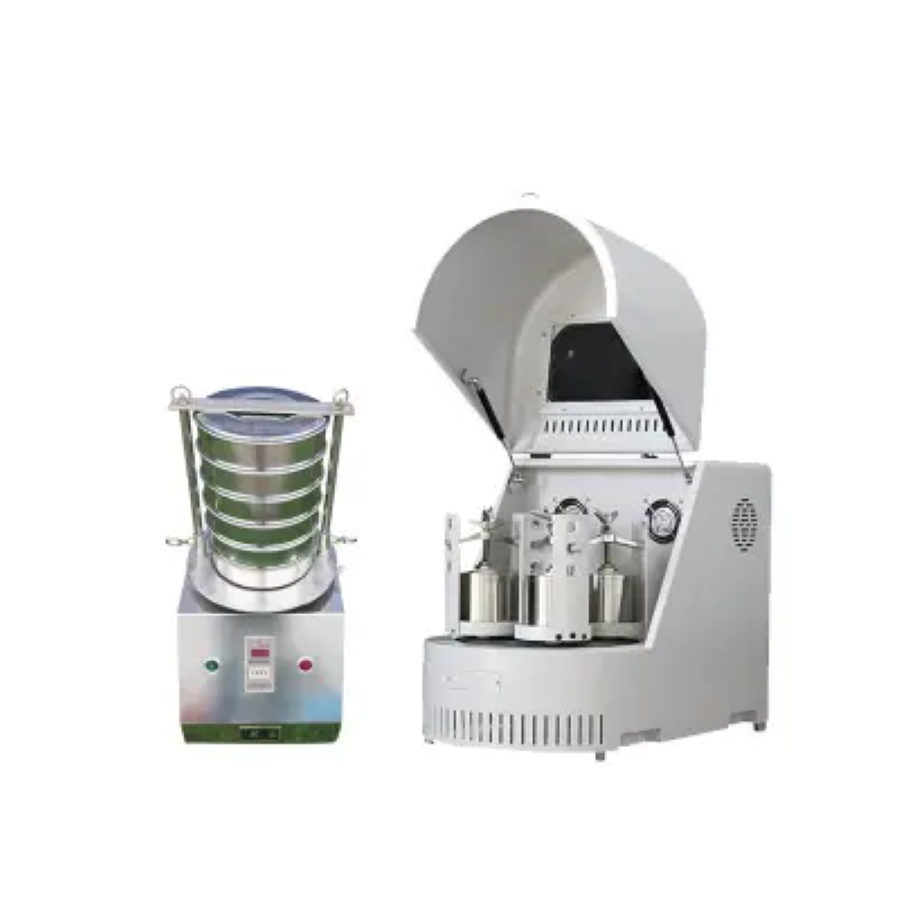
Soil Grinding and Screening Machine
Product Introduction
This machine is designed for heavy metal analysis in soil, equipped with 4 agate grinding jars. The sealing pressure of the agate grinding jars is adjustable via a graduated scale. The grinding jars rotate reversely around their own axes while revolving around the turntable axis. Samples inside the jars collide and rub against each other at high speed, achieving sample crushing, grinding, mixing and dispersion. It supports dry grinding, wet grinding and vacuum grinding. Two or four grinding jars can work simultaneously at a time.
Technical Parameter Table of Planetary Ball Mill
| No. | Model | Style | Jar Rotation Speed | Jar Holder Inner Diameter (mm) | Motor Power | Jar Revolution Diameter (mm) | Overall Dimensions (mm) | Net Weight (kg) |
| 1 | XQM-0.2 | Mini Type | 0~1160 r/min | 50 | 90W | Φ111 | 420×260×310 | 25 |
| 2 | XQM-0.2S | Mini Glove Box Type | 0~1160 r/min | 50 | 90W | Φ111 | Main Unit: 390×220×270Control Box: 200×180×240 | 29 |
| 3 | XQM-0.4A | Semi-Circular Type | 0~870 r/min | 80 | 250W | Φ140 | 530×300×360 | 34 |
| 4 | XQM-6 | – | 0~670 r/min | 134 | 0.75KW | Φ234 | 760×470×580 | 100 |
| 5 | XQM-4A | Semi-Circular Type | 0~670 r/min | 134 | 0.75KW | Φ234 | 760×470×600 | 85 |
| 6 | XQM-(8-12) | – | 0~580 r/min | 162 | 1.5KW | Φ275 | 900×600×640 | 168 |
| 7 | XQM-(8-12)A | Semi-Circular Type | 0~580 r/min | 162 | 1.5KW | Φ275 | 880×560×642 | 150 |
| 8 | XQM-16A | Semi-Circular Type | 0~510 r/min | 182 | 3KW | Φ320 | 950×600×710 | 205 |
| 9 | XQM-20 | – | 0~430 r/min | 222 | 4KW | Φ385 | 1200×790×930 | 392 |
| 10 | XQM-40 | – | 0~390 r/min | 250 | 5.5KW | Φ430 | 1400×880×1070 | 656 |
| 11 | XQM-60 | – | 0~260 r/min (1:1.5) | 275 | 7.5KW | Φ490 | 1600×1070×1250 | 950 |
| 12 | XQM-100 | – | 0~240 r/min (1:1.5) | 326 | 11KW | Φ578 | 1750×1140×1330 | 1300 |
| 13 | XQM-200 | – | 0~215 r/min | 460 | 22KW | Φ738 | 2670×1600×2804 | 2725 |
Technical Specifications of Soil Grinding and Screening Machine
- Voltage: 220V AC
- Feed Particle Size: ≤10 mm for soil samples, ≤3 mm for other materials; Discharge Particle Size: as fine as 0.1 μm
- Rotation Speed (r/min): Revolution: 35-335 r/min; Rotation: 70-670 r/min
- Three-Phase Motor Variable Frequency Controller Power: 0.75KW (with power display electronic monitoring device; Continuous operation timer (min); Forward-reverse commutation cycle (min))
- Speed Control Mode: Stepless speed regulation, automatic timing for forward and reverse rotation, automatic stop
- Continuous Working Time (Full Load): 48 hours
- Electric Screener: Capable of holding seven layers of sieves with a diameter of 200 mm; Screening range: 20-200 mesh (20 microns), digital display; Screening vibration frequency: 1400 rpm
Standard Configuration of Soil Grinding and Screening Machine
- Main grinding unit
- 4 pcs of 250 ml agate grinding jars, 700 pcs of agate grinding balls
- Electric screener
- A complete set of round frame sieves (20, 40, 60, 80, 100, 120, 140, 160, 180, 200 mesh) and base
Working Principle
This machine is used for heavy metal analysis in soil, equipped with 4 agate grinding jars. The sealing pressure of the agate grinding jars is set by a graduated scale. The jars revolve around the turntable axis and rotate reversely around their own axes at the same time. Samples in the jars collide and rub against each other during high-speed movement, so as to crush, grind, mix and disperse samples. It can be used for dry grinding, wet grinding and vacuum grinding. Two or four grinding jars can operate at the same time.
Supporting Products Supply
We also supply various grinding balls: stainless steel balls, zirconia balls, alumina balls, PU balls, cemented carbide balls, tungsten balls, agate balls, hard alloy balls, silicon nitride balls, high wear-resistant steel balls, manganese steel balls, nylon balls, glass balls and other special metal material balls.
We also provide grinding jars of various materials: agate, alumina corundum ceramic, zirconia ceramic, silicon nitride ceramic, silicon carbide ceramic, stainless steel, wear-resistant steel, manganese steel, nylon, polyurethane, hard alloy, crystal glass, etc.
This planetary ball mill operates at 220V AC and contains rapidly rotating mechanical components that pose electrical and physical hazards. The agate jars are brittle and require careful handling to prevent breakage and ensure sample containment.
- Electrical Safety Constraint: Ensure the mill is grounded and connected to a dedicated 220V AC circuit to prevent electrical shock or fire.
- Jar Handling Constraint: Agate jars are fragile and must be inspected for cracks before each use to avoid fragmentation during operation.
- Vacuum Grinding Constraint: Confirm all seals are intact and the vacuum port is unobstructed before initiating vacuum grinding to maintain containment.
- Balance Loading Constraint: Distribute sample mass evenly across all jars to prevent excessive vibration and potential jar dislocation during operation.
- Sample Contamination Constraint: Clean jars thoroughly between different sample types to avoid cross-contamination.
This procedure covers safe initialization and operation of the planetary ball mill for grinding soil samples. Follow these steps to reduce the risk of injury and equipment damage.
Required Equipment: Agate Grinding Jars
- Inspect jars
Inspect each agate jar and its sealing gasket for cracks, chips, or wear before loading the sample. - Load sample
Load the soil sample into the jar, filling no more than two-thirds of the jar volume to allow proper particle motion. - Secure jars
Place each jar onto its holder and tighten the sealing nut using the graduated scale to achieve the recommended sealing pressure. - Set parameters
Set the desired rotation speed and grinding time on the control panel according to the sample type and target particle size. - Start operation
Press the start button and monitor the mill for abnormal noise, vibration, or jar imbalance during the first minute of operation.
How does the choice of agate jars in the XQM-6 affect contamination risk and achievable particle size for soil heavy metal analysis?
Agate jars are specifically equipped for soil heavy metal analysis because agate naturally minimizes trace metal contamination. The XQM-6 can reduce soil samples from a feed size of ≤10 mm to a discharge particle size as fine as 0.1 μm. While the mill supports alternative jar materials (e.g., zirconia, stainless steel) listed in the product's supporting supply, agate is the standard for applications requiring high elemental purity.
What are the constraints on sample throughput and particle size classification when using the XQM-6 with four 250 ml agate jars?
The XQM-6 can operate two or four 250 ml agate jars simultaneously, allowing batch processing of multiple soil samples. Post-grinding, the included electric screener holds up to seven layers of 200 mm sieves with a screening range of 20 to 200 mesh, enabling automated particle size separation. Continuous full-load operation is rated for 48 hours, but throughput depends on feed material hardness and desired fineness.
What electrical and handling requirements are needed for vacuum grinding and continuous operation of the XQM-6?
The XQM-6 requires a 220V AC supply and uses a 0.75 kW three-phase motor variable frequency controller, supporting continuous full-load operation for 48 hours. For vacuum grinding, the agate jar sealing pressure is adjustable via a graduated scale, preventing contamination and sample loss. The unit weighs 100 kg with dimensions 760×470×580 mm, requiring sufficient benchtop space and stable support.
The Atomfair XQM-6 planetary ball mill with four 250 ml agate jars supports dry, wet, and vacuum grinding modes, achieving discharge particle sizes as fine as 0.1 μm for soil sample preparation. Its 100 kg weight and strict feed particle size limits (≤10 mm for soil, ≤3 mm for other materials) require pre-crushing and a sturdy laboratory bench.
Positive
- Multi-mode grinding versatility: Supports dry, wet, and vacuum grinding in the same four-jar configuration, enabling a wide range of sample preparation protocols without additional equipment.
- Ultrafine particle size capability: Discharge particle size can be as fine as 0.1 μm, meeting demanding requirements for soil heavy metal analysis and other high-resolution material processing.
Trade-offs
- Feed particle size restriction: Feed material must be ≤10 mm for soil and ≤3 mm for other materials, necessitating pre-crushing or pre-sieving for larger sample particles.
- Heavy unit requires robust installation: Net weight of 100 kg and dimensions of 760×470×580 mm demand a sturdy lab bench or floor mounting with adequate load capacity and space.
Every advanced material, component, equipment, and instrument in our catalog is backed by rigorous testing. We maintain strict internal quality management frameworks and align with CE conformity metrics to deliver transparent, reproducible performance data via our public open-science repository.
To request raw batch performance data, submit formal vendor registration paperwork, or execute a fast-turnaround R&D manufacturing loop, contact us at inquiry@atomfair.com.
Item is dispatched under the Atomfair Shipping & Delivery Framework (Free worldwide shipping on orders over $59 USD). Return is governed by the Atomfair Return & Refund Policy (7-day technical return window).
