
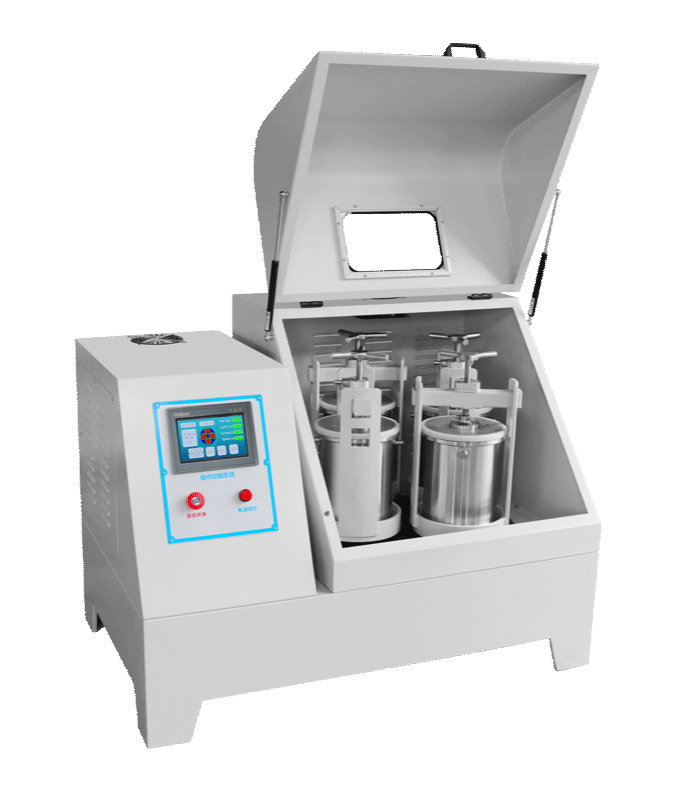
Description
Microcomputer Controlled Planetary Ball Mill
Product Introduction
Microcomputer controlled planetary ball mill is equipped with a touch screen control system on the basis of conventional planetary ball mills, which further upgrades the equipment grade and control performance. It is mainly designed for users with higher requirements on equipment quality and operation performance.
Application
Microcomputer controlled planetary ball mill is widely used in geology, mineral resources, metallurgy, electronics, building materials, ceramics, chemical industry, light industry, medicine, environmental protection and other industries.It is suitable for the production of electronic ceramics, structural ceramics, magnetic materials, lithium cobalt oxide, lithium manganate, catalysts, fluorescent powders, long afterglow luminescent powders, rare earth polishing powders, electronic glass powders, fuel cells, zinc oxide varistors, piezoelectric ceramics, nanomaterials, disc ceramic capacitors, MLCC, thermistors (PTC, NTC), dielectric ceramics, alumina ceramics, zirconia ceramics, zinc oxide powders, cobalt oxide powders, Ni-Zn ferrites, Mn-Zn ferrites and other products.
Product Features
The control system adopts branded hardware with powerful functions, including password setting, free programming, storage and call of multiple programs, process monitoring and fault alarm. The touch operation is intuitive, simple and user-friendly, realizing a friendly human-machine interface.
- Touch Screen: Easy to operate with a simple and intuitive interface, supporting forward and reverse rotation control, timing and power-off memory functions.
- Touch Screen PLC Integrated Machine: Flexible capacitive touch control with convenient adjustment, real-time equipment status monitoring, and customizable functions according to customer requirements.
Technical Parameters of Planetary Ball Mill
| No. | Model | Type | Jar Rotation Speed | Inner Diameter of Jar Base (mm) | Motor Power | Orbiting Diameter of Jar (mm) | Overall Dimension (mm) | Net Weight (kg) |
| 1 | XQM-0.2 | Mini Type | 0~1160 | 50 | 90W | Φ111 | 420×260×310 | 25 |
| 2 | XQM-0.2S | Mini Glove Box Type | 0~1160 | 50 | 90W | Φ111 | Equipment: 390×220×270Control Box: 200×180×240 | 29 |
| 3 | XQM-0.4A | Half-Round Type | 0~870 | 80 | 250W | Φ140 | 530×300×360 | 34 |
| 4 | XQM-6 | — | 0~670 | 134 | 0.75KW | Φ234 | 760×470×580 | 100 |
| 5 | XQM-4A | Half-Round Type | 0~670 | 134 | 0.75KW | Φ234 | 760×470×600 | 85 |
| 6 | XQM-(8-12) | — | 0~580 | 162 | 1.5KW | Φ275 | 900×600×640 | 168 |
| 7 | XQM-(8-12)A | Half-Round Type | 0~580 | 162 | 1.5KW | Φ275 | 880×560×642 | 150 |
| 8 | XQM-16A | Half-Round Type | 0~510 | 182 | 3KW | Φ320 | 950×600×710 | 205 |
| 9 | XQM-20 | — | 0~430 | 222 | 4KW | Φ385 | 1200×790×930 | 392 |
| 10 | XQM-40 | — | 0~390 | 250 | 5.5KW | Φ430 | 1400×880×1070 | 656 |
| 11 | XQM-60 | — | 0~260(1:1.5) | 275 | 7.5KW | Φ490 | 1600×1070×1250 | 950 |
| 12 | XQM-100 | — | 0~240(1:1.5) | 326 | 11KW | Φ578 | 1750×1140×1330 | 1300 |
| 13 | XQM-200 | — | 0~215 | 460 | 22KW | Φ738 | 2670×1600×2804 | 2725 |
Supporting Products
We also supply various grinding balls: stainless steel balls, zirconia balls, alumina balls, PU balls, cemented carbide balls, tungsten balls, agate balls, silicon nitride balls, high wear-resistant steel balls, manganese steel balls, nylon balls, glass balls and other special metal material balls.
We also provide grinding jars of various materials: agate, alumina corundum ceramics, zirconia ceramics, silicon nitride ceramics, silicon carbide ceramics, stainless steel, wear-resistant steel, manganese steel, nylon, polyurethane, cemented carbide, crystal glass, etc.
Operate the XQM-4A mill only with all safety covers in place and on a stable, vibration-dampening surface. Disconnect from mains power before any maintenance, cleaning, or jar exchange to prevent accidental startup.
- Electrical Safety: Ensure the mill is connected to a properly grounded outlet and protected by a residual-current device to prevent electrical shock.
- Mechanical Hazard: Rotating parts create pinch and projectile hazards; never reach into the chamber while the mill is running.
- Overload Protection: Do not exceed the maximum total mass of grinding media and sample as specified in the mill's manual to avoid motor overload.
- Ventilation: Operate in a well-ventilated area to dissipate heat generated during prolonged grinding sessions.
- Noise Exposure: Use hearing protection when operating the mill at high speeds due to potential noise levels exceeding 85 dBA.
This procedure describes the safe startup, operation, and shutdown of the XQM-4A mill for fine grinding of materials. Follow each step precisely to prevent equipment damage and personal injury.
Required Equipment: Planetary ball mill unit with touch screen control, Grinding jars and matching lids, Grinding media (balls of specified material and size), Personal protective equipment (safety glasses, gloves, hearing protection)
- Inspect Jars and Seals
Inspect all jars, lids, and gaskets for cracks or wear before mounting. - Load Media and Sample
Load the grinding media and sample into each jar, leaving adequate headspace for gas expansion. - Secure Jars on Sun Wheel
Secure each jar onto the sun wheel using the clamping mechanism until firmly locked. - Set Grinding Parameters
Set the desired rotation speed and grinding time via the touch screen interface. - Start and Monitor Operation
Press the start button and remain present to monitor the mill for abnormal noise or vibration. - Shutdown and Remove Jars
After the cycle ends, wait for all motion to cease fully before opening the lid and removing jars.
How does the jar rotation speed range of 0–670 rpm on the XQM-4A affect grinding efficiency for hard ceramic materials like alumina or zirconia?
The XQM-4A's variable speed control from 0 to 670 rpm, combined with a motor power of 0.75 kW and an orbiting diameter of Φ234 mm, allows optimal tuning of impact and shear forces for hard ceramics. Lower speeds favor gentle mixing while higher speeds maximize breakage, but prolonged operation at maximum speed may cause excessive heat buildup; the touch screen PLC enables programmed speed profiles to balance efficiency and thermal management.
Can the XQM-4A planetary ball mill be used for grinding lithium cobalt oxide (LiCoO2) and lithium manganate (LiMn2O4) cathode materials without cross-contamination?
Yes, the XQM-4A is specifically designed for grinding lithium cobalt oxide and lithium manganate, as listed in its application scope for magnetic materials and battery components. To avoid cross-contamination, the operator can select grinding jars and balls made from wear-resistant materials such as zirconia ceramics or agate, both of which are offered as supporting products and provide inert surfaces that minimize elemental leaching.
What are the electrical and space requirements for installing the XQM-4A half-round type planetary ball mill in a standard laboratory?
The XQM-4A requires a 0.75 kW electrical supply (standard single-phase outlet) and a footprint of 760×470 mm with a height of 600 mm, weighing 85 kg. Adequate bench support rated for at least 100 kg and clearance for jar loading and ventilation should be provided; the touch screen PLC also needs protection from dust and moisture to maintain reliable operation.
Atomfair XQM-4A planetary ball mill offers a touch screen PLC control system for automated grinding of medium batches (0.75 kW motor, 0-670 rpm jar speed) across multiple materials. Its programmable interface enables process monitoring and fault alarms, but batch size and media selection must be considered for lab integration.
Positive
- Touch screen PLC control with programming: Real-time monitoring and programmable sequences enable precise control of grinding parameters, allowing for automated multi-step processes and fault alarm functions.
- Broad material compatibility for diverse applications: Suitable for grinding a wide range of materials including ceramics, battery materials, catalysts, and luminescent powders, making it versatile for research and production.
Trade-offs
- Medium batch capacity limits throughput: The semi-circular type and jar size (134 mm inner diameter) are designed for medium batches, which may not be efficient for large-scale production runs.
- Requires selection of compatible grinding media: Optimal performance and contamination control depend on correct matching of jar and ball materials to the sample; consumables are not included.
Every advanced material, component, equipment, and instrument in our catalog is backed by rigorous testing. We maintain strict internal quality management frameworks and align with CE conformity metrics to deliver transparent, reproducible performance data via our public open-science repository.
To request raw batch performance data, submit formal vendor registration paperwork, or execute a fast-turnaround R&D manufacturing loop, contact us at inquiry@atomfair.com.
Item is dispatched under the Atomfair Shipping & Delivery Framework (Free worldwide shipping on orders over $59 USD). Return is governed by the Atomfair Return & Refund Policy (7-day technical return window).
