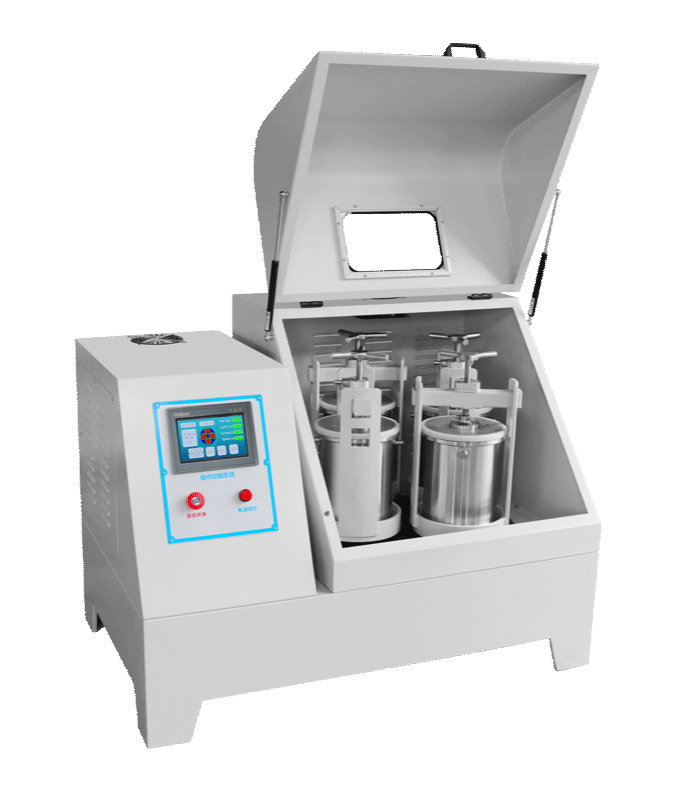
Description
Microcomputer Controlled Planetary Ball Mill
Product Introduction
Microcomputer controlled planetary ball mill is equipped with a touch screen control system on the basis of conventional planetary ball mills, which further upgrades the equipment grade and control performance. It is mainly designed for users with higher requirements on equipment quality and operation performance.
Application
Microcomputer controlled planetary ball mill is widely used in geology, mineral resources, metallurgy, electronics, building materials, ceramics, chemical industry, light industry, medicine, environmental protection and other industries.It is suitable for the production of electronic ceramics, structural ceramics, magnetic materials, lithium cobalt oxide, lithium manganate, catalysts, fluorescent powders, long afterglow luminescent powders, rare earth polishing powders, electronic glass powders, fuel cells, zinc oxide varistors, piezoelectric ceramics, nanomaterials, disc ceramic capacitors, MLCC, thermistors (PTC, NTC), dielectric ceramics, alumina ceramics, zirconia ceramics, zinc oxide powders, cobalt oxide powders, Ni-Zn ferrites, Mn-Zn ferrites and other products.
Product Features
The control system adopts branded hardware with powerful functions, including password setting, free programming, storage and call of multiple programs, process monitoring and fault alarm. The touch operation is intuitive, simple and user-friendly, realizing a friendly human-machine interface.
- Touch Screen: Easy to operate with a simple and intuitive interface, supporting forward and reverse rotation control, timing and power-off memory functions.
- Touch Screen PLC Integrated Machine: Flexible capacitive touch control with convenient adjustment, real-time equipment status monitoring, and customizable functions according to customer requirements.
Technical Parameters of Planetary Ball Mill
| No. | Model | Type | Jar Rotation Speed | Inner Diameter of Jar Base (mm) | Motor Power | Orbiting Diameter of Jar (mm) | Overall Dimension (mm) | Net Weight (kg) |
| 1 | XQM-0.2 | Mini Type | 0~1160 | 50 | 90W | Φ111 | 420×260×310 | 25 |
| 2 | XQM-0.2S | Mini Glove Box Type | 0~1160 | 50 | 90W | Φ111 | Equipment: 390×220×270Control Box: 200×180×240 | 29 |
| 3 | XQM-0.4A | Half-Round Type | 0~870 | 80 | 250W | Φ140 | 530×300×360 | 34 |
| 4 | XQM-6 | — | 0~670 | 134 | 0.75KW | Φ234 | 760×470×580 | 100 |
| 5 | XQM-4A | Half-Round Type | 0~670 | 134 | 0.75KW | Φ234 | 760×470×600 | 85 |
| 6 | XQM-(8-12) | — | 0~580 | 162 | 1.5KW | Φ275 | 900×600×640 | 168 |
| 7 | XQM-(8-12)A | Half-Round Type | 0~580 | 162 | 1.5KW | Φ275 | 880×560×642 | 150 |
| 8 | XQM-16A | Half-Round Type | 0~510 | 182 | 3KW | Φ320 | 950×600×710 | 205 |
| 9 | XQM-20 | — | 0~430 | 222 | 4KW | Φ385 | 1200×790×930 | 392 |
| 10 | XQM-40 | — | 0~390 | 250 | 5.5KW | Φ430 | 1400×880×1070 | 656 |
| 11 | XQM-60 | — | 0~260(1:1.5) | 275 | 7.5KW | Φ490 | 1600×1070×1250 | 950 |
| 12 | XQM-100 | — | 0~240(1:1.5) | 326 | 11KW | Φ578 | 1750×1140×1330 | 1300 |
| 13 | XQM-200 | — | 0~215 | 460 | 22KW | Φ738 | 2670×1600×2804 | 2725 |
Supporting Products
We also supply various grinding balls: stainless steel balls, zirconia balls, alumina balls, PU balls, cemented carbide balls, tungsten balls, agate balls, silicon nitride balls, high wear-resistant steel balls, manganese steel balls, nylon balls, glass balls and other special metal material balls.
We also provide grinding jars of various materials: agate, alumina corundum ceramics, zirconia ceramics, silicon nitride ceramics, silicon carbide ceramics, stainless steel, wear-resistant steel, manganese steel, nylon, polyurethane, cemented carbide, crystal glass, etc.
This equipment must be operated with appropriate personal protective equipment including safety glasses and hearing protection. All electrical connections must be grounded and rated for the specified voltage to prevent shock hazards.
- Rotational Safety: Keep all body parts, loose clothing, and tools clear of rotating jars and the sun wheel during operation.
- Vacuum Mode Integrity: Confirm all seals and vacuum connections are intact before initiating vacuum grinding to avoid containment loss and sample contamination.
- Grinding Media Selection: Use only compatible jar and ball materials rated for the intended sample chemistry to prevent exothermic reactions or fracture.
- Thermal Management: Monitor motor and bearing temperatures during prolonged operation; allow cooldown intervals to prevent overheating and mechanical degradation.
- Power Supply Protection: Utilize a surge-protected power source and never operate the mill with damaged cables or plugs to mitigate electrical fire risk.
Follow these steps to safely initialize and operate the mill for dry, wet, or vacuum grinding modes. Always verify mode-specific parameters before starting the run.
Required Equipment: Planetary ball mill with touch screen control, Grinding jars and matching balls, Vacuum pump (for vacuum mode), Sample and grinding medium
- Jar and media preparation
Select and securely fasten the appropriate grinding jar and media onto the sun wheel, ensuring balanced loading to prevent vibration. - Mode selection and parameter input
Set the desired grinding mode (dry, wet, or vacuum) and program rotation speed, direction, and duration through the touch screen interface. - Safety verification
Confirm that the lid is closed, all guards are in place, and no obstructions are near the rotating assembly before powering the system. - Start grinding cycle
Initiate the programmed cycle and monitor the equipment status via the real-time display, aborting immediately if unusual noise or vibration occurs. - Post-run shutdown
Allow the mill to come to a complete stop before opening the lid; then carefully remove the jars and inspect for debris or damage. - Vacuum mode specific steps
For vacuum grinding, connect the vacuum pump to the jar port, evacuate to the required level, then close the valve before starting the rotation.
For the XQM-200, how does the choice of grinding ball material (e.g., agate vs. tungsten carbide) impact contamination levels when milling high-purity materials like lithium cobalt oxide?
Agate balls provide low contamination for materials not requiring silica purity, while tungsten carbide balls offer high density and wear resistance but may introduce tungsten and cobalt traces. The mill supports a wide range of ball materials including stainless steel, zirconia, alumina, agate, silicon nitride, and cemented carbide, allowing selection based on target material purity requirements.
Can the XQM-200 be programmed for automated bidirectional milling with defined rest intervals to prevent overheating in long-duration runs?
Yes, the touch screen PLC control system supports free programming including forward and reverse rotation, timing, and power-off memory. Users can program specific milling intervals and rest periods to manage thermal buildup during extended grinding processes.
What are the electrical supply and floor loading specifications required for safe installation of the XQM-200?
The XQM-200 requires a 22 KW motor power connection and a floor area of 2670 mm by 1600 mm. With a net weight of 2725 kg, the installation floor must have adequate load-bearing capacity to support the mill's mass.
The Atomfair XQM-200 planetary ball mill integrates a microcomputer-controlled touch screen with dry, wet, and vacuum grinding modes, offering a 200-liter jar capacity for lab-scale production of advanced materials. Its 22 kW motor and 2725 kg mass require dedicated industrial installation.
Positive
- Programmable touch screen control: The PLC-integrated capacitive touch screen enables real-time monitoring, forward/reverse rotation, timing, power-off memory, and customizable programs, allowing precise process control for reproducible grinding protocols.
- Multi-mode grinding versatility: Supports dry, wet, and vacuum grinding modes, combined with a wide selection of jar and ball materials (e.g., agate, zirconia, stainless steel), making it suitable for diverse materials including ceramics, battery cathodes, and nanomaterials.
Trade-offs
- Large footprint and weight: With overall dimensions of 2670 mm × 1600 mm × 2804 mm and a net weight of 2725 kg, the mill requires a reinforced floor and dedicated laboratory space, limiting placement flexibility.
- High power and electrical demand: A 22 kW motor necessitates a three-phase industrial power supply and proper electrical infrastructure, which may not be available in standard academic lab settings without upgrades.
Every advanced material, component, equipment, and instrument in our catalog is backed by rigorous testing. We maintain strict internal quality management frameworks and align with CE conformity metrics to deliver transparent, reproducible performance data via our public open-science repository.
To request raw batch performance data, submit formal vendor registration paperwork, or execute a fast-turnaround R&D manufacturing loop, contact us at inquiry@atomfair.com.
Item is dispatched under the Atomfair Shipping & Delivery Framework (Free worldwide shipping on orders over $59 USD). Return is governed by the Atomfair Return & Refund Policy (7-day technical return window).