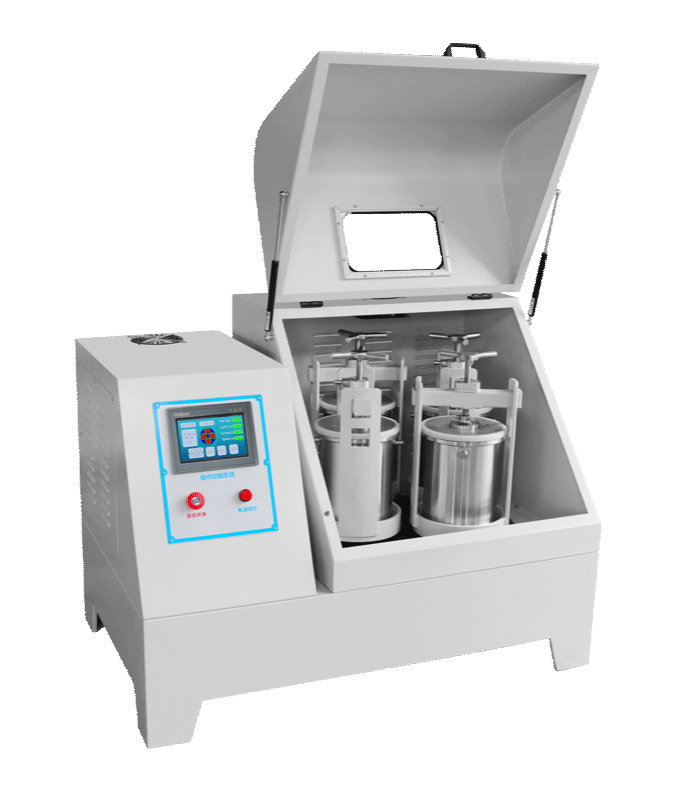
Description
Microcomputer Controlled Planetary Ball Mill
Product Introduction
Microcomputer controlled planetary ball mill is equipped with a touch screen control system on the basis of conventional planetary ball mills, which further upgrades the equipment grade and control performance. It is mainly designed for users with higher requirements on equipment quality and operation performance.
Application
Microcomputer controlled planetary ball mill is widely used in geology, mineral resources, metallurgy, electronics, building materials, ceramics, chemical industry, light industry, medicine, environmental protection and other industries.It is suitable for the production of electronic ceramics, structural ceramics, magnetic materials, lithium cobalt oxide, lithium manganate, catalysts, fluorescent powders, long afterglow luminescent powders, rare earth polishing powders, electronic glass powders, fuel cells, zinc oxide varistors, piezoelectric ceramics, nanomaterials, disc ceramic capacitors, MLCC, thermistors (PTC, NTC), dielectric ceramics, alumina ceramics, zirconia ceramics, zinc oxide powders, cobalt oxide powders, Ni-Zn ferrites, Mn-Zn ferrites and other products.
Product Features
The control system adopts branded hardware with powerful functions, including password setting, free programming, storage and call of multiple programs, process monitoring and fault alarm. The touch operation is intuitive, simple and user-friendly, realizing a friendly human-machine interface.
- Touch Screen: Easy to operate with a simple and intuitive interface, supporting forward and reverse rotation control, timing and power-off memory functions.
- Touch Screen PLC Integrated Machine: Flexible capacitive touch control with convenient adjustment, real-time equipment status monitoring, and customizable functions according to customer requirements.
Technical Parameters of Planetary Ball Mill
| No. | Model | Type | Jar Rotation Speed | Inner Diameter of Jar Base (mm) | Motor Power | Orbiting Diameter of Jar (mm) | Overall Dimension (mm) | Net Weight (kg) |
| 1 | XQM-0.2 | Mini Type | 0~1160 | 50 | 90W | Φ111 | 420×260×310 | 25 |
| 2 | XQM-0.2S | Mini Glove Box Type | 0~1160 | 50 | 90W | Φ111 | Equipment: 390×220×270Control Box: 200×180×240 | 29 |
| 3 | XQM-0.4A | Half-Round Type | 0~870 | 80 | 250W | Φ140 | 530×300×360 | 34 |
| 4 | XQM-6 | — | 0~670 | 134 | 0.75KW | Φ234 | 760×470×580 | 100 |
| 5 | XQM-4A | Half-Round Type | 0~670 | 134 | 0.75KW | Φ234 | 760×470×600 | 85 |
| 6 | XQM-(8-12) | — | 0~580 | 162 | 1.5KW | Φ275 | 900×600×640 | 168 |
| 7 | XQM-(8-12)A | Half-Round Type | 0~580 | 162 | 1.5KW | Φ275 | 880×560×642 | 150 |
| 8 | XQM-16A | Half-Round Type | 0~510 | 182 | 3KW | Φ320 | 950×600×710 | 205 |
| 9 | XQM-20 | — | 0~430 | 222 | 4KW | Φ385 | 1200×790×930 | 392 |
| 10 | XQM-40 | — | 0~390 | 250 | 5.5KW | Φ430 | 1400×880×1070 | 656 |
| 11 | XQM-60 | — | 0~260(1:1.5) | 275 | 7.5KW | Φ490 | 1600×1070×1250 | 950 |
| 12 | XQM-100 | — | 0~240(1:1.5) | 326 | 11KW | Φ578 | 1750×1140×1330 | 1300 |
| 13 | XQM-200 | — | 0~215 | 460 | 22KW | Φ738 | 2670×1600×2804 | 2725 |
Supporting Products
We also supply various grinding balls: stainless steel balls, zirconia balls, alumina balls, PU balls, cemented carbide balls, tungsten balls, agate balls, silicon nitride balls, high wear-resistant steel balls, manganese steel balls, nylon balls, glass balls and other special metal material balls.
We also provide grinding jars of various materials: agate, alumina corundum ceramics, zirconia ceramics, silicon nitride ceramics, silicon carbide ceramics, stainless steel, wear-resistant steel, manganese steel, nylon, polyurethane, cemented carbide, crystal glass, etc.
Operate the mill only with the touch screen PLC integrated machine active for fault monitoring. Use password settings to prevent unauthorized operation and ensure safe startup sequences.
- Electrical grounding: Ensure the mill is connected to a grounded electrical outlet to avoid shock hazards.
- Speed limit: Do not exceed the maximum jar rotation speed of 510 rpm as specified for the XQM-16A model.
- Jar locking: Confirm grinding jars are securely locked onto the planetary disk before starting rotation.
- Alarm response: Immediately stop the machine if the fault alarm activates and inspect for errors.
- Weight handling: Use appropriate lifting equipment to move the 205 kg mill to prevent injury.
This procedure describes safe startup and monitoring of the semi-circular planetary ball mill. Follow these steps to ensure proper grinding while avoiding mechanical and electrical hazards.
Required Equipment: Atomfair XQM-16A Planetary Ball Mill
- Pre-inspection
Inspect the mill and touch screen for any signs of damage or malfunction prior to operation. - Parameter setting
Set the rotation speed, direction, and grinding time via the capacitive touch interface. - Security configuration
Configure password protection to prevent unauthorized parameter changes if desired. - Operation monitoring
Monitor the real-time equipment status and fault alarm display during operation. - Program recall
After grinding, use the power-off memory function to resume or recall the program if needed.
How does the XQM-16A's larger jar size (182 mm inner diameter) and lower maximum speed (510 rpm) affect grinding efficiency compared to smaller, higher-speed planetary ball mills?
The XQM-16A prioritizes batch capacity over maximum impact energy due to its 182 mm jar base diameter and 510 rpm top speed. Smaller models like the XQM-0.2 achieve finer particles at 1160 rpm but handle only 50 mm jars, making the XQM-16A better suited for large-volume coarse or moderate grinding where throughput outweighs ultimate fineness.
What are the material compatibility constraints for grinding lithium battery cathode materials such as LiCoO₂ or LiMn₂O₄ in the XQM-16A?
For contamination-sensitive cathode materials, use grinding jars and balls made from zirconia ceramics, alumina ceramics, or agate, as these are non-metallic and chemically inert. The XQM-16A supports these jar materials directly per catalog. Avoid ferrous-based wear-resistant steel or manganese steel to prevent iron contamination that degrades battery performance.
What electrical and space infrastructure is needed to install the XQM-16A semi-circular planetary ball mill?
The XQM-16A requires a 3KW motor supply and a footprint of at least 950×600 mm based on its overall dimensions, with an additional clearance for jar loading. Its net weight of 205 kg demands a reinforced benchtop or floor stand. The touch-screen PLC includes real-time monitoring and fault alarms, so a stable, dry power circuit is essential.
The Atomfair XQM-16A semi-circular planetary ball mill integrates a touch screen PLC control system with programmable operation for reproducible grinding of advanced ceramics, battery materials, and catalysts, but requires separate procurement of grinding jars and media and adequate bench space due to its 205 kg weight.
Positive
- Touch screen PLC control with programmability: The integrated touch screen and PLC allow users to set, store, and recall multiple grinding programs, monitor real-time equipment status, and receive fault alarms, enhancing reproducibility and user-friendliness for complex grinding protocols.
- Broad material compatibility for advanced applications: The mill is designed for grinding electronic ceramics, lithium battery materials, catalysts, and nanomaterials, making it suitable for R&D in energy storage, electronics, and advanced functional materials.
Trade-offs
- Requires separate grinding jars and media: The XQM-16A is supplied without grinding jars or balls; users must purchase compatible jars and media from the supporting products list to operate the mill.
- Heavy unit with specific floor space needs: With a net weight of 205 kg and overall dimensions of 950×600×710 mm, the mill demands a sturdy workbench and adequate laboratory footprint, which may constrain placement in smaller facilities.
Every advanced material, component, equipment, and instrument in our catalog is backed by rigorous testing. We maintain strict internal quality management frameworks and align with CE conformity metrics to deliver transparent, reproducible performance data via our public open-science repository.
To request raw batch performance data, submit formal vendor registration paperwork, or execute a fast-turnaround R&D manufacturing loop, contact us at inquiry@atomfair.com.
Item is dispatched under the Atomfair Shipping & Delivery Framework (Free worldwide shipping on orders over $59 USD). Return is governed by the Atomfair Return & Refund Policy (7-day technical return window).