
Description
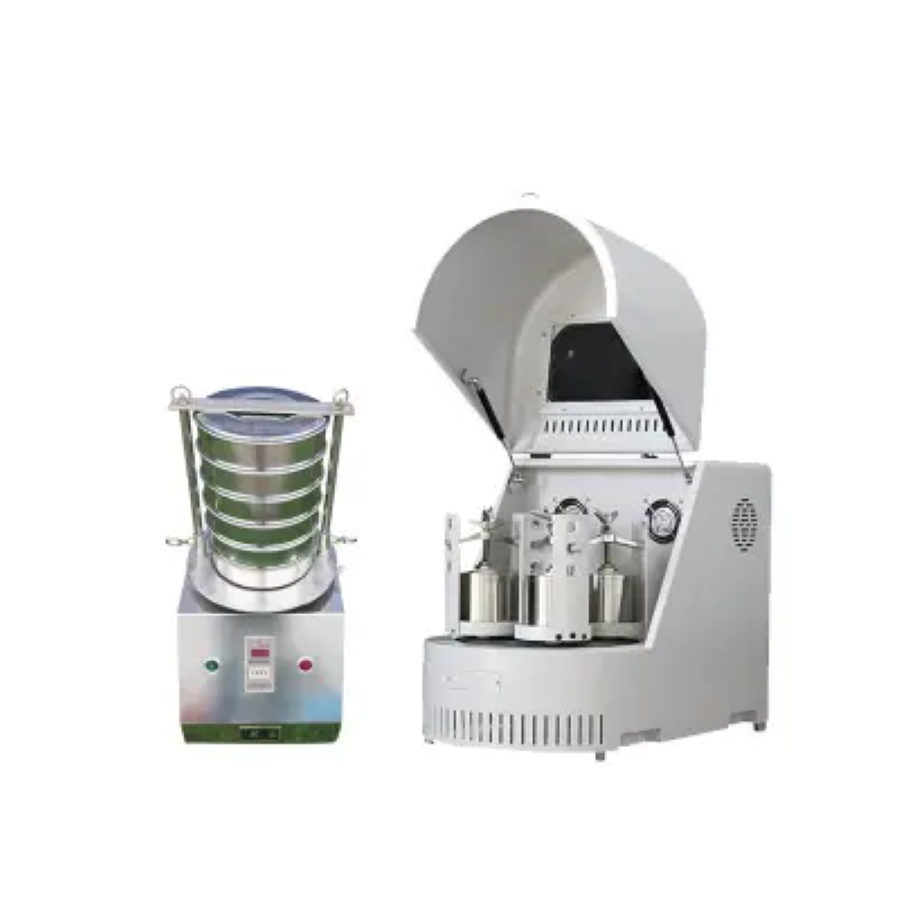
Soil Grinding and Screening Machine
Product Introduction
This machine is designed for heavy metal analysis in soil, equipped with 4 agate grinding jars. The sealing pressure of the agate grinding jars is adjustable via a graduated scale. The grinding jars rotate reversely around their own axes while revolving around the turntable axis. Samples inside the jars collide and rub against each other at high speed, achieving sample crushing, grinding, mixing and dispersion. It supports dry grinding, wet grinding and vacuum grinding. Two or four grinding jars can work simultaneously at a time.
Technical Parameter Table of Planetary Ball Mill
| No. | Model | Style | Jar Rotation Speed | Jar Holder Inner Diameter (mm) | Motor Power | Jar Revolution Diameter (mm) | Overall Dimensions (mm) | Net Weight (kg) |
| 1 | XQM-0.2 | Mini Type | 0~1160 r/min | 50 | 90W | Φ111 | 420×260×310 | 25 |
| 2 | XQM-0.2S | Mini Glove Box Type | 0~1160 r/min | 50 | 90W | Φ111 | Main Unit: 390×220×270Control Box: 200×180×240 | 29 |
| 3 | XQM-0.4A | Semi-Circular Type | 0~870 r/min | 80 | 250W | Φ140 | 530×300×360 | 34 |
| 4 | XQM-6 | – | 0~670 r/min | 134 | 0.75KW | Φ234 | 760×470×580 | 100 |
| 5 | XQM-4A | Semi-Circular Type | 0~670 r/min | 134 | 0.75KW | Φ234 | 760×470×600 | 85 |
| 6 | XQM-(8-12) | – | 0~580 r/min | 162 | 1.5KW | Φ275 | 900×600×640 | 168 |
| 7 | XQM-(8-12)A | Semi-Circular Type | 0~580 r/min | 162 | 1.5KW | Φ275 | 880×560×642 | 150 |
| 8 | XQM-16A | Semi-Circular Type | 0~510 r/min | 182 | 3KW | Φ320 | 950×600×710 | 205 |
| 9 | XQM-20 | – | 0~430 r/min | 222 | 4KW | Φ385 | 1200×790×930 | 392 |
| 10 | XQM-40 | – | 0~390 r/min | 250 | 5.5KW | Φ430 | 1400×880×1070 | 656 |
| 11 | XQM-60 | – | 0~260 r/min (1:1.5) | 275 | 7.5KW | Φ490 | 1600×1070×1250 | 950 |
| 12 | XQM-100 | – | 0~240 r/min (1:1.5) | 326 | 11KW | Φ578 | 1750×1140×1330 | 1300 |
| 13 | XQM-200 | – | 0~215 r/min | 460 | 22KW | Φ738 | 2670×1600×2804 | 2725 |
Technical Specifications of Soil Grinding and Screening Machine
- Voltage: 220V AC
- Feed Particle Size: ≤10 mm for soil samples, ≤3 mm for other materials; Discharge Particle Size: as fine as 0.1 μm
- Rotation Speed (r/min): Revolution: 35-335 r/min; Rotation: 70-670 r/min
- Three-Phase Motor Variable Frequency Controller Power: 0.75KW (with power display electronic monitoring device; Continuous operation timer (min); Forward-reverse commutation cycle (min))
- Speed Control Mode: Stepless speed regulation, automatic timing for forward and reverse rotation, automatic stop
- Continuous Working Time (Full Load): 48 hours
- Electric Screener: Capable of holding seven layers of sieves with a diameter of 200 mm; Screening range: 20-200 mesh (20 microns), digital display; Screening vibration frequency: 1400 rpm
Standard Configuration of Soil Grinding and Screening Machine
- Main grinding unit
- 4 pcs of 250 ml agate grinding jars, 700 pcs of agate grinding balls
- Electric screener
- A complete set of round frame sieves (20, 40, 60, 80, 100, 120, 140, 160, 180, 200 mesh) and base
Working Principle
This machine is used for heavy metal analysis in soil, equipped with 4 agate grinding jars. The sealing pressure of the agate grinding jars is set by a graduated scale. The jars revolve around the turntable axis and rotate reversely around their own axes at the same time. Samples in the jars collide and rub against each other during high-speed movement, so as to crush, grind, mix and disperse samples. It can be used for dry grinding, wet grinding and vacuum grinding. Two or four grinding jars can operate at the same time.
Supporting Products Supply
We also supply various grinding balls: stainless steel balls, zirconia balls, alumina balls, PU balls, cemented carbide balls, tungsten balls, agate balls, hard alloy balls, silicon nitride balls, high wear-resistant steel balls, manganese steel balls, nylon balls, glass balls and other special metal material balls.
We also provide grinding jars of various materials: agate, alumina corundum ceramic, zirconia ceramic, silicon nitride ceramic, silicon carbide ceramic, stainless steel, wear-resistant steel, manganese steel, nylon, polyurethane, hard alloy, crystal glass, etc.
This equipment operates with adjustable sealing pressure on agate grinding jars, requiring monitoring to prevent over-pressurization. Electrical safety requires proper grounding and use of specified 220V AC supply to avoid shock hazards.
- Sealing Pressure Limit: Verify that the sealing pressure adjustment does not exceed the jar's rated pressure to avoid rupture.
- Material Compatibility: Only use agate jars for heavy metal analysis to prevent sample contamination.
- Electrical Supply: Connect the mill to a grounded 220V AC outlet matching the specified voltage.
- Vacuum Grinding: For vacuum operation, ensure jars are fitted with vacuum-rated seals and connectors.
- Load Balancing: Balance the mass of sample and balls in each jar to minimize vibration during operation.
Follow these steps to safely grind soil samples for heavy metal analysis. Proper jar sealing and load balancing are critical for safe operation.
Required Equipment: Agate grinding jars, Sealing pressure adjustment scale
- Inspect Jars
Inspect each agate jar for cracks, chips, or other damage before use. - Load Sample
Place the soil sample and grinding balls into each jar, ensuring equal weight distribution across all jars. - Seal Jars
Seal the jars and adjust the sealing pressure using the graduated scale to the recommended setting. - Secure Jars
Secure the sealed jars into the turntable holders by tightening the clamping screws. - Set Parameters
Set the rotation speed and grinding time on the control panel according to the sample requirements. - Start Grinding
Start the mill and monitor the operation for abnormal vibrations or noise throughout the cycle. - Cool and Open
Allow the jars to cool to room temperature before opening to release any residual pressure.
How does the XQM-100 achieve a final particle size as fine as 0.1 μm when processing soil, and what compromises in grinding speed are necessary at this large-capacity scale?
The XQM-100, designed for 100L extra-large capacity, achieves particle sizes as fine as 0.1 μm through high-energy planetary motion, with its four agate jars rotating at speeds up to 240 r/min (1:1.5 ratio) and a revolution diameter of 578 mm. However, due to its large capacity, the maximum jar rotation speed is capped at 240 r/min, which is significantly lower than smaller models, representing a trade-off between batch volume and maximum grinding intensity.
What constraints limit the use of alternative grinding jar materials, such as stainless steel or zirconia, in the XQM-100 when performing trace heavy metal analysis on soil samples?
For soil heavy metal analysis, the XQM-100 is specifically equipped with agate grinding jars to prevent metallic contamination from jar materials. While alternative jar materials like stainless steel, zirconia, and alumina are available as supporting products, they can introduce trace metals into the sample, making them unsuitable for trace heavy metal analysis unless cross-contamination risks are fully assessed and mitigated.
What are the minimum power supply and floor-loading specifications required to install and operate the 1300 kg XQM-100 planetary ball mill?
The XQM-100 requires a 220V AC power source capable of delivering 11KW, necessitating a dedicated high-amp circuit. With a net weight of 1300 kg and overall dimensions of 1750×1140×1330 mm, the installation floor must support this static and dynamic load while accommodating vibration from continuous operation up to 48 hours.
The XQM-100 planetary ball mill is engineered for soil heavy metal analysis, combining a 100L capacity with four agate grinding jars that enable dry, wet, or vacuum grinding. Its integrated electric screener with multi-mesh sieves provides direct particle size classification down to 0.1 μm, though the 1300 kg net weight and 1.75 m footprint demand substantial lab space and floor reinforcement.
Positive
- Multi-mode grinding capability: Supports dry, wet, and vacuum grinding operations, offering flexibility for diverse sample preparation protocols. The planetary action with counter-rotation crushes soil samples to a discharge fineness as low as 0.1 μm.
- Integrated electric sieve analysis: Includes a built-in electric screener that holds seven layers of 200 mm diameter sieves (20–200 mesh), enabling simultaneous particle size classification and streamlining the workflow from grinding to fractionation.
Trade-offs
- High weight and large footprint: At 1300 kg net weight and dimensions of 1750×1140×1330 mm, the unit requires reinforced flooring, dedicated lab space, and mechanical handling equipment for installation and relocation.
- Agate jar brittleness and contamination risk: The included agate jars are essential for heavy metal analysis but are brittle and prone to chipping under heavy impact. Additionally, agate wear may introduce silicon traces, warranting verification for ultra-trace metal workflows.
Every advanced material, component, equipment, and instrument in our catalog is backed by rigorous testing. We maintain strict internal quality management frameworks and align with CE conformity metrics to deliver transparent, reproducible performance data via our public open-science repository.
To request raw batch performance data, submit formal vendor registration paperwork, or execute a fast-turnaround R&D manufacturing loop, contact us at inquiry@atomfair.com.
Item is dispatched under the Atomfair Shipping & Delivery Framework (Free worldwide shipping on orders over $59 USD). Return is governed by the Atomfair Return & Refund Policy (7-day technical return window).
