Description
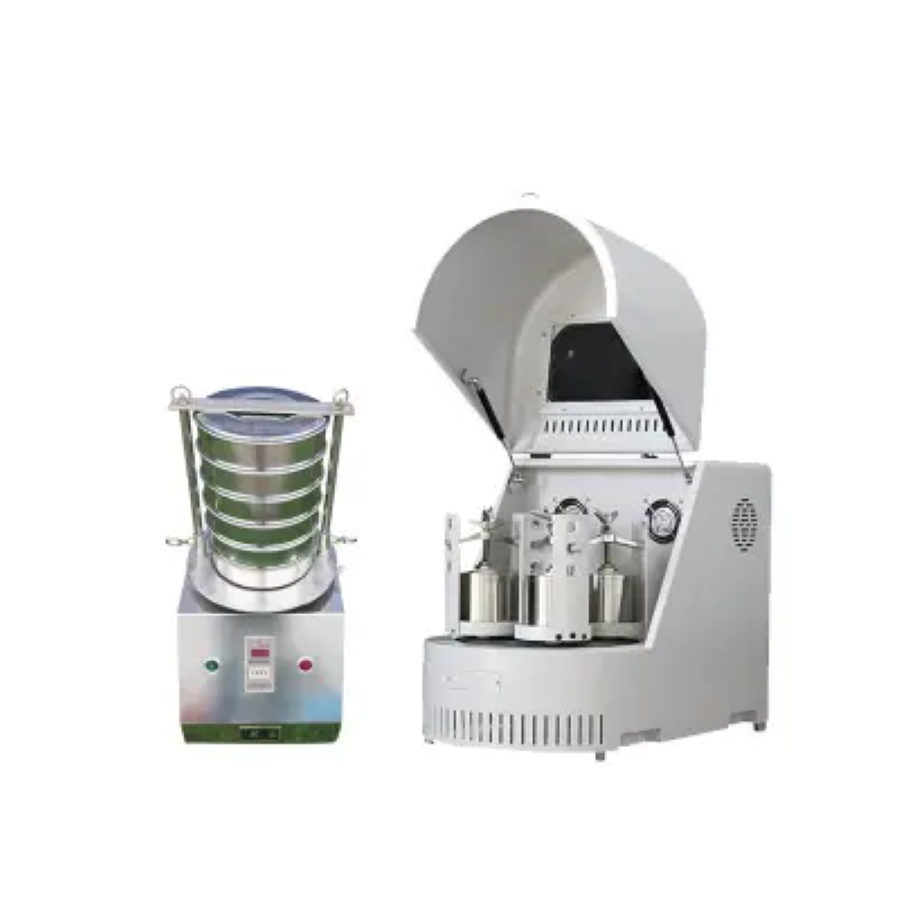
Soil Grinding and Screening Machine
Product Introduction
This machine is designed for heavy metal analysis in soil, equipped with 4 agate grinding jars. The sealing pressure of the agate grinding jars is adjustable via a graduated scale. The grinding jars rotate reversely around their own axes while revolving around the turntable axis. Samples inside the jars collide and rub against each other at high speed, achieving sample crushing, grinding, mixing and dispersion. It supports dry grinding, wet grinding and vacuum grinding. Two or four grinding jars can work simultaneously at a time.
Technical Parameter Table of Planetary Ball Mill
| No. | Model | Style | Jar Rotation Speed | Jar Holder Inner Diameter (mm) | Motor Power | Jar Revolution Diameter (mm) | Overall Dimensions (mm) | Net Weight (kg) |
| 1 | XQM-0.2 | Mini Type | 0~1160 r/min | 50 | 90W | Φ111 | 420×260×310 | 25 |
| 2 | XQM-0.2S | Mini Glove Box Type | 0~1160 r/min | 50 | 90W | Φ111 | Main Unit: 390×220×270Control Box: 200×180×240 | 29 |
| 3 | XQM-0.4A | Semi-Circular Type | 0~870 r/min | 80 | 250W | Φ140 | 530×300×360 | 34 |
| 4 | XQM-6 | – | 0~670 r/min | 134 | 0.75KW | Φ234 | 760×470×580 | 100 |
| 5 | XQM-4A | Semi-Circular Type | 0~670 r/min | 134 | 0.75KW | Φ234 | 760×470×600 | 85 |
| 6 | XQM-(8-12) | – | 0~580 r/min | 162 | 1.5KW | Φ275 | 900×600×640 | 168 |
| 7 | XQM-(8-12)A | Semi-Circular Type | 0~580 r/min | 162 | 1.5KW | Φ275 | 880×560×642 | 150 |
| 8 | XQM-16A | Semi-Circular Type | 0~510 r/min | 182 | 3KW | Φ320 | 950×600×710 | 205 |
| 9 | XQM-20 | – | 0~430 r/min | 222 | 4KW | Φ385 | 1200×790×930 | 392 |
| 10 | XQM-40 | – | 0~390 r/min | 250 | 5.5KW | Φ430 | 1400×880×1070 | 656 |
| 11 | XQM-60 | – | 0~260 r/min (1:1.5) | 275 | 7.5KW | Φ490 | 1600×1070×1250 | 950 |
| 12 | XQM-100 | – | 0~240 r/min (1:1.5) | 326 | 11KW | Φ578 | 1750×1140×1330 | 1300 |
| 13 | XQM-200 | – | 0~215 r/min | 460 | 22KW | Φ738 | 2670×1600×2804 | 2725 |
Technical Specifications of Soil Grinding and Screening Machine
- Voltage: 220V AC
- Feed Particle Size: ≤10 mm for soil samples, ≤3 mm for other materials; Discharge Particle Size: as fine as 0.1 μm
- Rotation Speed (r/min): Revolution: 35-335 r/min; Rotation: 70-670 r/min
- Three-Phase Motor Variable Frequency Controller Power: 0.75KW (with power display electronic monitoring device; Continuous operation timer (min); Forward-reverse commutation cycle (min))
- Speed Control Mode: Stepless speed regulation, automatic timing for forward and reverse rotation, automatic stop
- Continuous Working Time (Full Load): 48 hours
- Electric Screener: Capable of holding seven layers of sieves with a diameter of 200 mm; Screening range: 20-200 mesh (20 microns), digital display; Screening vibration frequency: 1400 rpm
Standard Configuration of Soil Grinding and Screening Machine
- Main grinding unit
- 4 pcs of 250 ml agate grinding jars, 700 pcs of agate grinding balls
- Electric screener
- A complete set of round frame sieves (20, 40, 60, 80, 100, 120, 140, 160, 180, 200 mesh) and base
Working Principle
This machine is used for heavy metal analysis in soil, equipped with 4 agate grinding jars. The sealing pressure of the agate grinding jars is set by a graduated scale. The jars revolve around the turntable axis and rotate reversely around their own axes at the same time. Samples in the jars collide and rub against each other during high-speed movement, so as to crush, grind, mix and disperse samples. It can be used for dry grinding, wet grinding and vacuum grinding. Two or four grinding jars can operate at the same time.
Supporting Products Supply
We also supply various grinding balls: stainless steel balls, zirconia balls, alumina balls, PU balls, cemented carbide balls, tungsten balls, agate balls, hard alloy balls, silicon nitride balls, high wear-resistant steel balls, manganese steel balls, nylon balls, glass balls and other special metal material balls.
We also provide grinding jars of various materials: agate, alumina corundum ceramic, zirconia ceramic, silicon nitride ceramic, silicon carbide ceramic, stainless steel, wear-resistant steel, manganese steel, nylon, polyurethane, hard alloy, crystal glass, etc.
This device operates with high rotational speeds and electrical power, posing risks of mechanical injury and electrical shock. Proper jar sealing pressure adjustment and symmetrical loading are critical to prevent imbalance and jar breakage.
- Jar Sealing Pressure: Adjust the jar sealing pressure via the graduated scale to ensure proper containment during grinding.
- Symmetrical Jar Loading: Always load two or four jars symmetrically to maintain balance and prevent excessive vibration.
- Feed Particle Size Limit: Do not exceed the maximum feed particle size of 10 mm for soil or 3 mm for other materials to avoid jamming.
- Electrical Safety: Connect the mill to a properly grounded 220V AC outlet and avoid operation in wet conditions.
- Mode Compatibility: Select dry, wet, or vacuum grinding mode only with the corresponding jar setup and lid sealing.
Follow these steps to initialize and conduct a grinding run while maintaining safety. Proper preparation of jars and symmetrical loading are essential for stable operation.
Required Equipment: Agate Grinding Jars
- Inspect Jars
Inspect each agate jar for cracks or damage before every use. - Adjust Sealing Pressure
Adjust the jar sealing pressure using the graduated scale to the appropriate level for the selected grinding mode. - Load Sample
Load the sample and grinding media into the jars, ensuring the feed particle size does not exceed the maximum limit. - Secure Jars
Secure the jars into the holders, ensuring symmetrical distribution of weight across the turntable. - Set Parameters
Set the desired rotation speed and grinding duration on the control panel. - Start Grinding
Start the grinding cycle and monitor the operation for any unusual noise or vibration. - Stop and Retrieve
After the cycle completes, allow the mill to come to a full stop before opening the lid and removing the jars.
How does the XQM-0.4A achieve submicron particle sizes down to 0.1 μm from a feed size of up to 10 mm, and what is the trade-off in throughput when targeting the finest grind?
The XQM-0.4A achieves 0.1 μm discharge by operating jar rotation speeds up to 870 r/min with stepless speed control and automatic forward-reverse commutation, generating high-energy collisions inside the 250 ml agate jars. To reach submicron fineness from soil feed ≤10 mm or other materials ≤3 mm, throughput must be reduced and run times extended up to the maximum 48-hour continuous full-load limit, as finer grinding requires longer duration and lower effective sample volume per batch.
Can the XQM-0.4A be used to grind non-soil materials like ceramics or hard metals without contaminating the sample, given its standard agate jars?
Yes, the XQM-0.4A supports grinding non-soil materials such as ceramics or hard metals with a feed size ≤3 mm, but using the standard agate jars may introduce silica contamination into samples requiring high purity. To avoid cross-contamination, the mill accepts alternative jar and ball materials available separately—including zirconia, alumina, stainless steel, tungsten carbide, silicon nitride, and nylon—allowing the user to match jar and ball chemistry exactly to the sample composition.
What are the infrastructure and handling requirements for operating the XQM-0.4A in vacuum grinding mode, and how is jar seal integrity maintained?
The XQM-0.4A requires a 220V AC supply and uses a 250W motor with a three-phase variable frequency controller rated at 0.75 kW; for vacuum grinding, each agate jar features an adjustable sealing pressure set via a graduated scale on the jar closure. The seal must be correctly tensioned before operation to maintain vacuum integrity, and given the mill's 48-hour continuous full-load capability, periodic seal inspection during extended runs is recommended to prevent leakage.
This semi-circular planetary ball mill is tailored for heavy metal soil analysis, achieving sub-micron particle sizes with four agate jars. It supports multiple grinding modes but requires pre-crushing for larger feed and an external pump for vacuum operation.
Positive
- Adjustable sealing pressure for reproducibility: The agate grinding jars feature a graduated scale for adjusting sealing pressure, enabling reproducible vacuum or wet grinding conditions essential for consistent soil sample preparation.
- Ultra-fine grinding to 0.1 μm: Discharge particle size can reach as fine as 0.1 μm, providing the high surface area and homogeneity required for sensitive heavy metal analysis in soil.
Trade-offs
- Feed particle size restriction: Maximum feed particle size is 10 mm for soil and 3 mm for other materials, necessitating pre-crushing or sieving for larger samples before milling.
- Vacuum pump not included: While the mill supports vacuum grinding, the standard configuration does not include a vacuum pump; users must supply compatible external vacuum equipment.
Every advanced material, component, equipment, and instrument in our catalog is backed by rigorous testing. We maintain strict internal quality management frameworks and align with CE conformity metrics to deliver transparent, reproducible performance data via our public open-science repository.
To request raw batch performance data, submit formal vendor registration paperwork, or execute a fast-turnaround R&D manufacturing loop, contact us at inquiry@atomfair.com.
Item is dispatched under the Atomfair Shipping & Delivery Framework (Free worldwide shipping on orders over $59 USD). Return is governed by the Atomfair Return & Refund Policy (7-day technical return window).