Description
Heavy-Duty Horizontal Planetary Ball Mill
Product Introduction
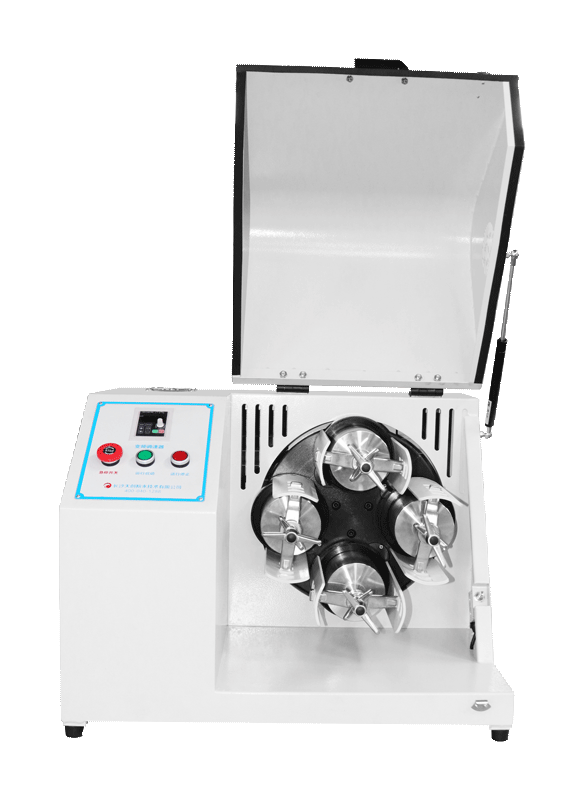
The heavy-duty horizontal planetary ball mill adopts a dual-disk support bracket structure at both ends, which effectively improves equipment stability and load-bearing capacity, overcoming the limitation that light-duty horizontal planetary ball mills are only suitable for light-load applications. This machine is mainly intended for pilot-scale tests or small-batch grinding production.
Operating Principle of Planetary Ball Mill
The main disk of the planetary ball mill is equipped with four grinding jars. As the motor drives the main disk to rotate, the jars revolve around the main disk shaft while rotating on their own under the drive of the planetary mechanism, forming a planetary motion. The grinding balls inside the jars rub and collide with each other during high-speed planetary movement, enabling efficient grinding and sample mixing.
Product Application
Heavy-duty horizontal planetary ball mills are widely used in geology, mineral resources, metallurgy, electronics, building materials, ceramics, chemical industry, light industry, medicine, environmental protection and other fields.They are suitable for the production of electronic ceramics, structural ceramics, magnetic materials, lithium cobalt oxide, lithium manganate, catalysts, fluorescent powders, long afterglow luminescent powders, rare earth polishing powders, electronic glass powders, fuel cells, zinc oxide varistors, piezoelectric ceramics, nanomaterials, wafer ceramic capacitors, MLCC, thermistors (PTC, NTC), dielectric ceramics, alumina ceramics, zirconia ceramics, zinc oxide powder, cobalt oxide powder, Ni-Zn ferrites, Mn-Zn ferrites and other materials.
Product Features
The equipment features a professional industrial exterior design. The casing is welded with thickened steel plates, delivering high strength, impact resistance, deformation resistance and a robust appearance. Machined parts undergo strict heat treatment and CNC processing. Transmission gears are precision-made from special materials, ensuring stable, safe and low-noise operation at high speeds.The machine is equipped with a brake locking function to guarantee safe operation during jar lifting, loading and locking. The integrated lifting and discharging device incorporates vibrating screen discharging technology, enabling quick jar handling, unloading and charging to improve production efficiency.A microcomputer touch screen is adopted for easy and intuitive operation. It supports forward and reverse alternating control, timing function and power-off memory.
Technical Parameters
| Model | Drive Ratio (rpm) | Jar Rotation Speed (rpm) | Jar Holder Inner Diameter (mm) | Motor Power | Jar Revolution Diameter (mm) | Overall Dimensions (mm) | Net Weight (kg) |
| WXQM-(2-6) | 0.134 | 0~670 | 134 | 0.75KW | Φ234 | 700×560×530 | 96 |
| WXQM-(2-6)(H) | 0.134 | 0~670 | 134 | 1.5KW | Φ234 | 1220×620×810 | 266 |
| WXQM-(8-12) | 0.116 | 0~580 | 162 | 1.5KW | Φ275 | 1360×670×920 | 380 |
| WXQM-16 | 0.096 | 0~480 | 182 | 3KW | Φ385 | 1640×840×1040 | 470 |
| WXQM-20 | 0.086 | 0~430 | 200 | 4KW | Φ385 | 1640×840×1040 | 730 |
| WXQM-40 | 0.086 | 0~430 | 250 | 5.5KW | Φ430 | 1780×860×1070 | 790 |
| WXQM-60 | 0.062 | 0~310 (1:1.5) | 275 | 7.5KW | Φ490 | 1980×1050×1220 | 1070 |
| WXQM-100 | 0.058 | 0~290 (1:1.5) | 328 | 11kW | Φ578 | 2110×1150×1370 | 1210 |
Working Principle
The heavy-duty horizontal ball mill drives grinding media and materials through the rotation of a horizontal cylinder:
- Cylinder Rotation: The motor, via a reducer, rotates the cylinder around a horizontal axis. Grinding media (steel balls, etc.) inside rise along the cylinder wall to a certain height and then fall freely.
- Grinding Effect: Falling media impact and crush materials, while friction and shearing between materials and media further refine particles.
- Classified Discharging: Materials are ground stage by stage through multi-compartment diaphragms and finally discharged through a grid, realizing continuous production.
Selection Guide
Capacity Requirements
Select cylinder volume based on output: 50L–500L for small-scale production, and above 1000L (e.g., 5000L-class equipment) for large industrial lines.
Material Characteristics
- High-hardness materials require highly wear-resistant linings (e.g., manganese steel or zirconia) and large-sized grinding media.
- Wet grinding needs corrosion-resistant cylinders and sealed structures.
Energy Consumption & Maintenance
- Prioritize models with rolling bearings and variable frequency speed control to reduce energy consumption and improve control accuracy.
- Regularly inspect lining wear and lubrication systems for long-term stable operation.
Special Requirements
- For ultra-fine powders (≤1μm), a forced stirring system or counter-rotating device is recommended to enhance grinding efficiency.
For industries with high cleanliness requirements (pharmaceuticals, food, etc.), full stainless steel structure and pollution-free linings are required.
This industrial ball mill requires a stable, grounded electrical supply and must be operated in a dry, ventilated environment to prevent electrical hazards. Mechanical lockout procedures are mandatory during jar loading and unloading to avoid injury from rotating components.
- Electrical Safety: Ensure the mill is connected to a properly grounded electrical supply with a dedicated circuit breaker to prevent electrical shock and equipment damage.
- Mechanical Lockout: Engage the brake locking mechanism before any jar loading, unloading, or maintenance to prevent unintentional rotation.
- Environmental Conditions: Operate the mill in a dry, well-ventilated area free of flammable dust and vapors to reduce fire risk.
- Vibration and Stability: Place the mill on a level, rigid surface that can support its weight and dampen vibrations to avoid mechanical stress.
This procedure describes the safe initialization and operation of the horizontal planetary ball mill for grinding materials. The steps cover jar loading, parameter setting, milling, and discharge using the integrated vibrating screen.
Required Equipment: Integrated jar lifting device, Microcomputer touch screen interface, Vibrating screen discharge assembly
- Inspection and Lockout
Inspect the mill for visible damage and confirm the brake locking mechanism is engaged before proceeding. - Jar Loading
Load the grinding jars with sample material and grinding media, then securely lock them into the holders using the integrated lifting device. - Parameter Setting
Set the rotation speed, run time, and direction alternation parameters through the microcomputer touch screen interface. - Milling Operation
Start the mill and monitor for unusual vibrations or noise, keeping the protective casing closed during operation. - Discharge
Engage the brake lock after the cycle completes, then activate the vibrating screen discharge mechanism to collect the ground material.
How does the WXQM-100's revolution diameter of Φ578 mm and 0.058 drive ratio influence grinding energy transfer compared to smaller models?
The WXQM-100 has the largest revolution diameter (Φ578 mm) and lowest drive ratio (0.058) in the series, delivering high torque for large-volume, heavy-load grinding at the cost of reduced maximum jar rotation speed (0–290 rpm, compared to 0–670 rpm on smaller models like the WXQM-2-6). This trade-off favors efficient pilot-scale processing of high-hardness materials but may limit ultrafine particle size reduction for nanomaterials. The 11 kW motor provides the necessary power to sustain these operating conditions.
What material and lining requirements are necessary when using the WXQM-100 for grinding high-hardness ceramics or corrosive slurries?
For high-hardness materials like alumina or zirconia ceramics, the WXQM-100 must be equipped with highly wear-resistant linings such as manganese steel or zirconia and paired with larger grinding media. For wet grinding of corrosive slurries, corrosion-resistant cylinders and sealed structures are mandatory to prevent chemical attack and contamination. These components are not standard on the base model and require specification at order.
What safety and handling features does the WXQM-100 include to manage its 1210 kg net weight during jar loading and discharging?
The WXQM-100 incorporates a brake locking function that secures the main disk during jar lifting, loading, and locking to prevent unintended rotation. An integrated lifting and discharging device with vibrating screen technology enables quick jar handling and material discharge without requiring separate hoisting equipment for jars. Despite the 1210 kg net weight and overall dimensions of 2110×1150×1370 mm, these features allow safe, single-operator handling of the grinding jars.
The WXQM-100 is a heavy-duty horizontal planetary ball mill designed for pilot-scale and small-batch grinding, featuring a dual-disk support structure for stability and an integrated vibrating screen discharging system for production efficiency. Its 11kW motor and large revolution diameter (Φ578 mm) enable processing of hard and abrasive materials, though specialized linings and optional ultra-fine grinding accessories may be required for demanding applications.
Positive
- Dual-Disk Support for Heavy Loads: The dual-disk support bracket at both ends enhances equipment stability and load-bearing capacity, enabling this mill to handle heavy pilot-scale and small-batch production that light-duty mills cannot accommodate.
- Integrated Vibrating Screen Discharging: The built-in lifting and discharging device with vibrating screen technology allows rapid jar handling, unloading, and charging, significantly boosting production efficiency in batch processing.
Trade-offs
- Material-Specific Lining Requirements: High-hardness and wet-grinding applications require specialized wear-resistant or corrosion-resistant linings (e.g., manganese steel, zirconia) not included as standard, necessitating customization for certain materials.
- Additional Gear for Ultra-Fine Grinding: Achieving particles ≤1 μm may require external forced stirring or counter-rotating devices, as the standard planetary motion alone may not provide sufficient grinding intensity for ultra-fine targets.
Every advanced material, component, equipment, and instrument in our catalog is backed by rigorous testing. We maintain strict internal quality management frameworks and align with CE conformity metrics to deliver transparent, reproducible performance data via our public open-science repository.
To request raw batch performance data, submit formal vendor registration paperwork, or execute a fast-turnaround R&D manufacturing loop, contact us at inquiry@atomfair.com.
Item is dispatched under the Atomfair Shipping & Delivery Framework (Free worldwide shipping on orders over $59 USD). Return is governed by the Atomfair Return & Refund Policy (7-day technical return window).