
Description
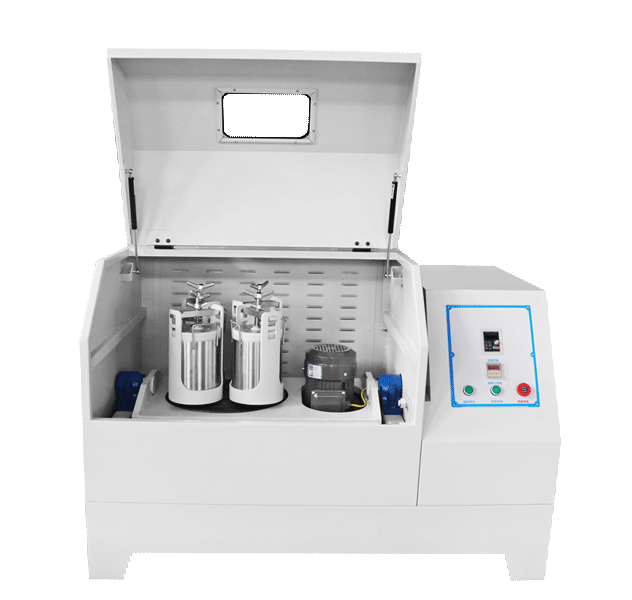
360° Rotating Planetary Ball Mill
- Product Name
360° Omnidirectional Laboratory Planetary Ball Mill, 360° Rotating Planetary Ball Mill
- Working Principle
Based on a vertical planetary ball mill, this equipment adds a planetary disk overturning function.While performing planetary motion, the planetary disk and grinding jars can carry out 360° tipping overturning in threedimensional space, realizing multidimensional and multidirectional movement of the jars.This enhances the disordered motion of grinding balls and materials, enabling 360° grinding inside the jar for finer and more uniform powder, and solves the problems of material sedimentation and wall adhesion.
- Applications
Widely used in geology, mining, metallurgy, electronics, building materials, ceramics, chemical industry, light industry, medicine, environmental protection and other fields.Suitable for the production of electronic ceramics, structural ceramics, magnetic materials, lithium cobalt oxide, lithium manganate, catalysts, phosphors, long afterglow luminescent powders, rare earth polishing powders, electronic glass powders, fuel cells, zinc oxide varistors, piezoelectric ceramics, nanomaterials, ceramic disc capacitors, MLCC, thermistors (PTC, NTC), ZnO varistors, dielectric ceramics, alumina ceramics, zirconia ceramics, zinc oxide powder, cobalt oxide powder, NiZn ferrites, MnZn ferrites and other products.
- Product Features
- Professional industrial exterior design with lean manufacturing and exquisite workmanship.
- Machined parts adopt CNC technology; transmission gears are precision-made from special materials, ensuring stable, safe and lownoise highspeed operation.
- The overturning motor features brake locking, allowing stopping at any angle safely and reliably.
- Equipped with a microcomputer touch screen for convenient operation and a simple, intuitive interface.
- Supports forward and reverse alternating control with timer and power-off memory functions.
- Optional integrated microcomputer touchscreen PLC control panel.
- Technical Parameters
| Model | Jar Rotation Speed (rpm) | Jar Holder ID (mm) | Motor Power | Jar Orbit Diameter (mm) | Overall Dimensions (mm) | Net Weight (kg) | |
| QXQM0.4 | 0~870 | 80 | 250W | Φ140 | 900×570×666.5 | 136 | |
| QXQM(26) | 0~670 | 134 | 0.75KW | Φ234 | 1330×810×860 | 305 | |
| QXQM(812) | 0~580 | 162 | 1.5KW | Φ275 | 1360×850×930 | 430 | |
| QXQM16 | 0~510 | 182 | 3KW | Φ320 | 1530×1018×1100 | 580 | |
| QXQM20 | 0~430 | 222 | 4KW | Φ385 | 1700×1210×1300 | 1180 | |
| QXQM40 | 0~390 | 250 | 5.5KW | Φ430 | 1900×1450×1480 | 1430 | |
| QXQM100 | 0~240 | 326 | 11KW | Φ578 | 2939×1680×2450 | 3900 | |
| Item | Specification | ||||||
| Transmission Mode | Gear drive | ||||||
| Working Mode | Two or four grinding jars working simultaneously | ||||||
| Max. Loading (Material + Grinding Balls) | Twothirds of jar volume | ||||||
| Jar Volume | 0.05L–25L per jar, total 0.2L–100L | ||||||
| Feed Size | Soil ≤10mm; others ≤3mm | ||||||
| Discharge Size | Down to 0.1μm (varies by material and process) | ||||||
| Speed Ratio (Revolution : Rotation) | Refer to main parameters | ||||||
| Rotation Speed | Refer to main parameters | ||||||
| Speed Control | Stepless speed regulation by brand inverter | ||||||
- Supplementary Products
We also supply various grinding balls: stainless steel balls, zirconia balls, alumina balls, PU balls, carbon steel balls, tungsten balls, agate balls, cemented carbide balls, silicon nitride balls, high wearresistant steel balls, manganese steel balls, nylon balls, cemented carbide, glass and other special metal materials.
We also provide grinding jars of various materials: agate, alumina corundum ceramic, zirconia ceramic, silicon nitride ceramic, silicon carbide ceramic, stainless steel, wearresistant steel, manganese steel, nylon, polyurethane, cemented carbide, crystal glass, etc.
- Core Parameters & Characteristics of Grinding Jars
| Category | Product Name | Core Material / Technology | Model Examples (Volume) | Density | Hardness | Wear Resistance | Key Features & Advantages | Applicable Materials | Cautions & Contraindications |
| Metal | 304 Stainless Steel Grinding Jar | Highquality SUS304 stainless steel | 50ml, 100ml, 250ml, 500ml, 1L, 2L, 4L, 5L, 10L, 20L, 25L | ~7.9 g/cm³ | HRC 20–30 | Medium | Sturdy, durable, costeffective; customizable vacuum jar; standard laboratory choice. | Materials insensitive to metal ions: chemicals, alloy powders, soil, ores. | Not for highpurity materials sensitive to Fe/Cr/Ni (battery materials, highend ceramics); strong acids/alkalis. |
| Cemented Carbide Grinding Jar | WCCo sintered, ultrawearresistant | 50ml, 100ml, 250ml, 500ml, 1L, 1.5L, 2L | 14.5–15.0 g/cm³ | HRA 88–93 | Top | “King of Grinding”: extremely high hardness, minimal wear, long service life, high ROI. | Ultrahard materials: SiC, diamond, carbide powder; ultrafine grinding of highvalue materials. | Avoid severe impact; high procurement cost. | |
| Ceramic | Zirconia Grinding Jar | Yttriastabilized zirconia, highdensity sintered | 50ml, 100ml, 250ml, 500ml, 1L, 1.5L, 2L, 2.5L, 3L, 4L, 5L | 6.0 g/cm³ | HV ~1250 | Excellent | Highpurity allround performance; zero metal contamination, high hardness, toughness, corrosion resistance. | Lithium battery materials, electronic ceramics, pharmaceutical nanopowders, highend pigments, catalysts. | Avoid extreme thermal shock. |
| Alumina / Corundum Grinding Jar | Highpurity αAl₂O₃ sintered | 25ml, 50ml, 100ml, 250ml, 500ml, 1L, 1.5L, 2L, 2.5L, 3L | 3.6–3.9 g/cm³ | Mohs 9 | Excellent | High hardness, heat resistance, economical; wear resistance second only to zirconia. | Ceramic glazes, refractories, quartz, feldspar and other mediumhigh hardness minerals. | Not for Alsensitive materials; fragile, avoid impact. | |
| Polymer | Nylon Grinding Jar | Pure white PA66 nylon, precision machined | 25ml, 50ml, 100ml, 250ml, 500ml, 1L, 1.5L, 2L (large volume with stainless steel outer shell) | ~1.15 g/cm³ | Low | Good | Lightweight, metalfree, rustproof, corrosionresistant; ideal for ironsensitive wet grinding. | Precious metal powders, highgrade pigments, coatings, pharmaceuticals and ironfree materials. | Avoid temperatures <120℃, acids/alkalis, solvents, highhardness materials. |
| PTFE Grinding Jar | Pure PTFE integrally machined | 25ml, 50ml, 100ml, 250ml, 500ml, 1L, 1.5L, 2L (large volume with stainless steel outer shell) | ~2.2 g/cm³ | Low | Good | “King of Corrosion Resistance”: chemically inert, acid/alkaliproof, nonstick, easy to clean. | Strong acid/alkali systems, reactive chemicals, ultrapure material synthesis and grinding. | Avoid impact grinding of hard materials; longterm use <250℃. | |
| Polyurethane (PU) Grinding Jar | Highwear PU, integrally cast | 100ml, 250ml, 500ml, 1L | ~1.2 g/cm³ | Low | Excellent (elastic wearresistant) | High elasticity, shock absorption, noise reduction; tight seal prevents leakage and wall adhesion. | Electronic pastes, battery slurries, inks, soft material mixing, dispersion and homogenization. | Avoid hard material grinding; hightemperature environments. | |
| Natural | Agate Grinding Jar | Natural agate | 50ml, 100ml, 150ml, 250ml, 300ml, 400ml, 500ml, 1000ml, 2000ml | ~2.65 g/cm³ | Mohs 7 | Good | “Gold Standard” for laboratory analysis; 100% metalfree for accurate testing. | Geology, environmental, agricultural sample preparation; food and drug testing; highpurity research. | Avoid grinding materials harder than Mohs 7; severe impact. |
| Functional / Composite | Planetary Vacuum Grinding Jar | Stainless steel body with highvacuum sealing system | Customizable (50ml–2L typical) | Same as main material | Same as main material | Same as main material | Inert atmosphere protection; vacuum or Ar/N₂ filling; antioxidation, antivolatilization. | Active metals (Mg, Ti, Li alloys), oxidizable materials, lowmelting materials, dangerous goods. | Avoid seal aging; proper operation to maintain vacuum. |
| Stainless Steel Lined Zirconia Jar | Stainless steel shell + thickwall zirconia liner | 2.5L, 3L, 4L, 5L, 10L, 15L, 20L, 25L | Composite structure | Highhardness liner | Excellent (liner) | Strong and tough combination for largecapacity highpurity grinding; strength + purity. | Mass production of highpurity materials: battery materials, electronic ceramic powders. | Avoid liner stress damage under extreme conditions (low probability). |
This equipment requires a stable, grounded power supply and must be operated in a well-ventilated area free of flammable materials. Store the mill in a dry, temperature-controlled environment to prevent electrical component degradation and mechanical wear.
- Electrical Safety: Ensure the power cord is properly grounded and the main power switch is accessible before operation.
- Mechanical Loading: Do not exceed the maximum loading capacity of two-thirds of jar volume to avoid imbalance and mechanical stress.
- Environmental Storage: Store the mill in an environment with relative humidity below 70% to prevent corrosion of exposed metal parts.
- Brake Engagement: The overturning motor brake must be engaged before any jar change or maintenance procedure.
- Compatible Components: Use only grinding jars and media specified for the QXQM-40 model to prevent mechanical failure or imbalance.
Follow these steps to safely set up and run the planetary ball mill for large-batch grinding. Proper initialization ensures mechanical integrity and prevents material spillage or damage.
Required Equipment: Grinding jars of appropriate size, Grinding balls (specified diameter), Material to be ground, Protective gloves
- Inspect the mill
Inspect the mill for any visible damage and ensure all fasteners are tight before use. - Install grinding jars
Install the appropriate grinding jars onto the jar holders and confirm the locking mechanism is engaged. - Load materials
Load the material and grinding balls into the jars, filling no more than two-thirds of the jar volume. - Set parameters
Set the desired rotation speed and time on the microcomputer touchscreen interface. - Start operation
Press the start button and monitor the operation for any abnormal vibration or noise. - Stop and retrieve
After completion, allow the mill to come to a complete stop before opening the lid or removing jars. - Clean up
Clean the jars and mill surfaces after each use to prevent cross-contamination and material buildup.
How does the 360° rotating mechanism of the QXQM-40 improve grinding of materials prone to sedimentation and wall adhesion?
The 360° overturning motion combined with planetary rotation creates multidimensional jar movement, preventing material sedimentation and wall adhesion. This enables finer and more uniform powders down to 0.1 μm, even for sticky materials like lithium cobalt oxide or long-afterglow phosphors, by continuously reorienting the grinding path inside the jar while maintaining a maximum loading of two-thirds jar volume.
Which grinding jar material should be selected for processing high-purity battery cathode materials to minimize contamination?
For high-purity battery materials such as lithium cobalt oxide or lithium manganate, avoid 304 stainless steel jars due to the described risk of Fe/Cr/Ni ion contamination. Instead, select zirconia ceramic or agate jars from the product's available jar materials, as these provide chemical inertness and high wear resistance suitable for contamination-sensitive grinding.
What are the essential infrastructure requirements for operating the QXQM-40 5.5 kW planetary ball mill in a research lab?
The QXQM-40 requires a 5.5 kW electrical supply, a floor area of at least 1900 × 1450 mm, and a load capacity exceeding its 1430 kg net weight. The overturning motor features brake locking for safe stopping at any angle, and the microcomputer touch screen provides operational control.
The Atomfair QXQM-40 360° Rotating Planetary Ball Mill delivers industrial-scale wet/dry grinding for battery ceramics and advanced powders, using 5.5 kW gear-drive with full jar overturning to eliminate sedimentation. Its 40L total capacity and submicron discharge capability suit high-throughput R&D or pilot production, though feed pre-processing and volumetric loading limits must be factored into workflow planning.
Positive
- 360° jar overturning eliminates sedimentation: The planetary disk and jars tip over in 3D space during operation, creating multidirectional ball motion that prevents material sedimentation and wall adhesion, resulting in finer, more uniform powder even for sticky or dense formulations.
- Programmable control with power-off memory: A microcomputer touch screen supports forward/reverse alternating cycles, timing, and power-off memory, enabling automatic runs with reproducible process parameters for consistent batch outcomes.
Trade-offs
- Feed size requires pre-crushing: Maximum feed size is 10 mm for soil and 3 mm for other materials; larger particles must be pre-ground before loading into the mill, adding a preparation step for coarse feedstock.
- Effective batch volume limited to two-thirds of jar capacity: The combined material and grinding ball load must not exceed two-thirds of each jar's volume, reducing the nominal 40 L total to a practical working capacity of roughly 26–27 L per batch.
Every advanced material, component, equipment, and instrument in our catalog is backed by rigorous testing. We maintain strict internal quality management frameworks and align with CE conformity metrics to deliver transparent, reproducible performance data via our public open-science repository.
To request raw batch performance data, submit formal vendor registration paperwork, or execute a fast-turnaround R&D manufacturing loop, contact us at inquiry@atomfair.com.
Item is dispatched under the Atomfair Shipping & Delivery Framework (Free worldwide shipping on orders over $59 USD). Return is governed by the Atomfair Return & Refund Policy (7-day technical return window).
