Description
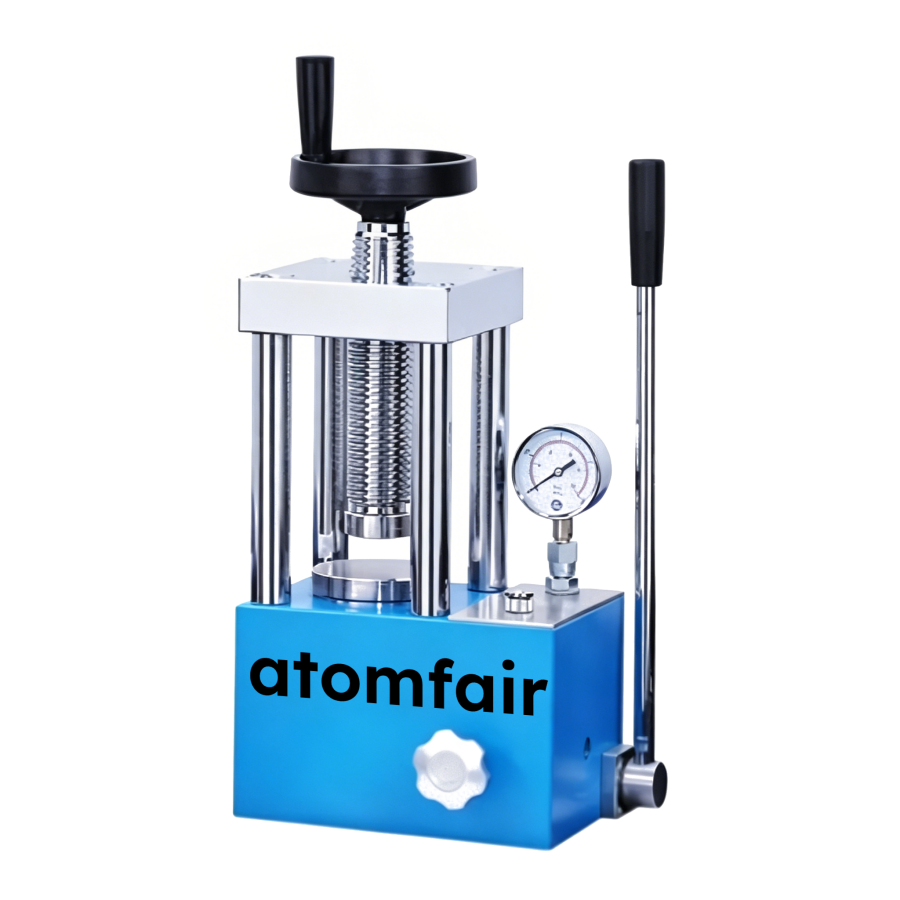
ATOMFAIR PPF-367 PROTECTIVE MANUAL POWDER PELLET PRESS (0-30 TON)SAFETY-ENHANCED LAB COMPACTION COMPONENT
|
|||||||||||||||||||||||||
|
|||||||||||||||||||||||||
|
TAILORED SOLUTIONS FOR RESEARCH
Contact our engineering team for technical support or customized equipment quotations.
EMAIL: INQUIRY@ATOMFAIR.COM
|
|||||||||||||||||||||||||
|
Manufacturer: Atomfair LLC
Brand: ATOMFAIR
|
Store the press on a stable, level benchtop in a dry, temperature-controlled environment to prevent corrosion and mechanical misalignment. The integrated safety shield must remain undamaged and fully closed during all pressing operations to contain potential debris or sample ejection.
- Overload Prevention: Never apply pressure beyond the calibrated 30-ton maximum to avoid mechanical overload and structural failure.
- Shield Operation: Position the safety shield fully closed before initiating any pressing cycle to contain ejected fragments or powder.
- Hydraulic Release: Engage the pressure release valve gradually to control decompression and prevent sudden piston recoil.
This procedure outlines the safe and effective operation of the PPF-367 press for preparing uniform powder pellets. Follow each step sequentially to ensure operator safety and sample integrity.
Required Equipment: PPF-367 Manual Powder Pellet Press, Sample die and plunger set
- Inspect Equipment
Inspect the safety shield, hydraulic hoses, and pressure gauge for any damage or leaks before each use. - Prepare Sample Assembly
Load the powder sample into the die, assemble the plunger, and center the die on the press platen under the piston. - Close Shield and Apply Pressure
Close the safety shield completely, then slowly pump the hydraulic lever to increase pressure to the target value within the 0–30 ton range. - Hold and Release Pressure
Maintain the target pressure for the required dwell time, then turn the release valve counterclockwise to slowly decompress the system. - Retrieve Pellet
Retract the piston fully, open the safety shield, and carefully disassemble the die to extract the formed pellet.
Does the 30 mm ram stroke restrict the thickness of pellets or the height of die assemblies that can be used?
Yes. The 30 mm vertical piston stroke limits the combined height of the die and powder sample to under 30 mm. For typical FTIR pellet dies requiring less than 20 mm, this is adequate, but thicker specimens or taller die components may not fit without risking incomplete compaction or mechanical interference.
What are the maximum allowable die dimensions that can be accommodated in the PPF-367 press workspace?
The internal column clearance is 112 mm × 160 mm, meaning dies must fit within this space. The 110 mm piston further restricts die diameter to a maximum of about 110 mm if centered. Standard FTIR dies up to 40 mm diameter are easily accommodated, but larger or non-standard dies require verification of clearance against these two constraints.
What specific bench or support infrastructure is required to safely operate the 65 kg PPF-367 press at full 30-ton load?
The press weighs 65 kg and must be placed on a lab bench capable of supporting this static load plus the dynamic force of manual pumping. A reinforced benchtop or hydraulic press stand rated for at least 100 kg is recommended. Additionally, the safety shield must be secured before applying pressure to contain potential sample fragments.
The PPF-367 manual powder pellet press delivers 0-30 ton compaction via a safety-shielded, four-pillar frame that maintains alignment and reduces disk cracking, but operators must ensure the 65 kg unit is mounted on a rated bench and never exceed the 30-ton maximum to avoid valve damage.
Positive
- Integrated Safety Shielding Barrier: Physical containment blocking potential sample fragments or brittle shards during maximum load processing arrays, enhancing operator protection in high-risk compaction workflows.
- Rigid Four-Pillar Architecture: Eliminates minor axis distortion under deep loading intervals, yielding parallel compaction faces and mitigating disk cracking for reproducible sample quality.
Trade-offs
- Heavy Benchtop Infrastructure Requirement: The 65 kg net mass necessitates verification that the target laboratory table can safely sustain the load, as stated in the operational compliance notice.
- Manual Over-Pressure Risk: The manual hydraulic actuation requires strict operator discipline to never pump past the 30-ton maximum ceiling, in order to maintain interior line and valve tolerances.
Every advanced material, component, equipment, and instrument in our catalog is backed by rigorous testing. We maintain strict internal quality management frameworks and align with CE conformity metrics to deliver transparent, reproducible performance data via our public open-science repository.
To request raw batch performance data, submit formal vendor registration paperwork, or execute a fast-turnaround R&D manufacturing loop, contact us at inquiry@atomfair.com.
Item is dispatched under the Atomfair Shipping & Delivery Framework (Free worldwide shipping on orders over $59 USD). Return is governed by the Atomfair Return & Refund Policy (7-day technical return window).