
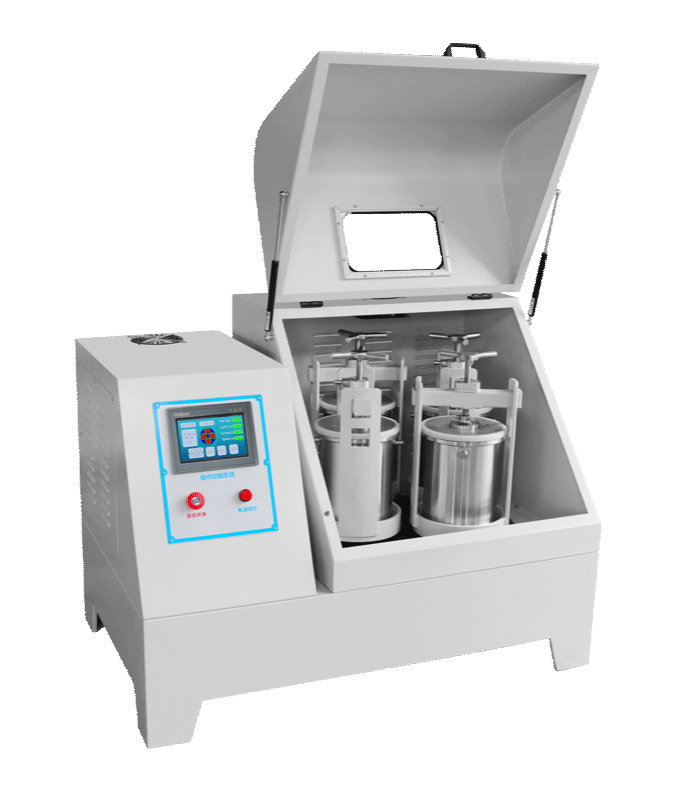
Description
Microcomputer Controlled Planetary Ball Mill
Product Introduction
Microcomputer controlled planetary ball mill is equipped with a touch screen control system on the basis of conventional planetary ball mills, which further upgrades the equipment grade and control performance. It is mainly designed for users with higher requirements on equipment quality and operation performance.
Application
Microcomputer controlled planetary ball mill is widely used in geology, mineral resources, metallurgy, electronics, building materials, ceramics, chemical industry, light industry, medicine, environmental protection and other industries.It is suitable for the production of electronic ceramics, structural ceramics, magnetic materials, lithium cobalt oxide, lithium manganate, catalysts, fluorescent powders, long afterglow luminescent powders, rare earth polishing powders, electronic glass powders, fuel cells, zinc oxide varistors, piezoelectric ceramics, nanomaterials, disc ceramic capacitors, MLCC, thermistors (PTC, NTC), dielectric ceramics, alumina ceramics, zirconia ceramics, zinc oxide powders, cobalt oxide powders, Ni-Zn ferrites, Mn-Zn ferrites and other products.
Product Features
The control system adopts branded hardware with powerful functions, including password setting, free programming, storage and call of multiple programs, process monitoring and fault alarm. The touch operation is intuitive, simple and user-friendly, realizing a friendly human-machine interface.
- Touch Screen: Easy to operate with a simple and intuitive interface, supporting forward and reverse rotation control, timing and power-off memory functions.
- Touch Screen PLC Integrated Machine: Flexible capacitive touch control with convenient adjustment, real-time equipment status monitoring, and customizable functions according to customer requirements.
Technical Parameters of Planetary Ball Mill
| No. | Model | Type | Jar Rotation Speed | Inner Diameter of Jar Base (mm) | Motor Power | Orbiting Diameter of Jar (mm) | Overall Dimension (mm) | Net Weight (kg) |
| 1 | XQM-0.2 | Mini Type | 0~1160 | 50 | 90W | Φ111 | 420×260×310 | 25 |
| 2 | XQM-0.2S | Mini Glove Box Type | 0~1160 | 50 | 90W | Φ111 | Equipment: 390×220×270Control Box: 200×180×240 | 29 |
| 3 | XQM-0.4A | Half-Round Type | 0~870 | 80 | 250W | Φ140 | 530×300×360 | 34 |
| 4 | XQM-6 | — | 0~670 | 134 | 0.75KW | Φ234 | 760×470×580 | 100 |
| 5 | XQM-4A | Half-Round Type | 0~670 | 134 | 0.75KW | Φ234 | 760×470×600 | 85 |
| 6 | XQM-(8-12) | — | 0~580 | 162 | 1.5KW | Φ275 | 900×600×640 | 168 |
| 7 | XQM-(8-12)A | Half-Round Type | 0~580 | 162 | 1.5KW | Φ275 | 880×560×642 | 150 |
| 8 | XQM-16A | Half-Round Type | 0~510 | 182 | 3KW | Φ320 | 950×600×710 | 205 |
| 9 | XQM-20 | — | 0~430 | 222 | 4KW | Φ385 | 1200×790×930 | 392 |
| 10 | XQM-40 | — | 0~390 | 250 | 5.5KW | Φ430 | 1400×880×1070 | 656 |
| 11 | XQM-60 | — | 0~260(1:1.5) | 275 | 7.5KW | Φ490 | 1600×1070×1250 | 950 |
| 12 | XQM-100 | — | 0~240(1:1.5) | 326 | 11KW | Φ578 | 1750×1140×1330 | 1300 |
| 13 | XQM-200 | — | 0~215 | 460 | 22KW | Φ738 | 2670×1600×2804 | 2725 |
Supporting Products
We also supply various grinding balls: stainless steel balls, zirconia balls, alumina balls, PU balls, cemented carbide balls, tungsten balls, agate balls, silicon nitride balls, high wear-resistant steel balls, manganese steel balls, nylon balls, glass balls and other special metal material balls.
We also provide grinding jars of various materials: agate, alumina corundum ceramics, zirconia ceramics, silicon nitride ceramics, silicon carbide ceramics, stainless steel, wear-resistant steel, manganese steel, nylon, polyurethane, cemented carbide, crystal glass, etc.
The mill must be operated on a stable, level surface with adequate ventilation to dissipate motor heat. Proper electrical grounding and overload protection are required to prevent electrical hazards.
- Electrical and Mechanical Safety: Ensure the power supply matches the motor rating and the mill is placed away from flammable materials to mitigate fire risk from rotating components.
This procedure outlines the initialization and safe handling steps for the planetary ball mill. Follow the touch screen interface to control rotation speed, direction, and timing.
Required Equipment: Touch Screen PLC Integrated Machine, Grinding Jars and Grinding Balls
- Setup and Power Connection
Place the mill on a stable, level surface and connect it to a properly grounded power outlet matching the motor specifications. - Load Sample and Grinding Media
Fill the grinding jars with the sample material and appropriate grinding balls, then securely fasten the lids and mount the jars onto the planetary base. - Configure Parameters via Touch Screen
Use the touch screen interface to set rotation speed, forward/reverse direction, and total milling time, then activate the power-off memory function to retain settings. - Start Milling Process
Press the start button on the touch screen to begin milling, and monitor real-time operation status through the process monitoring display. - Shutdown and Unload
After milling completes, allow the mill to come to a full stop, then carefully remove jars and extract the ground sample for analysis.
How does the jar rotation speed of 0–580 rpm and 1.5 kW motor on the XQM-(8-12) affect grinding efficiency for hard materials like zirconia or silicon nitride?
The XQM-(8-12) offers a jar rotation speed range of 0–580 rpm driven by a 1.5 kW motor, which provides sufficient torque for medium to large batch grinding of hard materials. For high-hardness materials like zirconia or silicon nitride, operating at higher speeds within this range can increase impact energy, but may require longer grinding times compared to smaller mills with higher rpm. The specific jar and ball material selection (e.g., zirconia jars and balls) further optimizes wear resistance and contamination control.
What jar and ball material combinations are recommended for grinding lithium cobalt oxide or fuel cell catalysts in the XQM-(8-12) to avoid contamination?
For lithium cobalt oxide or fuel cell catalyst grinding, zirconia ceramic jars and zirconia balls are recommended to minimize metal contamination, as zirconia is chemically inert and wear-resistant. The XQM-(8-12) accommodates jars with an inner diameter of 162 mm and an orbiting diameter of 275 mm, allowing use of standard 500–1000 ml jars. Agate jars are also suitable for non-metallic samples requiring ultra-low contamination, while tungsten carbide jars may be used for extremely hard materials.
What are the electrical and space requirements for installing the XQM-(8-12) planetary ball mill in a laboratory?
The XQM-(8-12) requires a single-phase 1.5 kW electrical supply (typically 220V/50Hz or 110V/60Hz depending on region) and a sturdy benchtop capable of supporting its 168 kg net weight. Its overall dimensions are 900×600×640 mm, so a bench area of at least 1 m x 0.7 m is recommended with access for cooling air. The microcomputer-controlled touch screen and PLC system support programmable operation and fault alarm, but no special ventilation or noise damping is mandatory.
The Atomfair XQM-(8-12) planetary ball mill combines a 1.5 kW motor with a touch-screen PLC for automated, reproducible grinding of large to medium batches. Its 162 mm jar base and 275 mm orbiting diameter deliver high-energy milling for a broad range of advanced materials, though its 168 kg mass and need for dedicated accessories require careful lab planning.
Positive
- Intuitive Touch Screen Control: The integrated PLC with capacitive touch screen allows multi-program storage, real-time monitoring, and fault alarm, enabling precise and user-friendly operation.
- Versatile Material Processing: Capable of grinding a wide range of materials from ceramics and oxides to catalysts and nanomaterials, supporting diverse R&D and production needs.
Trade-offs
- Significant Weight and Size: Weighing 168 kg and occupying 900x600x640 mm, it requires dedicated floor space and a robust support structure, limiting mobility.
- Accessory Selection Required: Effective grinding performance depends on choosing the correct jar and ball materials (sold separately) for each sample type, adding setup complexity.
Every advanced material, component, equipment, and instrument in our catalog is backed by rigorous testing. We maintain strict internal quality management frameworks and align with CE conformity metrics to deliver transparent, reproducible performance data via our public open-science repository.
To request raw batch performance data, submit formal vendor registration paperwork, or execute a fast-turnaround R&D manufacturing loop, contact us at inquiry@atomfair.com.
Item is dispatched under the Atomfair Shipping & Delivery Framework (Free worldwide shipping on orders over $59 USD). Return is governed by the Atomfair Return & Refund Policy (7-day technical return window).
