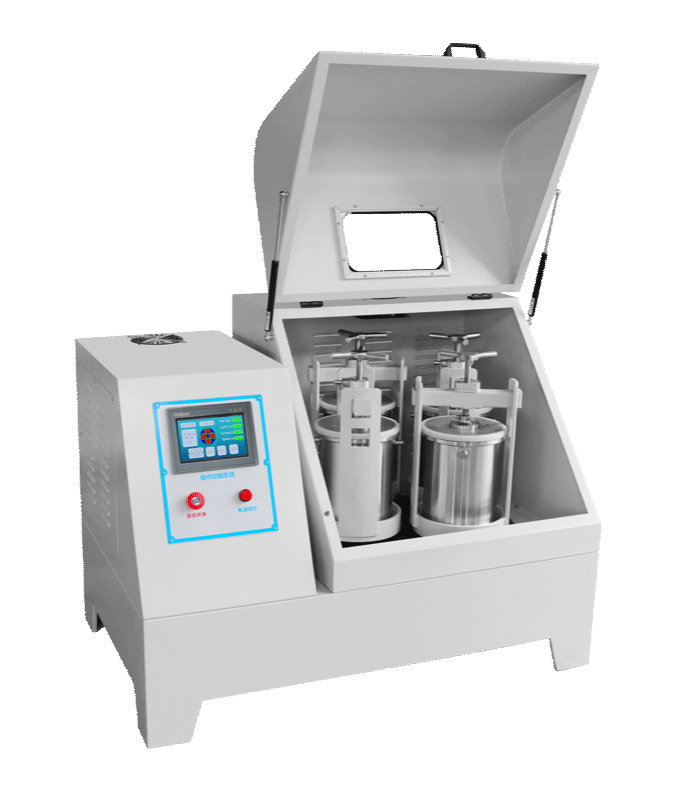
Description
Microcomputer Controlled Planetary Ball Mill
Product Introduction
Microcomputer controlled planetary ball mill is equipped with a touch screen control system on the basis of conventional planetary ball mills, which further upgrades the equipment grade and control performance. It is mainly designed for users with higher requirements on equipment quality and operation performance.
Application
Microcomputer controlled planetary ball mill is widely used in geology, mineral resources, metallurgy, electronics, building materials, ceramics, chemical industry, light industry, medicine, environmental protection and other industries.It is suitable for the production of electronic ceramics, structural ceramics, magnetic materials, lithium cobalt oxide, lithium manganate, catalysts, fluorescent powders, long afterglow luminescent powders, rare earth polishing powders, electronic glass powders, fuel cells, zinc oxide varistors, piezoelectric ceramics, nanomaterials, disc ceramic capacitors, MLCC, thermistors (PTC, NTC), dielectric ceramics, alumina ceramics, zirconia ceramics, zinc oxide powders, cobalt oxide powders, Ni-Zn ferrites, Mn-Zn ferrites and other products.
Product Features
The control system adopts branded hardware with powerful functions, including password setting, free programming, storage and call of multiple programs, process monitoring and fault alarm. The touch operation is intuitive, simple and user-friendly, realizing a friendly human-machine interface.
- Touch Screen: Easy to operate with a simple and intuitive interface, supporting forward and reverse rotation control, timing and power-off memory functions.
- Touch Screen PLC Integrated Machine: Flexible capacitive touch control with convenient adjustment, real-time equipment status monitoring, and customizable functions according to customer requirements.
Technical Parameters of Planetary Ball Mill
| No. | Model | Type | Jar Rotation Speed | Inner Diameter of Jar Base (mm) | Motor Power | Orbiting Diameter of Jar (mm) | Overall Dimension (mm) | Net Weight (kg) |
| 1 | XQM-0.2 | Mini Type | 0~1160 | 50 | 90W | Φ111 | 420×260×310 | 25 |
| 2 | XQM-0.2S | Mini Glove Box Type | 0~1160 | 50 | 90W | Φ111 | Equipment: 390×220×270Control Box: 200×180×240 | 29 |
| 3 | XQM-0.4A | Half-Round Type | 0~870 | 80 | 250W | Φ140 | 530×300×360 | 34 |
| 4 | XQM-6 | — | 0~670 | 134 | 0.75KW | Φ234 | 760×470×580 | 100 |
| 5 | XQM-4A | Half-Round Type | 0~670 | 134 | 0.75KW | Φ234 | 760×470×600 | 85 |
| 6 | XQM-(8-12) | — | 0~580 | 162 | 1.5KW | Φ275 | 900×600×640 | 168 |
| 7 | XQM-(8-12)A | Half-Round Type | 0~580 | 162 | 1.5KW | Φ275 | 880×560×642 | 150 |
| 8 | XQM-16A | Half-Round Type | 0~510 | 182 | 3KW | Φ320 | 950×600×710 | 205 |
| 9 | XQM-20 | — | 0~430 | 222 | 4KW | Φ385 | 1200×790×930 | 392 |
| 10 | XQM-40 | — | 0~390 | 250 | 5.5KW | Φ430 | 1400×880×1070 | 656 |
| 11 | XQM-60 | — | 0~260(1:1.5) | 275 | 7.5KW | Φ490 | 1600×1070×1250 | 950 |
| 12 | XQM-100 | — | 0~240(1:1.5) | 326 | 11KW | Φ578 | 1750×1140×1330 | 1300 |
| 13 | XQM-200 | — | 0~215 | 460 | 22KW | Φ738 | 2670×1600×2804 | 2725 |
Supporting Products
We also supply various grinding balls: stainless steel balls, zirconia balls, alumina balls, PU balls, cemented carbide balls, tungsten balls, agate balls, silicon nitride balls, high wear-resistant steel balls, manganese steel balls, nylon balls, glass balls and other special metal material balls.
We also provide grinding jars of various materials: agate, alumina corundum ceramics, zirconia ceramics, silicon nitride ceramics, silicon carbide ceramics, stainless steel, wear-resistant steel, manganese steel, nylon, polyurethane, cemented carbide, crystal glass, etc.
This planetary ball mill must be placed on a stable, level surface and connected to a grounded electrical outlet to prevent electrical hazards. All milling jar lids must be securely tightened before operation to avoid mechanical ejection or imbalance.
- Electrical Safety: Operate the mill only with a properly rated power supply and verify that the motor does not exceed its rated power of 3 kW.
- Mechanical Containment: Inspect jars and sealing gaskets for damage before each use to prevent leaks or detachment during rotation.
- Environmental Conditions: Keep the mill away from flammable or explosive atmospheres and ensure adequate ventilation to dissipate heat generated during operation.
- Material Compatibility: Use only milling jars and media that are chemically compatible with the sample to avoid corrosion or contamination.
Follow these steps to safely initialize the planetary ball mill for sample grinding. The procedure ensures proper containment and parameter setup before operation.
Required Equipment: Planetary ball mill unit, Milling jars and media, Touch screen control panel
- Check Jar Integrity
Inspect the milling jars and seals for cracks, wear, or debris and confirm that they are clean and dry before loading. - Load Sample and Media
Place the sample and appropriate grinding media into the jar, filling no more than two-thirds of the jar volume to allow free movement. - Secure Jars on Machine
Mount the jars onto the jar base and tighten the clamping mechanism firmly to prevent displacement during rotation. - Set Operating Parameters
Use the touch screen interface to program rotation speed, time, and direction, and verify the settings before starting. - Start and Monitor
Press the start button and observe the initial acceleration; monitor the real-time status display for any fault alarms. - Stop and Unload
Allow the mill to complete the programmed cycle or press stop, then wait for full cessation of motion before opening the lid.
How does the maximum speed of 450 rpm affect the grinding capacity of the XQM-20 compared to smaller, higher-speed planetary ball mills?
The XQM-20's 450 rpm maximum speed is lower than mini planetary mills, but its 3KW motor and design for ultra-large batch processing provide high torque and energy input for sample volumes in the kilogram range. This trade-off prioritizes throughput and batch size over maximum achievable fineness, making it suitable for pre-grinding or medium-fineness applications in battery material and ceramic production.
Can the XQM-20 be used for grinding air-sensitive battery materials such as lithium cobalt oxide without a glove box?
The standard XQM-20 does not include a glove box or gas sealing system. For air-sensitive materials, users can employ sealed grinding jars made of compatible materials like stainless steel or agate and perform jar loading in an inert atmosphere glove box. The mill's programmable forward/reverse rotation and timing functions help reduce material compaction during processing.
What electrical and facility requirements are needed to install the XQM-20 planetary ball mill in a laboratory?
Installation requires a dedicated electrical circuit capable of delivering 3KW continuous power (typically a 15–20 amp, 220V line). The mill's significant weight and dynamic forces demand a vibration-dampened bench or floor anchoring. Adequate clearance for jar access and the touch screen interface is necessary, and the PLC system includes fault alarms for operational safety.
The Atomfair XQM-20 planetary ball mill combines microcomputer-controlled touch screen operation with ultra-large batch capacity, offering programmable grinding for diverse materials. Its heavy weight and high power draw are key infrastructure factors for lab planning.
Positive
- Touch Screen PLC with Programmable Control: The microcomputer-controlled touch screen system enables password protection, free programming, multi-program storage, and real-time monitoring, supporting reproducible grinding processes with forward/reverse and timing functions.
- Broad Material Compatibility for Diverse Industries: Designed for applications from lithium-ion battery materials to ceramics, catalysts, and pharmaceuticals, the mill handles a wide range of sample types with customizable grinding jars and balls.
Trade-offs
- Heavy Weight Requires Robust Installation: Weighing 392 kg with a footprint of 1200×790×930 mm, the XQM-20 demands a reinforced floor or sturdy bench, limiting mobility and placement options in standard laboratories.
- Significant Electrical Infrastructure Needed: The 4 kW motor requires a dedicated, high-amp electrical circuit; facilities with standard 110-120V outlets may need professional upgrades to support continuous operation.
Every advanced material, component, equipment, and instrument in our catalog is backed by rigorous testing. We maintain strict internal quality management frameworks and align with CE conformity metrics to deliver transparent, reproducible performance data via our public open-science repository.
To request raw batch performance data, submit formal vendor registration paperwork, or execute a fast-turnaround R&D manufacturing loop, contact us at inquiry@atomfair.com.
Item is dispatched under the Atomfair Shipping & Delivery Framework (Free worldwide shipping on orders over $59 USD). Return is governed by the Atomfair Return & Refund Policy (7-day technical return window).