
Description
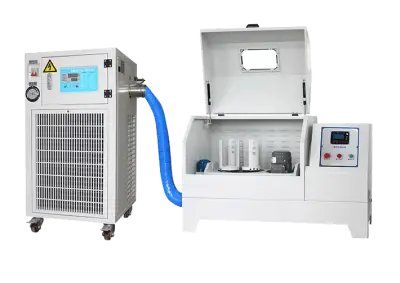
Low Temperature Planetary Ball Mill
Product Introduction
Low temperature planetary ball mill is a combined equipment of planetary ball mill and refrigeration device. During high-speed grinding, most materials will heat up due to friction or exothermic reactions, which may alter the physical and chemical properties of materials and produce negative grinding effects. Low temperature planetary ball mill is mainly used for material grinding processes requiring strict temperature control.
Operating Principle of Planetary Ball Mill
Four grinding jars are installed on the main disc of the planetary ball mill. When the motor drives the main disc to rotate, the grinding jars revolve around the main disc axis and rotate simultaneously driven by the planetary mechanism, performing planetary motion. The grinding balls inside the jars rub and collide with each other under high-speed planetary motion, enabling efficient sample grinding and mixing.
Product Application
Low temperature planetary ball mill is widely used in geology, mineral resources, metallurgy, electronics, building materials, ceramics, chemical industry, light industry, medicine, environmental protection and other fields.It is suitable for the production of electronic ceramics, structural ceramics, magnetic materials, lithium cobalt oxide, lithium manganate, catalysts, fluorescent powders, long afterglow luminescent powders, rare earth polishing powders, electronic glass powders, fuel cells, zinc oxide varistors, piezoelectric ceramics, nanomaterials, wafer ceramic capacitors, MLCC, thermistors (PTC, NTC), zinc oxide varistors, dielectric ceramics, alumina ceramics, zirconia ceramics, fluorescent powders, zinc oxide powder, cobalt oxide powder, Ni-Zn ferrites, Mn-Zn ferrites and other products.
Product Features
Low temperature planetary ball mill is a combined equipment of planetary ball mill and air cooling device. The air cooling unit adopts the air-conditioning compression refrigeration principle, and the cold air circulation quickly removes heat generated during grinding. According to ambient temperature differences, the temperature of the grinding chamber can be controlled at 5–15℃. It is mainly used for ultra-fine grinding of materials under low-temperature processes. The air cooling device features simple structure, convenient operation, easy maintenance and low energy consumption.
Technical Parameter Table of Planetary Ball Mill
| No. | Model | Style | Grinding Jar Rotation Speed | Grinding Jar Holder ID (mm) | Motor Power | Jar Revolution Diameter (mm) | Overall Dimensions (mm) | Net Weight (kg) |
| 1 | XQM-0.2 | Mini Type | 0~1160 r/min | 50 | 90W | Φ111 | 420×260×310 | 25 |
| 2 | XQM-0.2S | Mini Glove Box Type | 0~1160 r/min | 50 | 90W | Φ111 | Unit: 390×220×270Control Box: 200×180×240 | 29 |
| 3 | XQM-0.4A | Half-Round Type | 0~870 r/min | 80 | 250W | Φ140 | 530×300×360 | 34 |
| 4 | XQM-6 | — | 0~670 r/min | 134 | 0.75KW | Φ234 | 760×470×580 | 100 |
| 5 | XQM-4A | Half-Round Type | 0~670 r/min | 134 | 0.75KW | Φ234 | 760×470×600 | 85 |
| 6 | XQM-(8-12) | — | 0~580 r/min | 162 | 1.5KW | Φ275 | 900×600×640 | 168 |
| 7 | XQM-(8-12)A | Half-Round Type | 0~580 r/min | 162 | 1.5KW | Φ275 | 880×560×642 | 150 |
| 8 | XQM-16A | Half-Round Type | 0~510 r/min | 182 | 3KW | Φ320 | 950×600×710 | 205 |
| 9 | XQM-20 | — | 0~430 r/min | 222 | 4KW | Φ385 | 1200×790×930 | 392 |
| 10 | XQM-40 | — | 0~390 r/min | 250 | 5.5KW | Φ430 | 1400×880×1070 | 656 |
| 11 | XQM-60 | — | 0~260 (1:1.5) r/min | 275 | 7.5KW | Φ490 | 1600×1070×1250 | 950 |
| 12 | XQM-100 | — | 0~240 (1:1.5) r/min | 326 | 11KW | Φ578 | 1750×1140×1330 | 1300 |
| 13 | XQM-200 | — | 0~215 r/min | 460 | 22KW | Φ738 | 2670×1600×2804 | 2725 |
General Technical Parameters
| Parameter | Specification |
| Transmission Mode | Gear drive |
| Working Mode | Two or four grinding jars working simultaneously |
| Maximum Loading Capacity (Material + Grinding Balls) | Two-thirds of the grinding jar volume |
| Grinding Jar Volume | 5L–50L per jar, total volume 20L–200L |
| Feed Particle Size | Soil material ≤10mm, other materials ≤3mm |
| Discharge Particle Size | Minimum up to 0.1μm (varies with different materials and grinding processes) |
| Speed Ratio (Revolution : Rotation) | Refer to main parameters of planetary ball mill |
| Rotation Speed | Refer to main parameters of planetary ball mill |
| Speed Control Mode | Stepless speed regulation by brand frequency converter |
Working Principle
Low temperature planetary ball mill is a combined equipment of planetary ball mill and refrigeration device. During high-speed grinding, most materials will heat up due to friction or exothermic reactions, which may alter the physical and chemical properties of materials and produce negative grinding effects. Low temperature planetary ball mill is mainly used for material grinding processes requiring strict temperature control.
Supporting Products
We also supply various grinding balls: stainless steel balls, zirconia balls, alumina balls, PU balls, carbon steel balls, tungsten balls, agate balls, cemented carbide balls, silicon nitride balls, high wear-resistant steel balls, manganese steel balls, nylon balls, cemented carbide, glass and other special metal materials.
We also provide grinding jars of various materials: agate, alumina corundum ceramics, zirconia ceramics, silicon nitride ceramics, silicon carbide ceramics, stainless steel, wear-resistant steel, manganese steel, nylon, polyurethane, cemented carbide, crystal glass, etc.”
The device integrates a planetary ball mill with an air-cooling refrigeration unit to maintain grinding temperatures within a controlled low-temperature range. Proper installation and operational safety measures are required to prevent mechanical failure and personnel injury.
- Grinding Jar Security: Ensure all grinding jars are properly sealed and locked into holders before rotation to avoid ejection of contents.
- Cooling System Activation: Activate the air cooling unit before starting the mill to prevent thermal damage to materials and components.
- Electrical Grounding: Connect the equipment to a properly grounded electrical outlet to mitigate shock hazards.
- Load Balancing: Distribute material and grinding balls evenly across jars to minimize vibration and stress on the drive mechanism.
This procedure outlines the safe startup and operation of the low temperature planetary ball mill for fine grinding of materials. Follow each step sequentially to ensure proper temperature control and mechanical safety.
Required Equipment: Grinding Jar Assembly, Air Cooling Unit, Mill Control Panel
- Prepare grinding jars
Load the grinding jars with the sample material and appropriate grinding balls, then seal the lids tightly. - Install jars on mill
Secure the filled grinding jars into the jar holders on the mill's main disc and lock them in place. - Activate air cooling
Turn on the air cooling unit and verify that cold air circulation is established within the grinding chamber. - Set rotation speed
Adjust the rotation speed control to the desired value within the permissible operating range for the model. - Start grinding operation
Press the start button to begin planetary motion and monitor the grinding temperature during operation.
How does the air-cooling system affect the maximum achievable grinding speed and final particle size for heat-sensitive materials like lithium cobalt oxide or rare earth powders?
The air-cooling system maintains the grinding chamber at 5–15°C, enabling continuous operation at the maximum rotation speed of 580 rpm without thermal degradation of heat-sensitive materials. This allows achieving discharge particle sizes down to 0.1 μm while preserving the physicochemical properties of materials such as lithium cobalt oxide, rare earth powders, and other advanced ceramics.
What are the feed particle size limits and jar volume constraints when grinding ceramic and rare earth materials in the XQM-(8-12) low temperature planetary ball mill?
Feed particle size must be ≤3mm for most materials and ≤10mm for soil; the maximum loading of material plus grinding balls must not exceed two-thirds of the grinding jar volume. The XQM-(8-12) accepts jar volumes from 5L to 50L per jar, supporting a total capacity of 20L–200L when using four jars simultaneously.
What electrical, installation, and ambient temperature requirements are needed for operating the XQM-(8-12) low temperature planetary ball mill?
The unit requires a 1.5KW power supply and uses a brand frequency converter for stepless speed regulation. The air-cooling system is designed to control the grinding chamber at 5–15°C, with performance dependent on ambient temperature; the system can compensate for higher ambient conditions. The mill weighs 168 kg and has overall dimensions of 900×600×640 mm, requiring a stable, well-ventilated installation area.
This low-temperature planetary ball mill integrates an air-cooling refrigeration unit to sustain a 5–15°C grinding environment, enabling ultra-fine milling down to 0.1 μm without thermal damage. It is specifically suited for ceramics, rare earth powders, and battery materials that require strict temperature control.
Positive
- Integrated air-cooling temperature control: The built-in air cooling unit, based on air-conditioning compression refrigeration, maintains the grinding chamber at 5–15°C, preventing thermal degradation of heat-sensitive materials during high-speed grinding.
- Ultra-fine grinding down to 0.1 μm: With a minimum discharge particle size of 0.1 μm (dependent on material and process), this mill supports submicron and nano-scale powder preparation for advanced ceramics and rare earth applications.
Trade-offs
- Feed particle size restrictions: Feed material must be ≤10 mm for soil materials and ≤3 mm for others, requiring prior size reduction for larger particles before milling.
- Limited loading capacity per jar: The combined volume of material and grinding balls must not exceed two-thirds of the jar capacity, restricting batch size and requiring careful loading.
Every advanced material, component, equipment, and instrument in our catalog is backed by rigorous testing. We maintain strict internal quality management frameworks and align with CE conformity metrics to deliver transparent, reproducible performance data via our public open-science repository.
To request raw batch performance data, submit formal vendor registration paperwork, or execute a fast-turnaround R&D manufacturing loop, contact us at inquiry@atomfair.com.
Item is dispatched under the Atomfair Shipping & Delivery Framework (Free worldwide shipping on orders over $59 USD). Return is governed by the Atomfair Return & Refund Policy (7-day technical return window).
