Description
Laboratory Stirred Ball Mill
Product Introduction
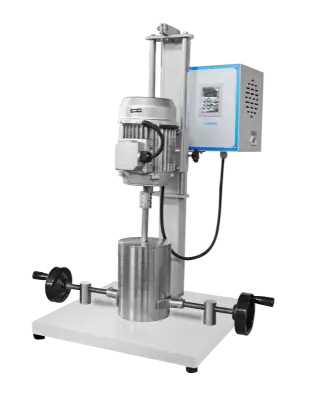
Stirred mills are mainly composed of a stationary grinding cylinder filled with small-diameter grinding media, a stirring device, and other auxiliary devices (such as circulation units, cooling units, timing and speed control systems, etc.). They feature high grinding efficiency and fine grinding particle size, which can well meet various process parameter requirements and simulate various indicators in actual production. Meanwhile, with the advantages of small-batch processing, low power consumption and cost-effectiveness, they are ideal equipment for universities, research institutes and enterprises to conduct research on grinding processes, new materials and coatings.
They are widely applied in the production of various fine powder materials in fields including zirconium silicate, zirconia, alumina, ceramics, chemical industry, electronic materials, magnetic materials, papermaking, coatings, non-metallic minerals, new materials, paints, graphite, calcium carbonate, pharmaceuticals and more.
Product Features
- High energy utilization rate and high power density, enabling outstanding energy-saving performance.
- Easy adjustment of product particle size; the fineness can be controlled by adjusting the residence time of materials in the cylinder.
- Low vibration and low noise during operation.
- Elegant and high-end appearance, reliable performance, simple maintenance, easy and labor-saving operation, and long service life.
- The stirring rod supports automatic lifting, and the grinding cylinder can be tilted freely.
- Capable of satisfying diverse process requirements, supporting continuous or batch production as needed.
- The grinding cylinder is designed with a jacket, allowing precise control of the grinding temperature.
- Customizable with various special functions, such as timing, speed regulation, circulation and temperature adjustment.
- Optional grinding cylinders and stirring components made of different materials (stainless steel, corundum ceramic, polyurethane, zirconia, etc.).
Technical Parameters
| Name | Speed (rpm) | Volume (L) | Loading Capacity (L) | Motor Power (kW) | Wear-Resistant Materials | Feed Particle Size (mm) | Discharge Particle Size (μm) | Speed Regulation Mode | Remarks |
| JM-1L | 50~1400 | 1 | 0.35 | 0.37 | Stainless steel, nylon, corundum, polyurethane, zirconia, agate, PTFE, etc. | ≤5 | ≤1 | Frequency conversion speed regulation | Laboratory Stirred Mill |
| JM-2L | 50~1400 | 2 | 0.7 | 0.37 | — | — | — | — | — |
| JM-3L | 50~1400 | 3 | 1.05 | 0.37 | — | — | — | — | — |
| JM-5L | 60~560 | 5 | 1.75 | 0.75 | — | ≤10 | — | Frequency conversion / fixed speed | Small Stirred Mill |
| JM-10L | 60~560 | 10 | 3.5 | 1.5 | — | — | — | — | — |
| JM-15L | 60~380 | 15 | 5.25 | 2.2 | — | — | — | — | — |
| JM-20L | 60~380 | 20 | 7.0 | 2.2 | — | — | — | — | Light-duty Stirred Mill |
| JM-30L | 60~310 | 30 | 10.5 | 3 | Carbon steel, stainless steel, lined with nylon, polyurethane, PTFE, corundum, etc. | — | — | — | — |
| JM-50L | 60~140 | 50 | 17.5 | 4 | — | ≤15 | — | — | Production Stirred Mill |
| JM-100L | 60~140 | 100 | 35 | 7.5 | — | — | — | — | — |
| JM-200L | 60~110 | 200 | 70 | 11 | — | — | — | — | — |
| JM-300L | 60~110 | 300 | 100 | 15 | — | — | — | — | — |
| JM-500L | 60~90 | 500 | 170 | 18.5 | — | — | — | — | — |
| JM-600L | 60~90 | 600 | 200 | 22 | — | — | — | — | — |
Working Principle
The main shaft drives the stirrer to rotate at a high speed, making the grinding media move irregularly. This chaotic motion generates collision, extrusion, friction and shearing forces between the grinding media, thus pulverizing and fine-grinding the materials.
In addition, different sizes, shapes and ratios of grinding media will lead to different grinding effects. Generally speaking, larger grinding media result in coarser particle size of the ground materials, while smaller media produce finer powder. A proper ratio of grinding media with different specifications, combined with appropriate speed adjustment, will achieve better grinding performance.
Operate the stirred mill in a dry, well-ventilated area to prevent electrical hazards. Ensure the grinding cylinder is securely latched before initiating rotation to avoid mechanical ejection.
- Electrical Safety: Always connect the mill to a grounded power outlet to mitigate electric shock risk.
- Mechanical Stability: Position the mill on a level, vibration-absorbing surface to prevent tipping during operation.
This sequence describes the safe initialization and operation of the laboratory stirred mill. Follow these steps to achieve efficient grinding while maintaining equipment integrity.
Required Equipment: Laboratory Stirred Mill
- Prepare the Grinding Cylinder
Select the appropriate wear-resistant liner and fill the cylinder with grinding media and the sample material. - Engage the Stirring Mechanism
Lower the stirring rod until it is fully immersed in the media bed and secure the cylinder latch. - Set and Start the Grinding Process
Set the desired rotational speed using the variable frequency drive control panel and then start the motor.
How does the JM-3L's 0.37kW motor achieve submicron grinding without compromising throughput at a 1.05L loading capacity?
The JM-3L uses a VFD-controlled speed range of 50–1400 rpm combined with high power density to generate collision, extrusion, friction, and shearing forces, enabling a discharge particle size of ≤1 μm. The 1.05 L loading capacity balances batch size with the 0.37 kW motor's energy efficiency, and the mill supports batch or continuous operation to maintain throughput for laboratory powder research.
Can the JM-3L stirred mill handle abrasive ceramic powders without cross-contamination?
Yes, because the grinding cylinder and stirring components are available in multiple wear-resistant materials including stainless steel, corundum, zirconia, polyurethane, nylon, agate, and PTFE, allowing material-specific compatibility to minimize contamination. The mill also supports optional circulation and temperature adjustment to maintain process integrity when grinding abrasive ceramic, alumina, or zirconia powders.
What are the cooling and infrastructure requirements for operating the JM-3L during extended grinding runs?
The JM-3L's grinding cylinder is designed with a jacket for precise temperature control, and the system supports optional circulation and temperature adjustment functions to manage heat during extended runs. The mill operates with low vibration and noise, requires a VFD-compatible power supply for the 0.37 kW motor, and the stirring rod can be lifted automatically while the cylinder tilts freely for easy cleaning and maintenance.
The Atomfair JM-3L Lab Stirred Mill delivers ultra-fine grinding down to ≤1 μm with high energy efficiency and material flexibility through interchangeable grinding cylinder and stirring component options. However, its 1.05 L batch capacity and dependence on optimized grinding media selection necessitate careful process planning for laboratory research.
Positive
- High Energy Efficiency and Fine Grinding: High energy utilization and power density enable energy-saving operation while achieving a discharge particle size ≤1 μm, suitable for ultra-fine grinding applications.
- Versatile Material Compatibility Options: Optional grinding cylinders and stirring components in stainless steel, corundum, zirconia, and other materials allow processing of diverse substances without cross-contamination.
Trade-offs
- Limited Batch Processing Capacity: The loading capacity of 1.05 L restricts throughput, making this mill suitable only for small-scale research and not for production-scale operations.
- Media Selection Dependent Performance: Grinding effectiveness is highly dependent on the size, shape, and ratio of grinding media, requiring user expertise to optimize parameters for desired particle size distribution.
Every advanced material, component, equipment, and instrument in our catalog is backed by rigorous testing. We maintain strict internal quality management frameworks and align with CE conformity metrics to deliver transparent, reproducible performance data via our public open-science repository.
To request raw batch performance data, submit formal vendor registration paperwork, or execute a fast-turnaround R&D manufacturing loop, contact us at inquiry@atomfair.com.
Item is dispatched under the Atomfair Shipping & Delivery Framework (Free worldwide shipping on orders over $59 USD). Return is governed by the Atomfair Return & Refund Policy (7-day technical return window).