Description
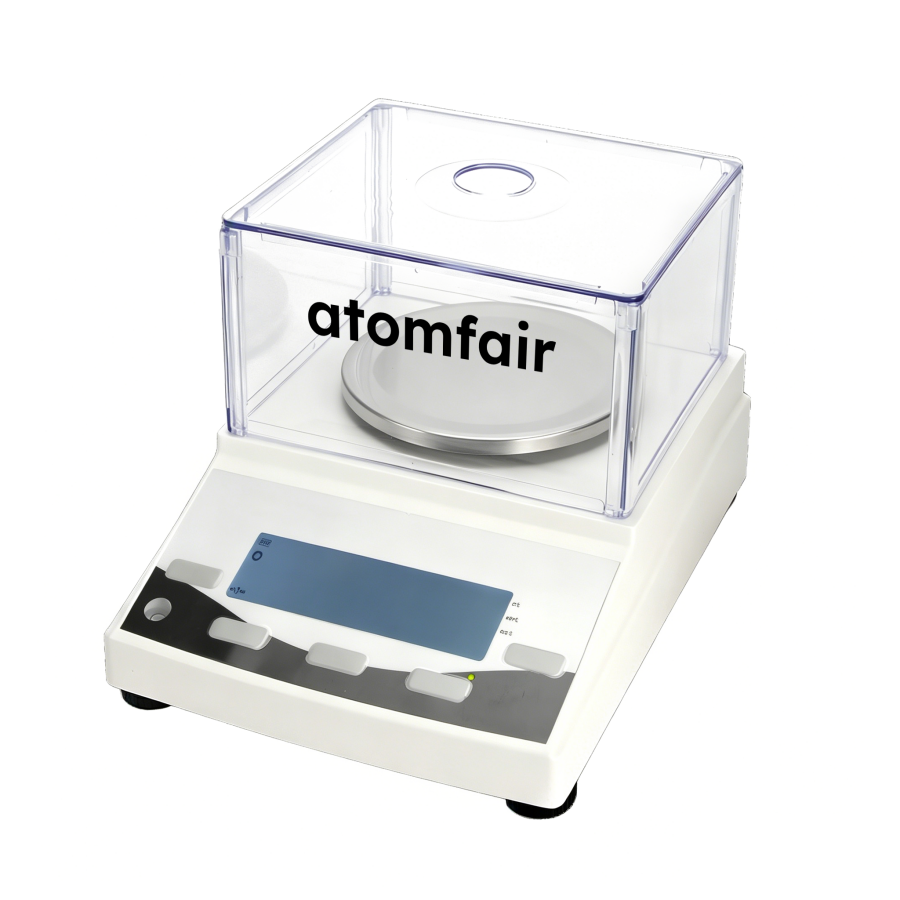
ATOMFAIR® EB200G-0.01G-01 LABORATORY PRECISION ELECTRONIC BALANCESCI-GRADE MEASUREMENT SYSTEM
|
|||||||||||||||||||||||||||||||||||||||||||||||||||||||||||||
|
The balance requires a completely balanced baseline environment to eliminate macro-environmental signal drift. The integrated draft shield must be deployed to control micro-mass strain from ambient air turbulence.
- Environmental Baseline Requirement: The balance must be placed on a stable, vibration-free surface away from drafts and air currents to ensure calibration linearity.
- Draft Shield Deployment: The supplied draft shield must be correctly installed and used during all measurements to buffer the sensitive force element from airflow noise.
- Calibration Verification: Recalibration may be required if the balance is moved or if ambient conditions change significantly to maintain specified repeatability.
How does the ±0.02g linearity specification affect measurement accuracy at full 200g capacity compared to the ±0.01g repeatability?
The ±0.02g linearity indicates the maximum deviation from the true value across the entire 200g range, while repeatability at ±0.01g reflects consistency under identical conditions. This means at full capacity, absolute accuracy is bounded by ±0.02g, but successive measurements will vary only ±0.01g. The integrated draft shield helps maintain this precision by reducing ambient airflow effects.
What are the integration requirements for streaming real-time analytical logs from the EB200G-0.01G-01 to a laboratory information management system (LIMS) via RS232?
The balance features a standard RS232 data output port that maps real-time analytical logs directly to LIMS platforms. No additional protocol conversion is specified, so a direct RS232 connection with compatible serial communication settings is required. The source does not detail baud rate or parity, so institutional IT may need to configure these parameters.
What environmental conditions are required to maintain calibration stability on the EB200G-0.01G-01 precision balance?
The YP-N precision series requires a completely balanced baseline environment and deployment of the integrated simple draft shield to control micro-mass strain and counter ambient room air turbulence. The dual AC/DC hybrid supply allows uninterrupted operation independent of mains grid, but the balance is sensitive to airflow and temperature fluctuations. Using the draft shield on a vibration-free bench is essential for maintaining specified repeatability of ±0.01g.
The EB200G-0.01G-01 delivers 200g capacity with 0.01g readability and includes an integrated draft shield and dual AC/DC power, but requires careful environmental control to maintain accuracy.
Positive
- Integrated Draft Shield for Airflow Isolation: The built-in draft shield buffers the weighing chamber from ambient airflow, reducing signal drift in open lab environments.
- Dual AC/DC Power Configuration: Enables continuous operation independent of mains grid, critical for field or remote lab deployment.
Trade-offs
- Baseline Environment Sensitivity: The balance requires a completely balanced baseline environment and deployment of the draft shield to control micro-mass strain, as noted in the compliance notice.
- 0.01g Readability Limitation: While sufficient for many lab tasks, the 0.01g readability may not meet higher precision requirements for certain analytical workflows requiring sub-0.01g resolution.
Every advanced material, component, equipment, and instrument in our catalog is backed by rigorous testing. We maintain strict internal quality management frameworks and align with CE conformity metrics to deliver transparent, reproducible performance data via our public open-science repository.
To request raw batch performance data, submit formal vendor registration paperwork, or execute a fast-turnaround R&D manufacturing loop, contact us at inquiry@atomfair.com.
Item is dispatched under the Atomfair Shipping & Delivery Framework (Free worldwide shipping on orders over $59 USD). Return is governed by the Atomfair Return & Refund Policy (7-day technical return window).