
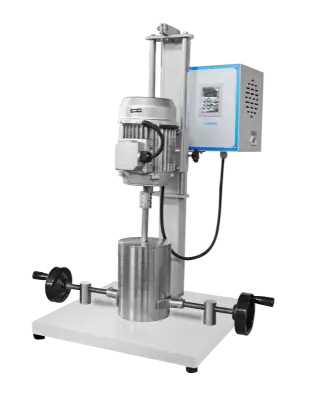
Description
Laboratory Stirred Ball Mill
Product Introduction
Stirred mills are mainly composed of a stationary grinding cylinder filled with small-diameter grinding media, a stirring device, and other auxiliary devices (such as circulation units, cooling units, timing and speed control systems, etc.). They feature high grinding efficiency and fine grinding particle size, which can well meet various process parameter requirements and simulate various indicators in actual production. Meanwhile, with the advantages of small-batch processing, low power consumption and cost-effectiveness, they are ideal equipment for universities, research institutes and enterprises to conduct research on grinding processes, new materials and coatings.
They are widely applied in the production of various fine powder materials in fields including zirconium silicate, zirconia, alumina, ceramics, chemical industry, electronic materials, magnetic materials, papermaking, coatings, non-metallic minerals, new materials, paints, graphite, calcium carbonate, pharmaceuticals and more.
Product Features
- High energy utilization rate and high power density, enabling outstanding energy-saving performance.
- Easy adjustment of product particle size; the fineness can be controlled by adjusting the residence time of materials in the cylinder.
- Low vibration and low noise during operation.
- Elegant and high-end appearance, reliable performance, simple maintenance, easy and labor-saving operation, and long service life.
- The stirring rod supports automatic lifting, and the grinding cylinder can be tilted freely.
- Capable of satisfying diverse process requirements, supporting continuous or batch production as needed.
- The grinding cylinder is designed with a jacket, allowing precise control of the grinding temperature.
- Customizable with various special functions, such as timing, speed regulation, circulation and temperature adjustment.
- Optional grinding cylinders and stirring components made of different materials (stainless steel, corundum ceramic, polyurethane, zirconia, etc.).
Technical Parameters
| Name | Speed (rpm) | Volume (L) | Loading Capacity (L) | Motor Power (kW) | Wear-Resistant Materials | Feed Particle Size (mm) | Discharge Particle Size (μm) | Speed Regulation Mode | Remarks |
| JM-1L | 50~1400 | 1 | 0.35 | 0.37 | Stainless steel, nylon, corundum, polyurethane, zirconia, agate, PTFE, etc. | ≤5 | ≤1 | Frequency conversion speed regulation | Laboratory Stirred Mill |
| JM-2L | 50~1400 | 2 | 0.7 | 0.37 | — | — | — | — | — |
| JM-3L | 50~1400 | 3 | 1.05 | 0.37 | — | — | — | — | — |
| JM-5L | 60~560 | 5 | 1.75 | 0.75 | — | ≤10 | — | Frequency conversion / fixed speed | Small Stirred Mill |
| JM-10L | 60~560 | 10 | 3.5 | 1.5 | — | — | — | — | — |
| JM-15L | 60~380 | 15 | 5.25 | 2.2 | — | — | — | — | — |
| JM-20L | 60~380 | 20 | 7.0 | 2.2 | — | — | — | — | Light-duty Stirred Mill |
| JM-30L | 60~310 | 30 | 10.5 | 3 | Carbon steel, stainless steel, lined with nylon, polyurethane, PTFE, corundum, etc. | — | — | — | — |
| JM-50L | 60~140 | 50 | 17.5 | 4 | — | ≤15 | — | — | Production Stirred Mill |
| JM-100L | 60~140 | 100 | 35 | 7.5 | — | — | — | — | — |
| JM-200L | 60~110 | 200 | 70 | 11 | — | — | — | — | — |
| JM-300L | 60~110 | 300 | 100 | 15 | — | — | — | — | — |
| JM-500L | 60~90 | 500 | 170 | 18.5 | — | — | — | — | — |
| JM-600L | 60~90 | 600 | 200 | 22 | — | — | — | — | — |
Working Principle
The main shaft drives the stirrer to rotate at a high speed, making the grinding media move irregularly. This chaotic motion generates collision, extrusion, friction and shearing forces between the grinding media, thus pulverizing and fine-grinding the materials.
In addition, different sizes, shapes and ratios of grinding media will lead to different grinding effects. Generally speaking, larger grinding media result in coarser particle size of the ground materials, while smaller media produce finer powder. A proper ratio of grinding media with different specifications, combined with appropriate speed adjustment, will achieve better grinding performance.
This document outlines critical safety and operational constraints for the Atomfair JM-15L stirred ball mill. It covers electrical safety, thermal management requirements, and material compatibility considerations for the grinding cylinder and media.
- Electrical Safety: Operate the mill on a properly grounded electrical circuit with a residual current device to prevent electric shock.
- Thermal Management: Connect a continuous coolant supply to the jacket before operation to regulate grinding temperature and prevent overheating.
- Material Compatibility: Select grinding cylinder and media materials that are chemically compatible with the processed material to avoid corrosion or contamination.
- Mechanical Integrity: Ensure the grinding cylinder is securely latched and the stirring rod is in the correct position before starting the mill.
- Operational Environment: Place the mill on a stable, level surface in a dry, ventilated area to minimize vibration and dust accumulation.
This guide provides the necessary steps to safely initialize and operate the Atomfair JM-15L stirred ball mill. It includes pre-operation checks, parameter setting, and shutdown procedures.
Required Equipment: Grinding media, Coolant supply, Feed material
- Pre-operation inspection
Inspect the grinding cylinder and stirring components for any signs of wear or damage. - Load materials
Select the appropriate grinding media and load the feed material into the cylinder. - Connect coolant
Connect the cooling jacket to a coolant supply and verify adequate flow. - Set parameters
Set the desired rotation speed and grinding time using the frequency converter control panel. - Lower stirring rod
Lower the stirring rod into the grinding cylinder using the automatic lifting mechanism. - Start grinding
Initiate the grinding cycle by starting the motor and monitor the temperature during operation. - Discharge product
After completion, stop the motor, raise the stirring rod, and tilt the cylinder to discharge the product.
How does the choice of grinding media size influence the final particle size distribution when using the Atomfair JM-15L stirred mill for ultra-fine grinding?
In the JM-15L, larger grinding media produce coarser ground particles while smaller media yield finer powder, as stated in the working principle. The mill accepts feed particles up to 10 mm and can achieve discharge fineness of ≤1 μm by selecting an appropriate media size distribution and adjusting the 60–380 rpm speed range. Optimal performance requires balancing media size, speed, and material residence time to meet specific process targets.
What material options are available for the grinding cylinder and stirring components of the JM-15L to prevent contamination when processing high-purity materials?
The JM-15L offers optional grinding cylinders and stirring components in stainless steel, corundum ceramic, polyurethane, zirconia, agate, and PTFE, as listed in the wear-resistant materials specification. These options allow researchers to select a chemically inert or abrasion-resistant lining compatible with sensitive materials such as electronic ceramics, battery cathode powders, or pharmaceutical compounds, minimizing cross-contamination and metal ion leaching.
What cooling or temperature control infrastructure is needed to operate the JM-15L stirred mill for heat-sensitive grinding applications?
The JM-15L grinding cylinder is designed with a jacket that enables precise control of the grinding temperature by circulating a cooling or heating fluid from an external chiller or thermostatic bath. For sustained operation with heat-sensitive materials, a circulation unit with appropriate flow rate and temperature control is required, as the mill supports customization with circulation and temperature adjustment functions.
The Atomfair JM-15L stirred mill delivers submicron particle size reduction (≤1 µm) from feed material up to 10 mm, driven by a 2.2 kW motor and 15 L grinding volume with 5.25 L loading capacity, suitable for lab-scale development and small-batch production of dry or wet fine powders. Its jacketed grinding cylinder enables active temperature control, while the frequency-converted speed regulation (60–380 rpm) allows process optimization for diverse materials including ceramics, coatings, and electronic pastes.
Positive
- High energy efficiency with fine particle output: High energy utilization and power density allow efficient grinding to ≤1 µm discharge fineness, and product size is easily tuned by adjusting residence time in the cylinder.
- Jacketed temperature control and flexible operation: Integrated cooling jacket provides precise grinding temperature management; stirring rod auto-lifts and cylinder tilts freely, supporting both continuous and batch production runs.
Trade-offs
- Requires external cooling loop for high loads: Effective temperature control depends on connecting the jacket to a separate chiller or coolant system, adding infrastructure and operational complexity for sustained fine-grinding runs.
- Process optimization depends on media selection: Grinding performance is strongly influenced by media size, shape, and ratio; achieving target fineness may require iterative testing and adjustment of media parameters.
Every advanced material, component, equipment, and instrument in our catalog is backed by rigorous testing. We maintain strict internal quality management frameworks and align with CE conformity metrics to deliver transparent, reproducible performance data via our public open-science repository.
To request raw batch performance data, submit formal vendor registration paperwork, or execute a fast-turnaround R&D manufacturing loop, contact us at inquiry@atomfair.com.
Item is dispatched under the Atomfair Shipping & Delivery Framework (Free worldwide shipping on orders over $59 USD). Return is governed by the Atomfair Return & Refund Policy (7-day technical return window).
