
SIBs Insight: Balancing 4.15V vs. 4.0V for Optimal Performance & Life
🌐 Introduction: When Energy Density Meets Cycle Life
In the development of sodium-ion batteries (SIBs), researchers often face a trade-off: pursuing higher energy density or maintaining a longer cycle life. Generally, every 0.1V increase in voltage leads to a significant leap in energy density; however, the resulting interfacial side reactions often cause the cycling curve to collapse.
In this issue of Next-Gen Battery Insights, we analyze empirical data from O3-type layered oxide NFM111 cathodes comparing a 4.15V high-voltage protocol against a 4.0V long-life protocol. We reveal how to balance material potential with systemic stability across different voltage dimensions.
📊 Empirical Comparison: From “Marathon Runner” to “All-Round Warrior”
This evaluation utilized industrial-grade 1Ah pouch full cells. By adjusting the charge cut-off voltage, we observed distinct performance boundaries for the NFM111 || Hard Carbon (HC) system:
1. 4.0V System: Ultimate Cycling Stability
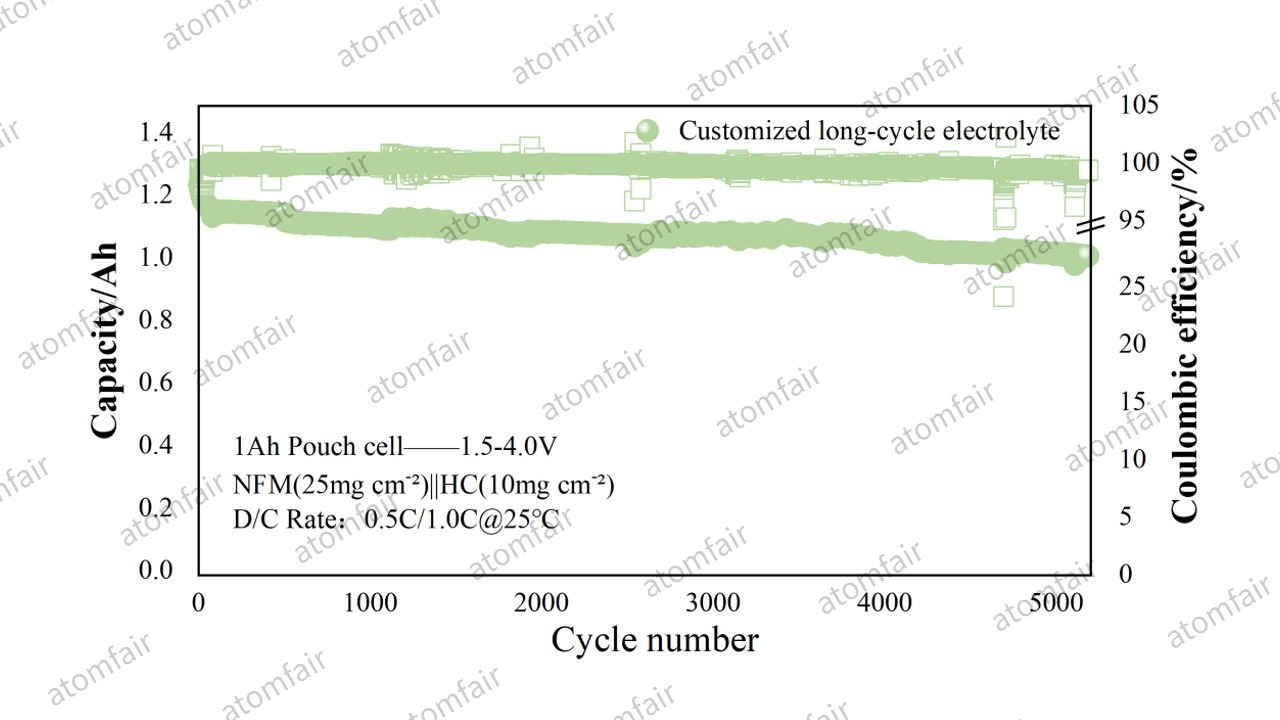
In the 1.5V – 4.0V range, paired with our Customized Long-cycle Electrolyte, the specific capacity measured 114.59 mAh/g.
- Cycle Life: Achieved an ultra-long cycle life of 5,185 cycles at 0.5C/1.0C rates.
- Retention Rate: Capacity retention remained as high as 81.74% after 5,000 cycles.
- Insights: This demonstrates that high-purity NFM111 possesses near-perfect lattice stability below 4.0V, where the intercalation and de-intercalation of active sodium ions exhibit exceptional reversibility.
2. 4.15V System: A Qualitative Leap in Energy Density
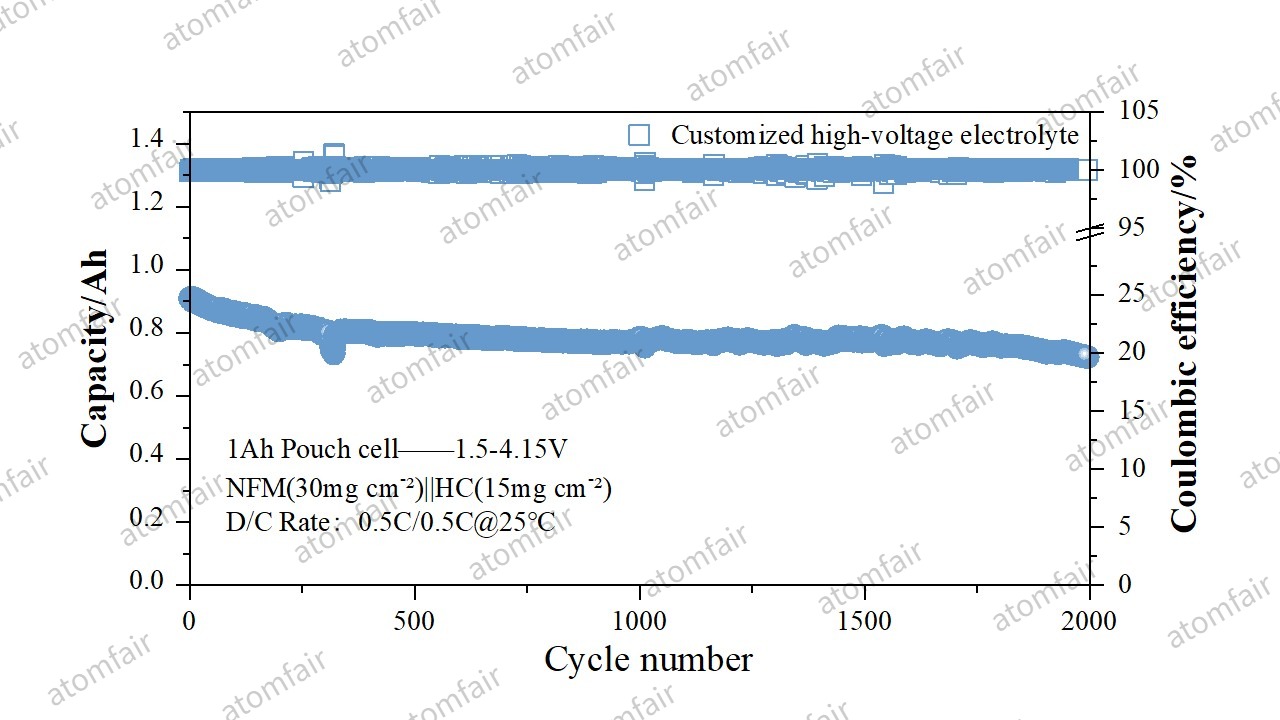
Increasing the cut-off voltage to 4.15V fundamentally transformed the energy performance. By employing a Customized High-voltage Electrolyte to suppress oxidation:
- Capacity Gain: Specific capacity jumped from 114.59 mAh/g to 138.96 mAh/g, an increase of 21.27%.
- Energy Gain: Due to the simultaneous elevation of the average voltage plateau, the total energy density increased by 30.96%.
- Cycling Performance: Even under 4.15V stress, the system achieved 1,988 stable cycles (Retention >80%).
💡 Deep Insight: The 31% Energy Dividend from a 0.15V Boost
Why does a mere 0.15V difference yield such massive gains?
In high-loading NFM111-HC systems, the 4.0V to 4.15V window corresponds to the deep desodiation plateau of the material. Within this range, the NFM111 lattice releases significantly more active sodium ions, drastically boosting specific capacity.
Historically, this system was prone to transition metal dissolution (such as Manganese/Mn) at high voltages, leading to rapid capacity fade. The electrolyte technology used in this evaluation successfully constructed a robust Cathode Electrolyte Interphase (CEI) on the surface of the spherical NFM111 particles. This layer effectively blocks side reactions between the active material and the electrolyte, elevating a high-voltage system—which typically spins out of control in conventional electrolytes—to industrial-grade standards.
🛠️ Technical Benchmarking Table
| Cut-off Voltage | 1C Specific Capacity | Energy Gain | Typical Life (80% SOH) |
| 4.0V | 114.59 mAh/g | Baseline | 5,185 Cycles |
| 4.15V | 138.96 mAh/g | ↑ 30.96% | 1,988 Cycles |
| 4.2V | 146.39 mAh/g | ↑ 39.25% | 800+ Cycles |
- Electrochemistry and Solid‐State Chemistry of NaMeO<sub>2</sub> (Me = 3d Transition Metals)
DOI: 10.1002/aenm.201703415
Focused review of O3/P2 layered sodium transition-metal oxides, including structural evolution, desodiation behavior, high-voltage operation, and degradation mechanisms relevant to NFM111 cathodes. - Sodium-ion batteries: present and future
DOI: 10.1039/c6cs00776g
Authoritative review covering sodium-ion battery cathode/anode chemistries, performance tradeoffs, practical cell development, layered oxides, electrolyte compatibility, and cycle-life challenges. - Research Development on Sodium-Ion Batteries
DOI: 10.1021/cr500192f
Comprehensive foundational review of sodium-ion battery materials, including layered oxide cathodes, hard carbon anodes, voltage windows, and cycling-performance limitations relevant to NFM111||hard carbon full cells.