
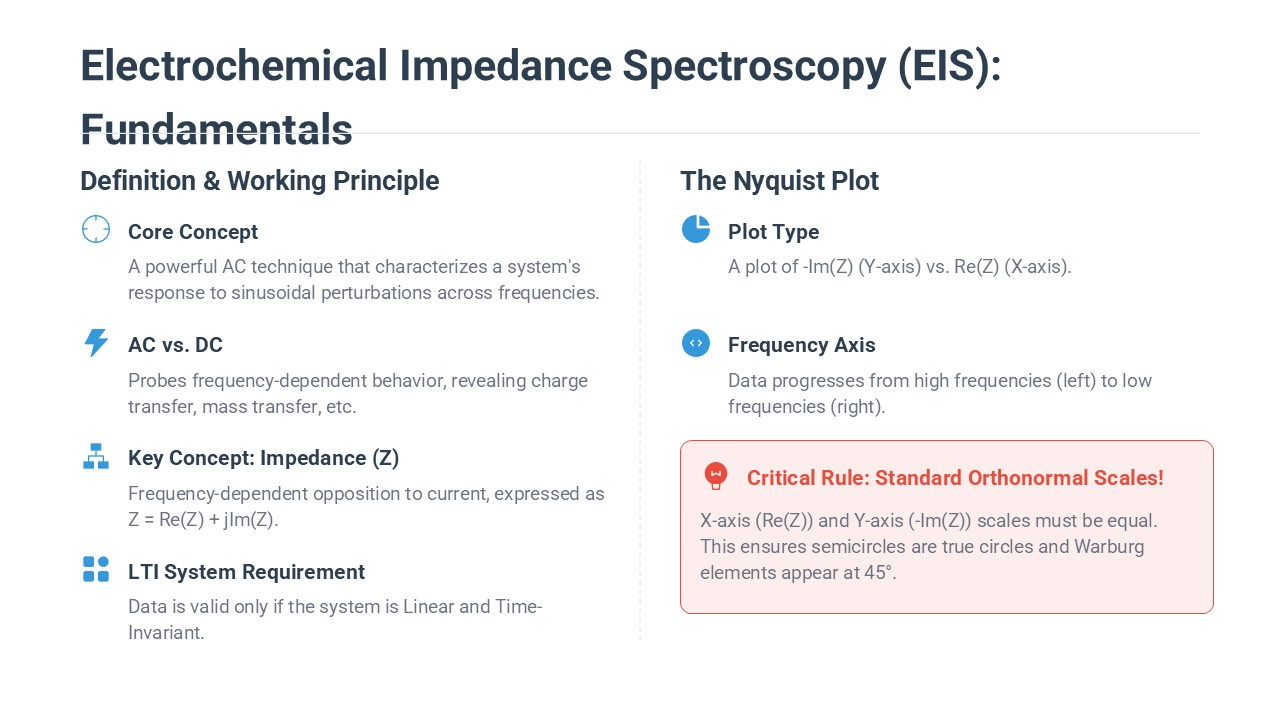
Electrochemical Impedance Spectroscopy (EIS) stands as one of the most indispensable methods in electrochemical analysis. While numerous high-quality resources cover its basics and principles online, many researchers remain unclear about practical operations, understanding the “what” but not the “why.” This article aims to fill these gaps through answering key questions, shedding light on how EIS works and how to use it effectively.
What is Electrochemical Impedance Spectroscopy (EIS)?
Electrochemical Impedance Spectroscopy (EIS) is widely applied in electrochemical research, recognized as a key technology for characterizing electrochemical reaction mechanisms and optimizing battery materials. In electrochemistry, two common current technologies exist: Direct Current (DC) and Alternative Current (AC). DC techniques, such as galvanostatic charge-discharge, rely on voltage-current control, with response signals primarily dependent on time. In contrast, EIS adopts AC technology, using regular sinusoidal wave signals.
For AC technology, the system’s response current or voltage signals are functions of frequency, which typically spans several orders of magnitude. Each frequency corresponds to distinct input and output signals with constant amplitude, requiring the system to be a Linear Time-Invariant (LTI) system. Different microstates in an electrochemical system exhibit unique frequency responses; thus, applying input signals of varying frequencies allows probing the entire process occurring at the electrode, including charge transfer and mass transfer.
Impedance extends beyond the concept of resistance. Resistance, defined as voltage divided by current, follows Ohm’s law and is frequency-independent in ideal cases. However, real circuit components have more complex properties, necessitating the use of impedance. Unlike resistance, impedance is frequency-dependent and is typically measured using small-amplitude AC signal excitation, representing the circuit’s opposition to current flow.
In electrochemical systems, EIS is not only used to characterize electrochemical processes such as electrode kinetics and interfacial double layers but also serves as a tool for optimizing electrochemical devices, aiding in material selection and electrochemical corrosion prevention.
EIS data and impedance plots are derived from LTI systems. When a sinusoidal current signal δI sin(2πft) (with amplitude δI and frequency f) is input, the output signal is also sinusoidal, with a phase difference φ = 2πΔt/T (where Δt is the time delay and T is the period). According to the definition of impedance, |Z| = δE/δI and φ = 2πΔt/T. This can be transformed into coordinates: ReZ = |Z|cosφ, ImZ = |Z|sinφ, and φ = arctan(ImZ/ReZ), or expressed as Z = ReZ + jImZ = |Z|(cosφ + jsinφ).
Two main plots represent EIS data: the Nyquist plot (-ImZ vs ReZ), where the X-axis is the real part and the Y-axis is the imaginary part, with each point corresponding to data at a specific frequency (high frequencies on the left, low frequencies on the right); and the Bode plot, which includes |Z| vs f (often logf) and φ vs f (often logf). The Nyquist plot is more frequently used in daily research.
Why Use Standard Orthonormal Scales for Nyquist Plots?
In literature, Nyquist plots often have exaggerated coordinates to highlight circles or diagonal lines, distorting their true shape. To avoid this, standard orthonormal scales are essential, meaning the scale length on the X-axis (URe) must equal that on the Y-axis (UIm) (UIm/URe = 1). This ensures circles appear regular and diffusion diagonal lines form a 45° angle, accurately reflecting the electrochemical system’s characteristics.
What Are the Requirements for Electrochemical Systems in EIS Testing?
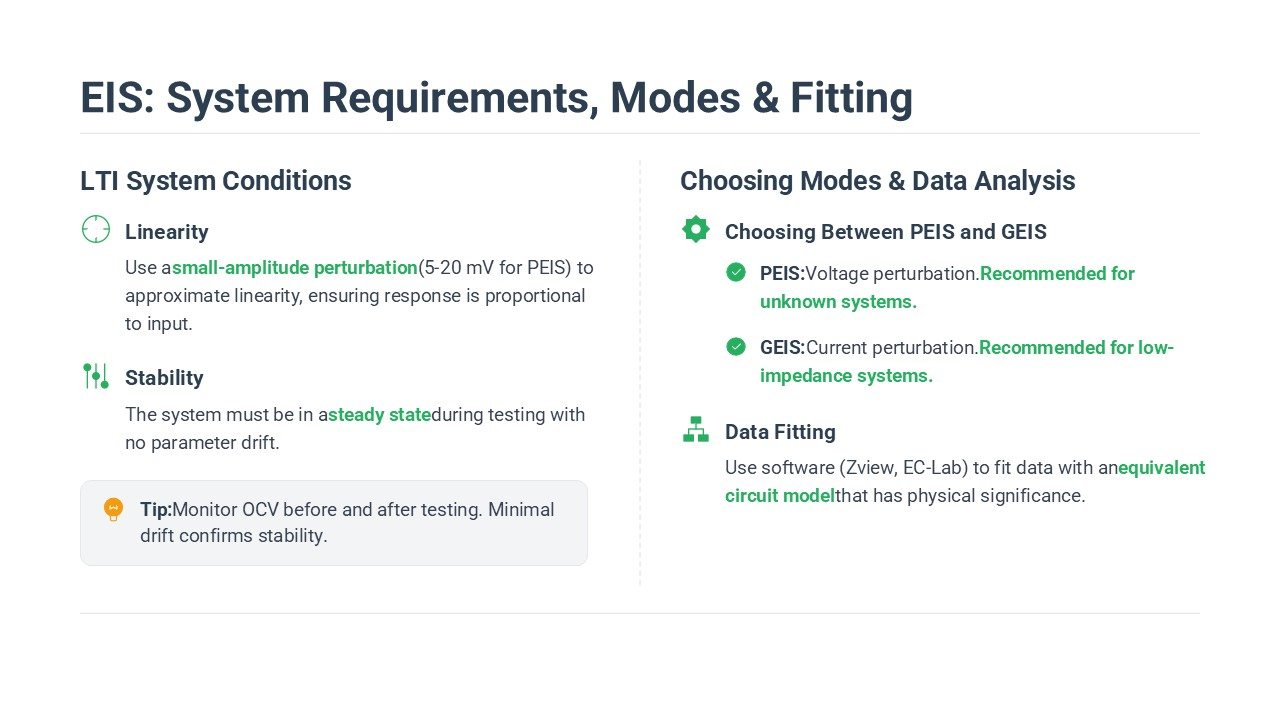
For EIS testing, the electrochemical system must be an LTI system, satisfying two core conditions: linearity and stability.
Linearity means the input and output signals of the electrochemical system exhibit a linear relationship. Naturally, electrochemical systems are nonlinear (e.g., battery charge-discharge curves do not follow V = K*I). To achieve linearity, the input signal amplitude must be sufficiently small—any curve can be approximated as linear within a narrow range of changes.
Stability requires that the parameters of the studied electrochemical system do not change over time during testing. This includes two aspects: (1) the system is in a steady state, not a transient state; (2) system parameters remain constant over time. In practical operations, use small current or voltage excitation signals and monitor Open Circuit Voltage (OCV) changes before and after testing to verify stability.
How to Choose Between GEIS and PEIS?
EIS testing offers two excitation modes: Galvanostatic EIS (GEIS, input current signal, output voltage signal) and Potentiostatic EIS (PEIS, input voltage signal, output current signal). The choice depends on the system characteristics:
- Choose PEIS for unknown electrochemical systems, using a voltage amplitude of 5-20 mV.
- Choose GEIS for low-impedance systems (e.g., batteries with impedance of a few mΩ) and systems with changing states (e.g., corroding systems or batteries during charge-discharge). For GEIS, use a current amplitude less than 10% of the capacity.
In low-impedance systems, a small voltage perturbation can generate large currents (per Ohm’s law U=IR), disrupting stability. A suitable current perturbation produces a small voltage response, preserving system stability. For systems with changing states (e.g., OCV shifts), PEIS may yield inconsistent impedance values as the operating point shifts, while GEIS maintains a stable current, ensuring consistent impedance measurements.
For most lithium-ion battery electrochemical systems, PEIS and GEIS produce equivalent data. If test data is noisy or scattered, try switching between the two modes.
How to Fit EIS Data?
Numerous software tools are available for EIS data fitting, including standalone programs like Zview and built-in toolboxes in testing software such as EC_Lab and AutoLab. Fitting involves selecting appropriate equivalent circuits composed of RLC components (resistors, inductors, capacitors) in series or parallel. The key is to choose a circuit model with physical significance to ensure meaningful results. For example, models like C1/R1-C2/R2 or R1/(C1+C2/R2) are commonly used, depending on the electrochemical processes involved (e.g., charge transfer, diffusion).
- A review of impedance measurements for determination of the state-of-charge or state-of-health of secondary batteries
DOI: 10.1016/s0378-7753(97)02665-7
Foundational battery-focused review supporting the page's discussion of EIS for battery characterization, impedance interpretation, and diagnostic use in secondary cells. - A Nonlinear Least Squares Fit procedure for analysis of immittance data of electrochemical systems
DOI: 10.1016/0167-2738(86)90031-7
Foundational source for equivalent-circuit fitting and nonlinear least-squares analysis of impedance data, supporting the page's section on fitting EIS spectra with physically meaningful circuits.