
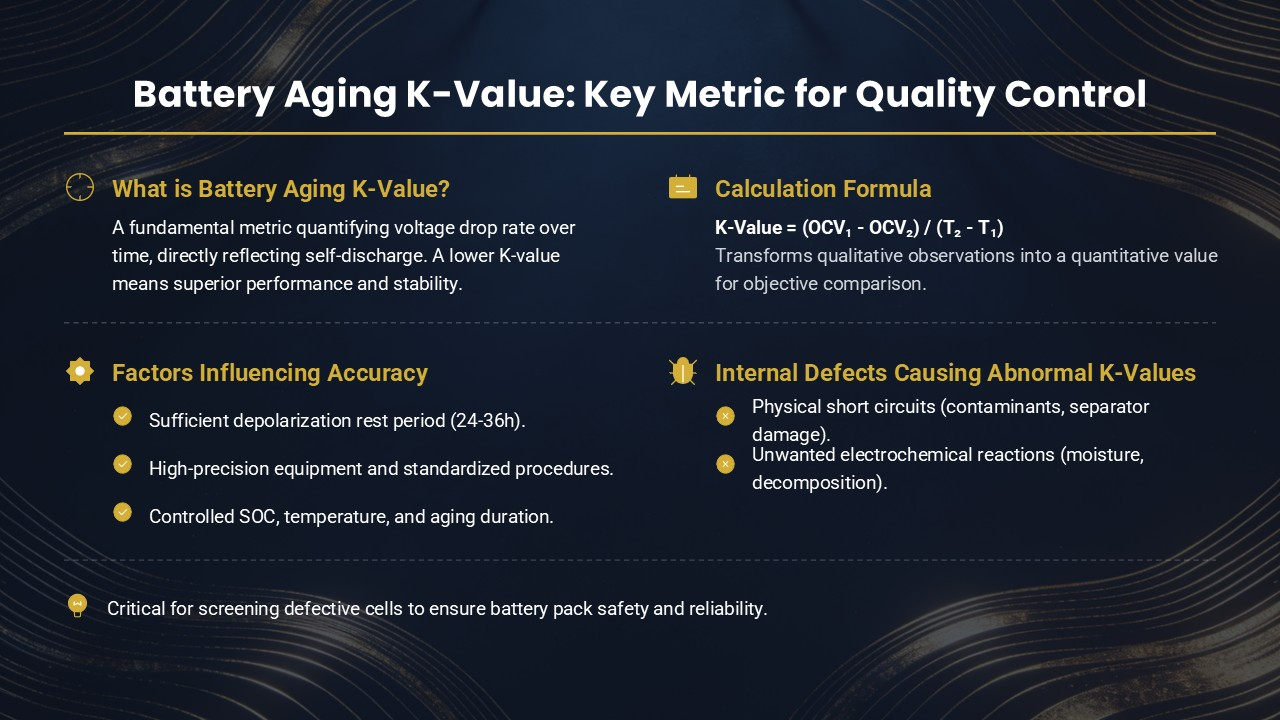
Battery Aging K-Value is a fundamental quality metric for lithium-ion batteries, quantifying the voltage drop rate of individual cells over time. Expressed in mV/h or mV/d, it directly reflects a cell’s self-discharge behavior, enabling manufacturers to identify defective cells with excessive self-discharge and ensure end-user safety. In general, a lower K-value signifies superior cell performance and stability.
What Is Battery Aging K-Value?
At its core, Battery Aging K-Value measures how quickly a battery’s open-circuit voltage (OCV) decreases during idle storage or aging. Self-discharge is an inherent property of lithium-ion batteries, but excessive self-discharge can shorten service life, reduce capacity retention, and pose safety risks—making the K-value a critical screening tool.
Calculation Formula: K-Value = (OCV₂ – OCV₁) / (T₂ – T₁)
- OCV₁ = Initial open-circuit voltage measured at time T₁ (before aging)
- OCV₂ = Open-circuit voltage measured at time T₂ (after aging period)
- T₂ – T₁ = Duration of the aging period (in hours or days)
This formula transforms qualitative self-discharge observations into a quantitative value, simplifying quality control and consistency checks across production batches.
Factors Influencing Battery Aging K-Value
The accuracy and reliability of Battery Aging K-Value are shaped by multiple variables, from testing conditions to internal cell defects. Controlling these factors is essential for meaningful K-value analysis.
1. Depolarization Effect
Lithium-ion batteries exhibit polarization during charging and discharging, where the measured voltage differs from the true equilibrium voltage. Depolarization— the process of voltage stabilizing after charge/discharge—varies with rest time.
For example, tests on lithium iron phosphate (LFP) cells show that after capacity grading, the K-value curve stabilizes at an inflection point around 21 hours of rest. Beyond this point, K-values and their rate of change (ΔK/ΔT) become consistent across cells. To eliminate polarization and ensure accurate OCV measurements, cells should rest for 24–36 hours after capacity grading before K-value testing—striking a balance between measurement accuracy and production efficiency.
2. Testing Equipment and Methodology
Voltage and internal resistance meters from different brands or models can produce varying readings for the same cell. To maintain K-value integrity:
- Use the same testing equipment for both initial (OCV₁) and post-aging (OCV₂) measurements.
- Standardize testing procedures, including tab contact position, contact area, and measurement duration.
Inconsistent equipment or methods introduce measurement errors, leading to misleading K-value results.
3. State of Charge (SOC)
A cell’s SOC during aging significantly impacts voltage drop rate and storage safety. Three key principles guide SOC range selection for K-value testing:
- High-value orientation: Faster voltage drops in higher SOC ranges make it easier to distinguish defective cells.
- Plateau orientation: Choose SOC ranges with stable voltage platforms to avoid erratic readings.
- Low SOC consideration: Lower SOC reduces storage safety risks but may slow voltage changes, requiring longer aging periods for accurate screening.
The SOC range, aging duration, and K-value threshold form the three pillars of effective self-discharge screening.
4. Aging Temperature and Duration
Temperature and time directly influence self-discharge kinetics:
- Higher temperatures accelerate chemical reactions inside the cell, increasing voltage drop rates and K-values.
- Longer aging durations allow self-discharge processes to stabilize, typically resulting in lower overall K-values.
Manufacturers must define standardized aging conditions (e.g., 25°C for 30 days) to ensure fair and consistent K-value comparisons across batches.
5. Physical Short Circuits
Internal physical short circuits are a leading cause of abnormal self-discharge and elevated K-values:
- Rigid contaminants: Metal particles or dust can pierce the separator under pressure, causing direct cathode-anode contact.
- Burrs: Sharp edges on die-cut electrodes may penetrate the separator or bridge adjacent electrodes, creating short circuits.
- Metal dissolution: Metal contaminants (Cu > Zn > Fe, in order of impact) dissolve into ions during use, depositing as dendrites on the anode that eventually pierce the separator.
- Separator damage/misalignment: Defects or misplacement of the separator leads to electrode contact, increasing self-discharge.
6. Electrochemical Reactions
Unwanted electrochemical reactions inside the cell can also inflate K-values:
- Excessive moisture: Water reacts with LiPF₆ (a common electrolyte salt) to form hydrofluoric acid (HF), which corrodes electrode materials and the SEI film—consuming capacity and accelerating voltage drop.
- Electrolyte issues: Improper electrolyte selection or decomposition during use causes irreversible capacity loss, boosting self-discharge.
Guidelines for Establishing Battery Aging K-Value Standards
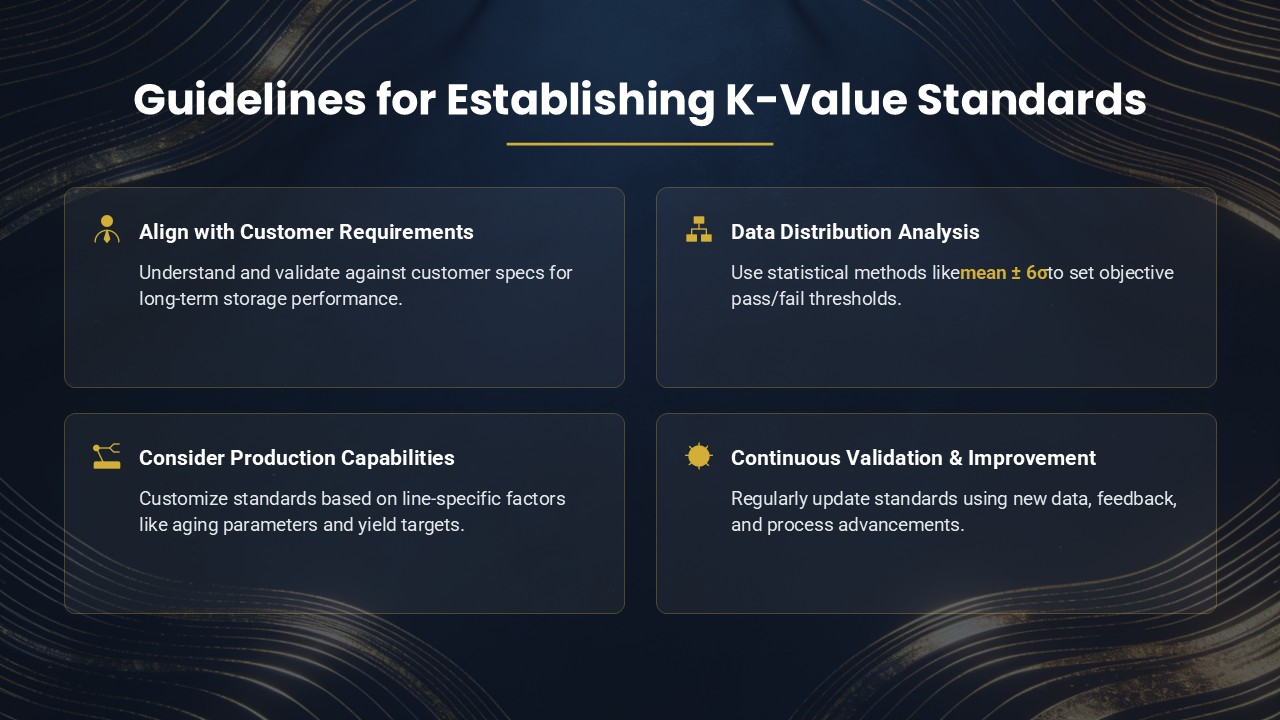
Setting robust K-value standards requires aligning technical requirements with customer needs, production capabilities, and data-driven insights.
1. Customer Requirements
Customers often specify monthly self-discharge rates in their Statements of Requirements (SOR). Manufacturers must validate K-value ranges against these requirements. For example, if testing shows cells within a specific K-value range have a maximum monthly self-discharge rate of 1.7%, the K-value standard can be reverse-engineered to ensure compliance.
2. Data Distribution Analysis
K-value standards are typically derived from statistical analysis of large datasets. A common approach is to use the mean ± 6σ (six sigma) to set pass/fail thresholds, ensuring only cells within the normal distribution are accepted. Cells near the threshold require further inspection (e.g., full-charge disassembly) to rule out hidden defects. Some manufacturers add tiered screening standards to enhance quality control.
3. Production Line Capabilities
Different production lines may have varying process designs (e.g., aging temperature, duration) and yield targets, leading to customized K-value standards. For example, a line with shorter aging times may adopt stricter K-value limits to compensate for reduced screening sensitivity.
4. Product Development Stage
K-value standards evolve with the product lifecycle:
- Early development: Broader standards accommodate variability in prototype batches and equipment.
- Mass production: Refined, tighter standards reflect process stability and larger sample sizes.
For lithium-ion battery manufacturers, establishing accurate K-value standards is a critical quality control step. Thorough data collection and experimental validation ensure defective cells are screened out, preventing safety incidents and customer complaints.
- A review on the key issues for lithium-ion battery management in electric vehicles
DOI: 10.1016/j.jpowsour.2012.10.060
Provides authoritative context for OCV, SOC, temperature effects, battery diagnostics, and consistency requirements that underpin manufacturing screening metrics such as K-value. - Ageing mechanisms in lithium-ion batteries
DOI: 10.1016/j.jpowsour.2005.01.006
Foundational review on lithium-ion aging mechanisms, including capacity loss, impedance rise, side reactions, electrolyte decomposition, and factors relevant to OCV drift and self-discharge screening.