
Differential Voltage Analysis (DVA) is a fundamental analytical method in battery engineering, widely applied to decode the internal electrochemical dynamics of rechargeable batteries—especially lithium-ion systems. In our prior discussion, we introduced voltage differential capacity (dQ/dV), and it is key to note that DVA (expressed as dV/dQ) is its mathematical reciprocal: while dQ/dV focuses on capacity change per unit voltage, DVA tracks voltage variation relative to unit capacity change, making it more intuitive for real-world battery performance assessment.
What Is Differential Voltage Analysis (DVA)?
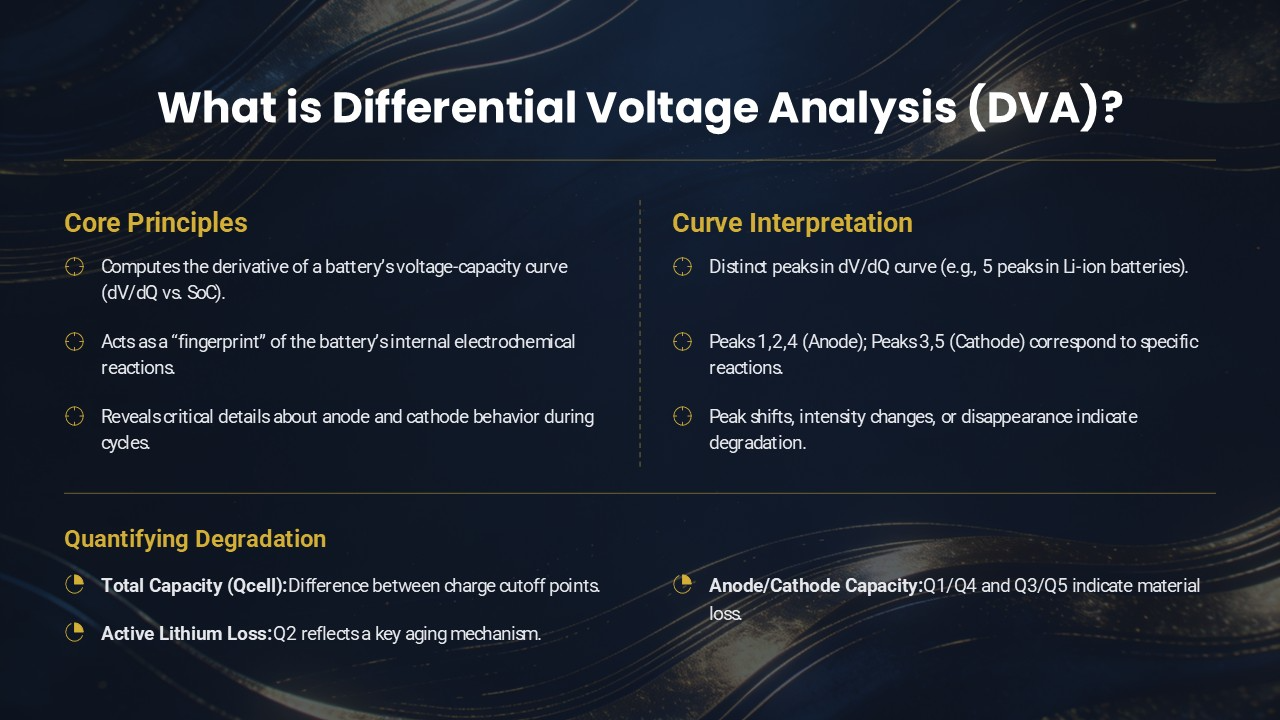
At its core, Differential Voltage Analysis (DVA) works by computing the derivative of a battery’s voltage-capacity curve, which is obtained through standard charge-discharge testing. This derivative process generates a differential voltage curve (dV/dQ vs. State of Charge, or SoC), which acts as a “fingerprint” of the battery’s internal reactions—revealing critical details about anode and cathode behavior.
During battery charging, the anode transitions from a lithium-free state to a lithium-inserted state, causing its potential to steadily drop. In contrast, the cathode undergoes lithium extraction, leading to a gradual rise in its potential. The full battery voltage is always the difference between cathode and anode potentials, and charging ceases when the cathode reaches a lithium-depleted state. When DVA is applied to this charge-discharge data, the resulting full-cell dV/dQ curve typically features distinct peaks. For example, a typical lithium-ion battery curve may display 5 peaks (labeled Peak 1 to Peak 5) and two critical cutoff points (E, the start of charging; F, the end of charging).
A key advantage of Differential Voltage Analysis (DVA) is its ability to link full-cell peaks to individual electrode reactions. Specifically, Peaks 1, 2, and 4 in the full-cell curve correspond to electrochemical processes at the anode, while Peaks 3 and 5 align with cathode reactions. By monitoring shifts in peak position, changes in peak intensity, or the disappearance of peaks over time, engineers can accurately assess two primary causes of battery degradation: the loss of active lithium (critical for energy storage) and the degradation of anode/cathode materials.
To quantify degradation via Differential Voltage Analysis (DVA), the total usable capacity of the battery (Qcell) is defined as the capacity difference between cutoff points E and F. For the anode, the capacity values Q1 and Q4—measured as the distance from lithium-depleted point E to Peaks 2 and 4—serve as direct indicators of anode material degradation. Q2, which represents lithium insertion capacity on the anode’s longest stable plateau, reflects active lithium loss (since anode material is usually abundant enough to not limit this process). For the cathode, Q3 and Q5 (distances from lithium-depleted point F to Peaks 3 and 5) indicate the extent of cathode material degradation.
Applications of Differential Voltage Analysis (DVA)
Differential Voltage Analysis (DVA) is a versatile tool with global relevance, supporting battery development, maintenance, and safety across industries like electric vehicles (EVs), consumer electronics, and grid energy storage. Its key applications include:
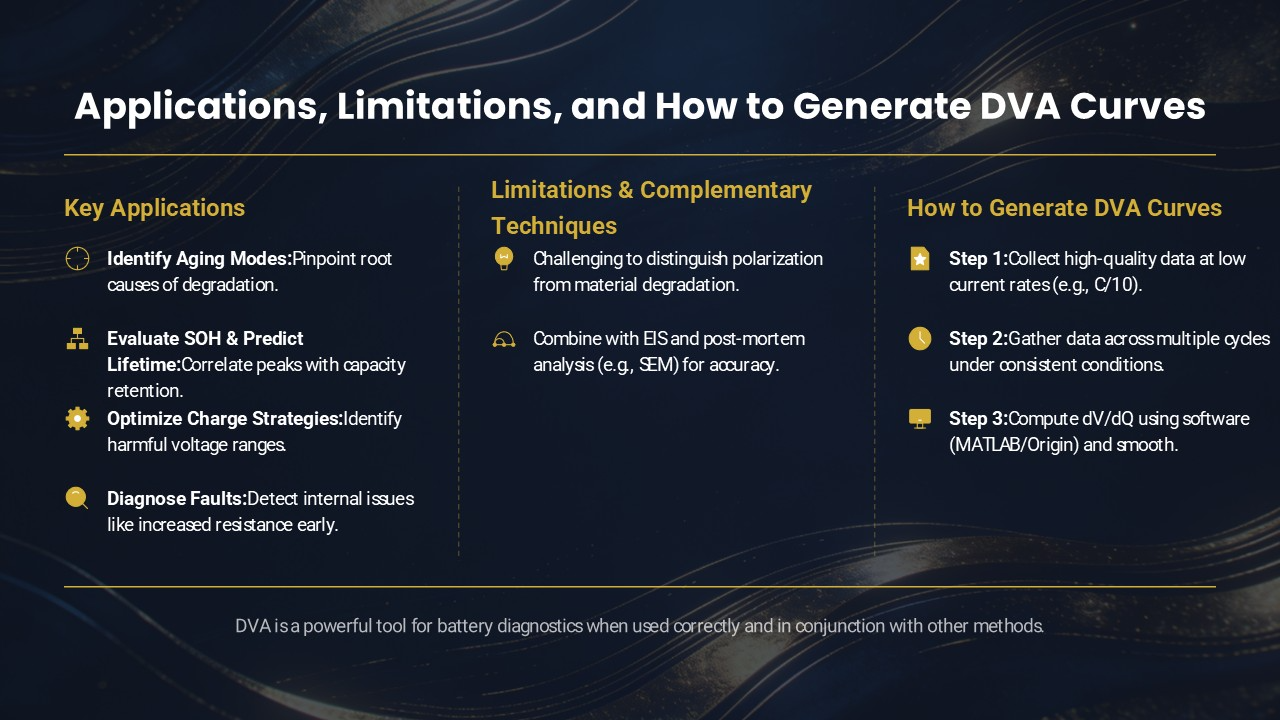
1. Identifying Battery Aging Modes
By comparing Differential Voltage Analysis (DVA) curves of batteries at different aging stages, analysts can pinpoint the root cause of degradation. For example, if Q2 (linked to active lithium) decreases significantly and its reduction matches the total capacity loss (Qcell), the battery’s aging is primarily driven by active lithium loss—often due to solid electrolyte interphase (SEI) layer growth or lithium plating. This insight guides targeted improvements, such as optimizing electrolyte formulations to reduce lithium consumption.
2. Evaluating State of Health (SOH) and Predicting Lifetime
Differential Voltage Analysis (DVA) enables precise SOH assessment by correlating peak changes with capacity retention. Researchers use long-term DVA data to build predictive models for battery lifetime, a critical need for EV manufacturers and grid operators. For instance, studies (like those published on arXiv) have used DVA to predict when a battery’s capacity will drop to 80% of its original value—often the threshold for end-of-useful-life in EVs.
3. Optimizing Charge-Discharge Strategies
Differential Voltage Analysis (DVA) helps identify voltage ranges where harmful side reactions (e.g., lithium plating on the anode) occur. By adjusting charge rates or voltage cutoffs based on DVA insights, engineers can extend battery life. For example, a DVA curve might reveal that charging above 4.2V causes a sharp peak shift—indicating cathode degradation—leading to revised charging protocols that cap voltage at 4.1V.
4. Diagnosing Battery Faults
Abnormal changes in Differential Voltage Analysis (DVA) curves signal internal faults. A sudden broadening of peaks, for example, may indicate increased internal resistance due to electrode cracking or electrolyte decomposition. Early fault detection via DVA prevents catastrophic failures, making it essential for safety-critical applications like medical devices or EV battery packs.
Limitations of Differential Voltage Analysis (DVA)
While Differential Voltage Analysis (DVA) is powerful, it has limitations that require consideration. A major challenge is distinguishing degradation caused by polarization (voltage deviation from equilibrium due to internal resistance) from material-related degradation. Polarization can distort DVA curves, leading to misinterpretation—for example, a peak shift might be incorrectly attributed to cathode degradation when it actually stems from high charge rates.
To overcome this, Differential Voltage Analysis (DVA) should be combined with complementary techniques. For example, pairing DVA with Electrochemical Impedance Spectroscopy (EIS) (a method to measure internal resistance across frequencies) separates polarization effects from material degradation. Post-mortem analysis—such as scanning electron microscopy (SEM) of electrodes—can also validate DVA conclusions, as demonstrated in studies from Imperial College London.
How to Generate DVA Curves
Creating reliable Differential Voltage Analysis (DVA) curves involves three critical steps, each designed to minimize errors:
1. Collect High-Quality Charge-Discharge Data: Use constant-current charge-discharge tests (e.g., with equipment like BioLogic’s EC-Lab or Metrohm’s Intello systems) to generate voltage-capacity curves. To reduce polarization, use low current rates (e.g., C/10, where C is the battery’s rated capacity). For example, a 2.5Ah battery would be charged/discharged at 0.25A.
2. Gather Data Across Cycles: Test the battery through multiple charge-discharge cycles (e.g., 100, 500, 1000 cycles) to capture aging trends. Consistent test conditions (temperature, humidity) are critical—variations can introduce noise in DVA curves.
3. Compute the Differential Curve: Use software (e.g., MATLAB, Origin, or dedicated battery analysis tools) to calculate the derivative (dV/dQ) of the voltage-capacity curve. Apply mild smoothing to reduce noise, but avoid over-smoothing (which can erase critical peak details). The resulting dV/dQ curve is ready for Differential Voltage Analysis (DVA).
- Degradation diagnostics for lithium ion cells
DOI: 10.1016/j.jpowsour.2016.12.011
Comprehensive review of lithium-ion degradation diagnostics, including differential voltage and incremental capacity approaches for identifying aging modes and state-of-health changes. - A Comparison between Electrochemical Impedance Spectroscopy and Incremental Capacity-Differential Voltage as Li-ion Diagnostic Techniques to Identify and Quantify the Effects of Degradation Modes within Battery Management Systems
DOI: 10.1016/j.jpowsour.2017.03.042
Directly supports the page's discussion of DVA/ICA and EIS as complementary diagnostic methods for distinguishing lithium-ion battery degradation modes. - Critical review of state of health estimation methods of Li-ion batteries for real applications
DOI: 10.1016/j.rser.2015.11.042
Authoritative review of lithium-ion SOH estimation methods for real-world applications, providing context for DVA/ICA-based diagnostics in battery management.