
Description
Model: ATM-PCBT-PP-4L
1. Basic Product Parameters
|
Item
|
Specification
|
|
Product Name
|
Pouch Cell Battery Cycle Test Fixture (PP Four-Layer with Pressure Sensor Version)
|
|
Model
|
ATM-PCBT-PP-4L
|
|
Main Material
|
PP (Polypropylene) (standard, full material customization available)
|
|
Structure Design
|
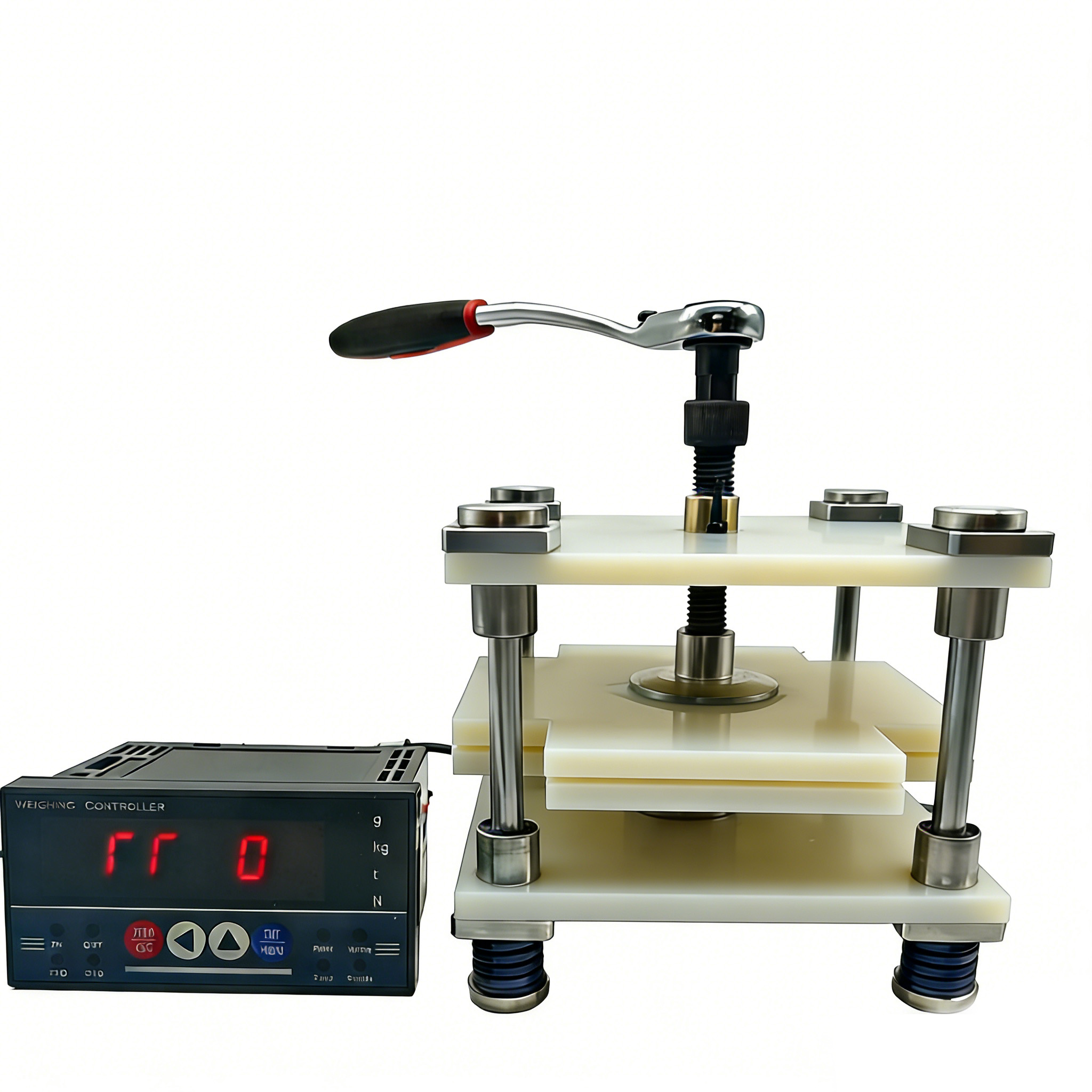
Four-layer structure (as shown in the figure), upgraded from the three-layer fixture with an additional layer; pressure sensor is an essential structural component (retained from the three-layer version); adopted single nut design to make pressure distribution more uniform, stable structure, and real-time pressure monitoring available
|
|
Standard Working Pressure
|
350kg (customizable up to 500kg, adapted to the load-bearing capacity of the PP four-layer structure, optimized pressure distribution by single nut design)
|
|
Compatible Battery Thickness
|
0.1–2.5 cm (four-layer structure supports testing thicker batteries or multiple batteries simultaneously)
|
|
Clamping Method
|
Single nut locking + die spring buffer + four-layer synchronous clamping; single nut design ensures more uniform pressure distribution, scratch-proof to protect battery cells
|
|
Customization Service
|
Fixture size, four-layer spacing, and pressure level can be customized according to battery dimensions and test requirements; surface treatment can be customized (corresponding to original anodizing color customization, adapted to PP material characteristics)
|
2. Fixture Size & Maximum Theoretical Load
Rule: Max. cell length & width = Fixture length & width − 30 mm; Four-layer spacing can be adjusted according to cell thickness
|
Fixture Size (mm)
|
Max. Theoretical Load (kg)
|
Max. Compatible Cell Size (mm)
|
Description
|
|
10*78*105
|
350
|
≤12*48*75
|
Suitable for mini small cells, ultra-lightweight PP material, four-layer structure (upgraded from three-layer), single nut design for uniform pressure, stable performance
|
|
10*90*107
|
350
|
≤12*60*77
|
Compact size, ultra-lightweight PP design, four-layer synchronous clamping, single nut locking ensures uniform pressure, suitable for cycle testing
|
|
10*100*130
|
350
|
≤12*70*100
|
Suitable for standard medium-sized cells, universally used in laboratories, ultra-lightweight PP, single nut design for more uniform pressure distribution
|
|
10*120*160
|
500
|
≤28*90*130
|
Standard high-pressure type (max 500kg), PP four-layer reinforced structure, single nut locking, inherent insulating performance (no need for anodizing)
|
|
12*120*160
|
500
|
≤26*90*130
|
Reinforced high-pressure type, max load 500kg, wear-resistant PP material, stable four-layer structure, single nut design for uniform pressure, ultra-lightweight and easy to operate
|
|
10*150*180
|
500
|
≤28*120*150
|
Suitable for large-capacity cells, PP four-layer structure (upgraded from three-layer), strong load-bearing capacity, single nut locking ensures uniform pressure, with inherent insulating performance
|
|
12*150*180
|
500
|
≤26*120*150
|
Top-level high-load version (max 500kg for PP four-layer), single nut design for uniform pressure distribution, ultra-lightweight PP and scratch-proof to protect battery film
|
3. Optional Materials & Core Advantages
|
Material Category
|
Optional Material
|
Core Advantages (Combined with Four-Layer Structure & Single Nut Design)
|
|
PP (Default)
|
PP (Polypropylene)
|
Ultra-lightweight; cost-effective; fully electrolyte-resistant (no swelling); high toughness; scratch-proof to protect battery film; four-layer structure (upgraded from three-layer) with built-in pressure sensor for real-time pressure monitoring; single nut design ensures more uniform pressure, suitable for four-layer low-pressure to high-pressure cycle testing
|
|
Aluminum Alloy
|
7075-T6 Aluminum Alloy
|
Lightweight; highest strength among aluminum alloys; good rigidity and precise positioning; insulated after anodizing; scratch-proof; four-layer structure (upgraded from three-layer) with built-in pressure sensor for real-time pressure monitoring; single nut design ensures more uniform pressure, suitable for precision cycle testing
|
|
Aluminum Alloy
|
6061-T6 Aluminum Alloy
|
Lightweight; easy to operate; good overall performance; easy to process and weld; insulated after anodizing; general electrolyte resistance; four-layer structure + single nut design ensures uniform pressure, cost-effective option
|
|
Stainless Steel
|
304 Stainless Steel
|
Cost-effective; resistant to regular electrolyte contact; non-magnetic; high load capacity; scratch-proof, optional for scenarios requiring higher corrosion resistance
|
|
Stainless Steel
|
316 Stainless Steel
|
Optimal electrolyte corrosion resistance; suitable for leakage/immersion testing; non-magnetic; compatible with high pressure, optional for harsh testing scenarios
|
|
PP/HDPE
|
PP (Polypropylene)
|
Ultra-lightweight; cost-effective; fully electrolyte-resistant (no swelling); high toughness; scratch-proof to protect battery film, optional for four-layer low-pressure testing (consistent with default PP material, for category completeness)
|
|
Engineering Plastic
|
PEEK (Polyetheretherketone)
|
Ultra-lightweight; optimal electrolyte resistance (no swelling); insulating and non-magnetic; wide temperature resistance range; extremely high precision, suitable for four-layer precision testing
|
|
Carbon Steel
|
Carbon Steel
|
Lowest cost; strong load-bearing capacity; four-layer structure improves rigidity, suitable for cost-sensitive four-layer high-pressure testing
|
|
Acrylic
|
Acrylic (PMMA)
|
Lightweight; high transparency for visual observation; insulating and non-magnetic; easy to process, optional for four-layer observation-type testing
|
4. Important Notes
Size Rule: Cell length & width = Fixture length & width − 30 mm; Four-layer spacing can be adjusted according to cell thickness, providing safe clamping space, and more uniform pressure distribution is achieved through the single nut design to ensure stable battery cycle test data.
The PP four-layer fixture is upgraded from the three-layer fixture, with an additional layer added to the original three-layer structure; the pressure sensor is still an essential structural component, and the sensor data cable can be connected to external acquisition equipment to realize real-time monitoring of test pressure. The core improvement is the adoption of a single nut locking design, which makes the pressure distribution more uniform compared with the three-layer version. It is ultra-lightweight, easy to operate, has inherent insulating performance (no need for anodizing), excellent rigidity, outstanding load-bearing performance (max 500kg), fully electrolyte-resistant (no swelling), scratch-proof to protect battery film, and does not interfere with test data.
Fixture size, four-layer spacing, material and pressure level can be customized according to different battery cycle test requirements; PP is recommended for cost-sensitive, electrolyte-resistant testing scenarios, while 7075-T6 aluminum alloy is suitable for high-precision, high-strength testing scenarios; the four-layer structure supports testing thicker batteries.
For any questions or customization needs, please contact: inquiry@atomfair.com

Reviews
There are no reviews yet.